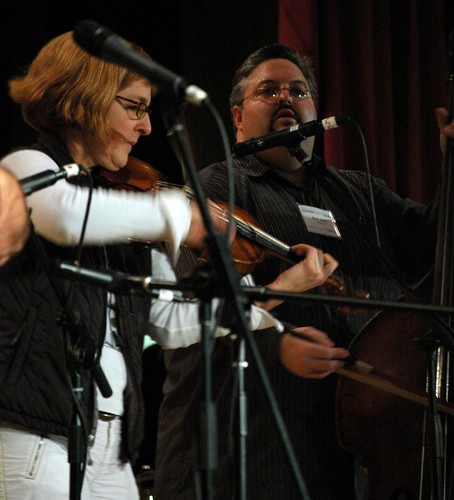
Here's an essay by Pulitzer winning American composer Milton Babbitt. It was sent to me by my old pal Danny Barnes, who knows a thing or two about making music devoid of concern of how the public will receive it. Grab you a nice cup of tea, sit back and check out this line of thinking.

"
Who Cares if You Listen?" by Milton Babbitt,
High Fidelity (Feb. 1958)This article might have been entitled "The Composer as Specialist" or, alternatively, and perhaps less contentiously, "The Composer as Anachronism." For I am concerned with stating an attitude towards the indisputable facts of the status and condition of the composer of what we will, for the moment, designate as "serious," "advanced," contemporary music. his composer expends an enormous amount of time and energy- and, usually, considerable money- on the creation of a commodity which has little, no, or negative commodity value. e is, in essence, a "vanity" composer. he general public is largely unaware of and uninterested in his music. he majority of performers shun it and resent it. Consequently, the music is little performed, and then primarily at poorly attended concerts before an audience consisting in the main of fellow 'professionals'. t best, the music would appear to be for, of, and by specialists.
Towards this condition of musical and societal "isolation," a variety of attitudes has been expressed, usually with the purpose of assigning blame, often to the music itself, occasionally to critics or performers, and very occasionally to the public. But to assign blame is to imply that this isolation is unnecessary and undesirable. t is my contention that, on the contrary, this condition is not only inevitable, but potentially advantageous for the composer and his music. From my point of view, the composer would do well to consider means of realizing, consolidating, and extending the advantages.
The unprecedented divergence between contemporary serious music and its listeners, on the one hand, and traditional music and its following, on the other, is not accidental and- most probably- not transitory. Rather, it is a result of a half-century of revolution in musical thought, a revolution whose nature and consequences can be compared only with, and in many respects are closely analogous to, those of the mid-nineteenth-century evolution in theoretical physics The immediate and profound effect has been the necessity of the informed musician to reexamine and probe the very foundations of his art. He has been obliged to recognize the possibility, and actuality, of alternatives to what were once regarded as musical absolutes. He lives no longer in a unitary musical universe of "common practice," but in a variety of universes of diverse practice.
This fall from musical innocence is, understandably, as disquieting to some as it is challenging to others, but in any event the process is irreversible; and the music that reflects the full impact of this revolution is, in many significant respects, a truly "new" music, apart from the often highly sophisticated and complex constructive methods of any one composition or group of compositions, the very minimal properties characterizing this body of music are the sources of its "difficulty," "unintelligibility," and- isolation. In indicating the most general of these properties, I shall make reference to no specific works, since I wish to avoid the independent issue of evaluation. The reader is at liberty to supply his own instances; if he cannot (and, granted the condition under discussion, this is a very real possibility) let him be assured that such music does exist.
First. This music employs a tonal vocabulary which is more "efficient" than that of the music of the past, or its derivatives. This is not necessarily a virtue in itself, but it does make possible a greatly increased number or pitch simultaneities, successions, and relationships. his increase in efficiency necessarily reduces the "redundancy" of the language, and as a result the intelligible communication of the work demands increased accuracy from the transmitter (the performer) and activity from the receiver (the listener). Incidentally, it is this circumstance, among many others, that has created the need for purely electronic media of "performance." More importantly for us, it makes ever heavier demands upon the training of the listener's perceptual capacities.
Second. Along with this increase of meaningful pitch materials, the number of functions associated with each component of the musical event also has been multiplied. In the simplest possible terms. Each such "atomic" event is located in a five-dimensional musical space determined by pitch-class, register, dynamic, duration, and timbre. These five components not only together define the single event, but, in the course of a work, the successive values of each component create an individually coherent structure, frequently in parallel with the corresponding structures created by each of the other components. Inability to perceive and remember precisely the values of any of these components results in a dislocation of the event in the work's musical space, an alternation of its relation to a other events in the work, and-thus-a falsification of the composition's total structure. For example, an incorrectly performed or perceived dynamic value results in destruction of the work's dynamic pattern, but also in false identification of other components of the event (of which this dynamic value is a part) with corresponding components of other events so creating incorrect pitch, registral, timbral, and durational associations. It is this high degree of "determinancy" that most strikingly differentiates such music from, for example, a popular song. A popular song is only very partially determined, since it would appear to retain its germane characteristics under considerable alteration of register, rhythmic texture, dynamics, harmonic structure, timbre, and other qualities.
The preliminary differentiation of musical categories by means of this reasonable and usable criterion of "degree of determinacy" offends those who take it to be a definition of qualitative categories, which-of course-it need not always be. Curiously, their demurrers usually take the familiar form of some such "democratic" counterdefinition as: "There is no such thing as 'serious' and 'popular' music." There is only 'good' and 'bad' music." As a public service, let me offer those who still patiently await the revelation of the criteria of Absolute Good an alternative criterion which possesses, at least, the virtue of immediate and irrefutable applicability: "There is no such thing as 'serious' and 'popular' music. There is only music whose title begins with the letter 'X,' and music whose title does not."
Third, musical compositions of the kind under discussion possess a high degree of contextuality and autonomy. That is, the structural characteristics of a given work are less representative of a general class of characteristics than they are unique to the individual work itself. Particularly, principles of relatedness, upon which depends immediate coherence of continuity, are more likely to evolve in the course of the work than to be derived from generalized assumptions. Here again greater and new demands are made upon the perceptual and conceptual abilities of the listener.
Fourth, and finally. Although in many fundamental respects this music is "new," it often also represents a vast extension of the methods of other musics, derived from a considered and extensive knowledge of their dynamic principles. For, concomitant with the "revolution in music," perhaps even an integral aspect thereof, has been the development of analytical theory, concerned with the systematic formulation of such principles to the end of greater efficiency, economy, and understanding. Compositions so rooted necessarily ask comparable knowledge and experience from the listener. Like all communication, this music presupposes a suitably equipped receptor. am aware that "tradition" has it that the lay listener, by virtue of some undefined, transcendental faculty, always is able to arrive at a musical judgment absolute in its wisdom if not always permanent in its validity. regret my inability to accord this declaration of faith the respect due its advanced age.
Deviation from this tradition is bound to dismiss the contemporary music of which I have been talking into "isolation." Nor do I see how or why the situation should be otherwise. Why should the layman be other than bored and puzzled by what he is unable to understand, music or anything else? It is only the translation of this boredom and puzzlement into resentment and denunciation that seems to me indefensible. After all, the public does have its own music, its ubiquitous music: music to eat by, to read by, to dance by, and to be impressed by. Why refuse to recognize the possibility that contemporary music has reached a stage long since attained by other forms of activity? The time has passed when the normally well-educated man without special preparation could understand the most advanced work in, for example, mathematics, philosophy, and physics. Advanced music, to the extent that it reflects the knowledge and originality of the informed composer, scarcely can be expected to appear more intelligible than these arts and sciences to the person whose musical education usually has been even less extensive than his background in other fields. But to this, a double standard is invoked, with the words music is music," implying also that "music is just music." Why not, then, equate the activities of the radio repairman with those of the theoretical physicist, on the basis of the dictum that "physics is physics." It is not difficult to find statements like the following, from the New York Times of September 8, 1 957: "The scientific level of the conference is so high… that there are in the world only 120 mathematicians specializing in the field who could contribute." Specialized music on the other hand, far from signifying "height" of musical level, has been charged with "decadence," even as evidence of an insidious "conspiracy."

It often has been remarked that only in politics and the "arts" does the layman regard himself as an expert, with the right to have his opinion heard. In the realm of politics he knows that this right, in the form of a vote, is guaranteed by fiat. Comparably, in the realm of public music, the concertgoer is secure in the knowledge that the amenities of concert going protect his firmly stated "I didn't like it" from further scrutiny. Imagine, if you can, a layman chancing upon a lecture on "Pointwise Periodic Homeomorphisms." At the conclusion, he announces: "I didn't like it," Social conventions being what they are in such circles, someone might dare inquire: "Why not?" Under duress, our layman discloses precise reasons for his failure to enjoy himself; he found the hall chilly, the lecturer's voice unpleasant, and he was suffering the digestive aftermath of a poor dinner. His interlocutor understandably disqualifies these reasons as irrelevant to the content and value of the lecture, and the development of mathematics is left undisturbed. If the concertgoer is at all versed in the ways of musical lifesmanship, he also will offer reasons for his "I didn't like it" - in the form of assertions that the work in question is "inexpressive," "undramatic," "lacking in poetry," etc., etc., tapping that store of vacuous equivalents hallowed by time for: "I don't like it, and I cannot or will not state why." The concertgoer's critical authority is established beyond the possibility of further inquiry. Certainly he is not responsible for the circumstance that musical discourse is a never-never land of semantic confusion, the last resting place of all those verbal and formal fallacies, those hoary dualisms that have been banished from rational discourse Perhaps he has read, in a widely consulted and respected book on the history of music, the following: "to call him (Tchaikovsky) the 'modern Russian Beethoven' is footless, Beethoven being patently neither modern nor Russian…" Or, the following, by an eminent "nonanalytic" philosopher: "The music of Lourie' is an ontological music... It is born in the singular roots of being, the nearest possible juncture of the soul and the spirit…" How unexceptionable the verbal peccadilloes of the average concertgoer appear beside these masterful models. Or, perhaps, in search of "real" authority, he has acquired his critical vocabulary from the pronouncements of officially "eminent" composers, whose eminence, in turn, is founded largely upon just such assertions as the concertgoer has learned to regurgitate. This cycle is of slight moment in a world where circularity is one of the norms of criticism. Composers (and performers), wittingly or unwittingly assuming the character of "talented children" and "inspired idiots" generally ascribed to them, are singularly adept at the conversion of personal tastes into general principles. Music they do not like is "not music," composers whose music they do not like are "not composers
In search of what to think and how to say it, the layman may turn to newspapers and magazines. Here he finds conclusive evidence for the proposition that "music is music." The science editor of such publications contents himself with straightforward reporting, usually news of the "factual" sciences; books and articles not intended for popular consumption are not reviewed. Whatever the reason, such matters are left to professional journals. The music critic admits no comparable differentiation. We may feel, with some justice, that music which presents itself in the market place of the concert hall automatically offers itself to public approval or disapproval. We may feel, again with some justice, that to omit the expected criticism of the "advanced" work would be to do the composer an injustice in his assumed quest for, if nothing else, public notice and "professional recognition." The critic, at least to this extent, is himself a victim of the leveling of categories.
Here, then, are some of the factors determining the climate of the public world of music. Perhaps we should not have overlooked those pockets of "power" where prizes, awards, and commissions are dispensed, where music is adjudged guilty, not only without the right to be confronted by its accuser, but without the right to be confronted by the accusations. Or those well-meaning souls who exhort the public "just to listen to more contemporary music," apparently on the theory that familiarity breeds passive acceptance. Or those, often the same well-meaning souls, who remind the composer of his "obligation to the public," while the public's obligation to the composer is fulfilled, manifestly, by mere physical presence in the concert hall or before loudspeaker or- more authoritatively- by committing to memory the numbers of phonograph and amplifier models. Or the intricate social world within this musical world where the salon becomes bazaar, and music itself becomes an ingredient of verbal canapés for cocktail conversation.

I say all this not to present a picture of a virtuous music in a sinful world, but to point up the problems of a special music in an alien and inapposite world. And so, I dare suggest that the composer would do himself and his music an immediate and eventual service by total, resolute, and voluntary withdrawal from this public world to one of private performance and electronic media, with its very real possibility of complete elimination of the public and social aspects of musical composition. By so doing, the separation between the domains would be defined beyond any possibility of confusion of categories, and the composer would be free to pursue a private life of professional achievement, as opposed to a public life of unprofessional compromise and exhibitionism
But how, it may be asked, will this serve to secure the means of survival or the composer and his music? One answer is that after all such a private life is what the university provides the scholar and the scientist. It is only proper that the university, which-significantly-has provided so many contemporary composers with their professional training and general education, should provide a home for the "complex," "difficult," and "problematical" in music. Indeed, the process has begun; and if it appears to proceed too slowly, I take consolation in the knowledge that in this respect, too, music seems to be in historically retarded parallel with now sacrosanct fields of endeavor. In E. T. Bell's Men of Mathematics, we read: "In the eighteenth century the universities were not the principal centers of research in Europe. hey might have become such sooner than they did but for the classical tradition and its understandable hostility to science. Mathematics was close enough to antiquity to be respectable, but physics, being more recent, was suspect. Further, a mathematician in a university of the time would have been expected to put much of his effort on elementary teaching; his research, if any, would have been an unprofitable luxury..." A simple substitution of "musical composition" for "research," of "academic" for "classical," of "music" for "physics," and of "composer" for "mathematician," provides a strikingly accurate picture of the current situation. And as long as the confusion I have described continues to exist, how can the university and its community assume other than that the composer welcomes and courts public competition with the historically certified products of the past, and the commercially certified products of the present?
Perhaps for the same reason, the various institutes of advanced research and the large majority of foundations have disregarded this music's need for means of survival. I do not wish to appear to obscure the obvious differences between musical composition and scholarly research, although it can be contended that these differences are no more fundamental than the differences among the various fields of study. I do question whether these differences, by their nature, justify the denial to music's development of assistance granted these other fields. Immediate "practical" applicability (which may be said to have its musical analogue in "immediate extensibility of a compositional technique") is certainly not a necessary condition for the support of scientific research. And if it be contended that such research is so supported because in the past it has yielded eventual applications, one can counter with, for example, the music of Anton Webern, which during the composer's lifetime was regarded (to the very limited extent that it was regarded at all) as the ultimate in hermetic, specialized, and idiosyncratic composition; today, some dozen years after the composer's death, his complete works have been recorded by a major record company, primarily- I suspect- as a result of the enormous influence this music has had on the postwar, nonpopular, musical world. I doubt that scientific research is any more secure against predictions of ultimate significance than is musical composition. Finally, if it be contended that research, even in its least "practical" phases, contributes to the sum of knowledge in the particular realm, what possibly can contribute more to our knowledge of music than a genuinely original composition?
Granting to music the position accorded other arts and sciences promises the sole substantial means of survival for the music I have been describing. Admittedly, if this music is not supported, the whistling repertory of the man in the street will be little affected, the concert-going activity of the conspicuous consumer of musical culture will be little disturbed. But music will cease to evolve, and, in that important sense, will cease to live.
 by Paul Lester.
 Well, lets be honest here, there are some mighty crappy bands that "peddle" pap as culture. Yale Strom's clumsy horror show is a fine example of poor scholarship wedded to poor musicianship and presented in a an overly precious package. And there's a whole genre of low-brow, low-rent"klezmer" acts out there: Maxwell Street, Yiddiche Cup, Best Little Klezmer Band in Texas, ect..I was in one of these dog-and-pony-shows for a time (Austin Klezmorim) so I know of what I speak. I'm sure if all you had heard was that, I reckon the article's thesis would ring true. As Earl Scruggs once famously remarked when asked why Bluegrass music wasn't as popular in the 70's as it was a generation before, "It because of the lousy Bluegrass bands playing today." Emmis.
 when discussions of "jazz" and the sort of expressive musics of the avaunt guard. To my mind, this essay, like those critics, reject anything that smacks of "plantation" (or concentration camp) and promotes only those art forms which reflect the values of the dominant culture. And much like our African brothers, we kikes routinely beat the pants off the goyim even playing by their rules (see author of "White Christmas," and "Easter Parade.") Accomplishments to be rightly proud of. But here it sounds like the rant of what Black writers would call a "porch nigger" (or my favorite curse, a "kapo.") Mr. Lester has chosen an "either/or" scenario that doesn't exist in the real world.
 I'm guessing too, and this is simply a guess, that Mr. Lester has never been denied admittance into a public pool for being Jewish. Nor has he has a swastika painted on his door, or a cross burnt in his lawn. Nor was he regularly quizzed about his personal association with the death of Jesus in English class. Like many today, he displays an attitude born of a life of complete enfranchisement, comfortable and safe in his identity. Nu?
 Hancock, the Derailers and Don Walser (Google 'em, yankees.) I recorded a Grammy nominated CD for Tex-Mex accordion legend Santiago Jimenez, and have played festivals with members of the Savoy Family of Eunice LA. I am a first call musician in the Czech and Polish dance bands around greater Houston.