Showing posts with label Yiddish. Show all posts

8/14/15

The Murder of Leo Frank, 100 years ago this week.

There's quite a few Jewish people involved in the study and performance of American old time musical traditions. As it happens, I'm one of them. I could do literally hundreds of essays about the curious nature of this strange truth, which I found to be not limited to the American experience but actually happens world wide; Jews seem to be at the vanguard of nearly every great cultural output around the globe. 

Well, yes, um, nearly every one save their own Yiddish culture it seems. Rather than address that confusing conundrum, I chose rather to focus on a dark chapter of Southern American history that I hope would bring context to this disconnect in a way that would have some resonance, and maybe give my fellow claw-hammer banjo slinging Hebrews a new lens with which to view their place in the narrative that created the "old time" music so many of us have participated in for so long.

Years ago I was reading a article on Georgia Fiddle styles. I was genuinely shocked when I came across an aside about the influential and media savvy fiddler John Carson, where it was reported that he would serenade the crowds gathered outside of the Atlanta Courthouse during the Leo Frank trial , composing songs designed to whip up the anti-Semitic sentiments of the crowd, including a little ditty sung by the assembled "Hang the Little Jew."

Hmmmm.


"Wonder how many folks know that story?" I thought to myself. So I looked up the YouTube video for John Carsons' "Little Mary Phagan," where I made the mistake of reading the comments section. 


OK, right. So here we are 100 years after the fact and nearly NO Jewish person I know knows literally anything about it, yet rage filled bigots are all over the interwebs using the the event as if happened last week and proves every evil narrative against the Jews that you could possibly imagine. It would be hilarious if it were not so real. What do you do when presented with that kind of hatred? Not "long ago" hatred, but RIGHT NOW TODAY hatred.

I'm a folk singer, so my only response naturally is a folk song:


Though it's only gotten less than 200 plays, Its already been singled out by the twitter account that runs www.leofrank.org as "Jewish pedophile convicted of murdering a child is romanticized by anti-Gentile Jewish activist bard." Classy.


As I note in the song, August 17th marks his yahrtzeit and by extension, the eventual founding of the Anti-Defamation League. I'll be singing this ballad this Monday at a local ADL meeting here in NOLA. Maybe somewhere, someplace else, there will be a landsman who will also sing of Leo Frank and maybe want to learn a nice Yiddish fiddle tune, rather than one more North Georgia tune. Maybe.


8/9/14

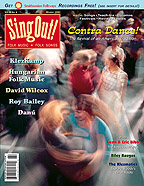
The Klezkamp Mitzvah, Sing OUT! Magazine, Winter 2007, Vol. 50 Issue 4

"Reviving and Reconnecting with a Vanishing Culture"  by Mark Rubin

Learning about culture and traditions can be a tricky business in the best of circumstances. If you were interested in, say for the sake of example, traditional Irish fiddling, you could theoretically pack up, grab a flight to Ireland and head off to County Cork. There you could to sit in on any one of the innumerable music sessions that can be found at any number of local Pub, soaking in the tunes created entirely within its element. In the course of your time there, you would hear the Gaelic ballads, taste the beer and pie, see the rolling country side and meet the other people there enjoying the good times that the music created with it’s community. If you were lucky, after all the fun you might even get one of the old lads to show you a bowing trick or two. You would come home to New Mexico or Indiana or wherever you come from, probably with a deeper level of understanding of Irish music. It would most likely inform the way you play the Irish tunes and think about Irish culture. 

For the descendants of E. European Ashkenazic Jews eager for the same experience of connection to one’s traditions, there is however no “old country” to visit. If one were to return to our homelands, outside of overgrown cemeteries and a few disused synagogues, you would hardly find any indication that Jews were ever there, much less find anyone sing us a song or fiddle us a tune. To complicate matters, in the post War years American Jews very successfully assimilated into the greater American culture, shedding their language and great many of their customs in the process. If that wasn’t enough, with the creation of the Jewish State of Israel in 1948, the Hebrew language with it’s attendant “Israeli” music and dance all but effectively replaced what American Jews considered “Jewish” cultural identity, though it is a language and vernacular that our Yiddish and Russian speaking grandparents would hardly recognize. It’s within this conundrum that Living Tradition’s annual “KlezKamp” was born. 

For the last week of the year, a sleepy corner of the Catskill Mountains is transformed into a Yiddish speaking “Brigadoon” of sorts. There you’ll find the greatest practitioners of what was at one time considered a “dead” language and all the aspects of the culture that sprang from it. Originally billed at the Yiddish Folk Arts Program, it’s founder’s informal nickname “KlezKamp” has stuck and for 22 years its dedicated staff have done nearly the impossible. It has over last two decades effectively rescued, revived and nourished what is today a full blown International re-appreciation of Yiddish Music, Dance and Culture. 

It’s an unlikely story but the seeds of this Jewish Culture rebirth start in rural Appalachia. KlezKamp founder Henry Sapoznik, known to many in the old-time country revival community as “Hank,“ is noted five-string banjoist having been among the first waves of Yankees who headed to the hills of rural North Carolina in the early seventies, seeking out hill-billy music as played by the genuine articles. As a student of such notables as Tommy Jarrell and Fred Cockerham, Sapoznik had imbibed their playing styles and then in turn helped present them to an eager new audience of Folk music devotees in NYC and other urban areas. As a banjo instructor he attended various music camps that sprouted up in the wake of the Eastern “Folk Scare” and in that experience became aware of the power of the intensive immersion approach to the transmission of culture. 
Henry "Hank" Sapoznik, Founder and Director


Conversely, it was at Tommy Jarrell’s innocent prompting (“Don’t you Jews have music of your own?”) that led Sapoznik to examine his own musical heritage, and in doing so a whole new yet familiar path. The son of a famous cantor and a native Yiddish speaker, he hadn’t properly realized that growing up he was completely surrounded by a vibrant Jewish environment, rich with it’s own Yiddish “Tommy Jarrells” as it were. It eventually led his to form Kapelye, a seminal group at the forefront of the clumsily titled “klezmer” music revival, and to a job in 1982 as sound archivist at YIVO, the Yiddish Cultural foundation and archive first founded in Vilna Lithuania in 1925 and now located in New York City after WW2.

These converging streams came together into a single idea. “The model was the music camps, having taught at Jay Ungar’s Fiddle and Dance Camp at Ashokan and then attending a Balkan music camp at the same location. I asked myself: What are they doing? They were almost entirely peer-driven events populated with instructors who were not from the communities of which they were teaching, in other words outsiders teaching other outsiders. One positive thing about having that kind of teacher is that they can present a culture to students on their own terms, they can keep the experience at an arm’s length in some ways.” Many of these “outsiders” were in fact like Sapoznik, Jews themselves. At a camp dedicated to southern old time banjo and fiddle music it’s an easy bet there would be little interest in Jewish tunes. But strangely at the Balkan week, where many of the instructors were also Jewish and well versed in all the many East European folk musics, the very place where you might think East European Jewish music would be well understood even celebrated, you couldn’t find it at all. 


Ultimately what Sapoznik felt was missing from these music and instrument themed camps was the greater context of the culture that created this “folk” music in the first place. “It seemed a big departure from the way folk traditions are actually passed on. As much as I liked working with my peers” said Sapoznik “I wanted younger players to have the same experience I had: learning directly from senior musicians so they would get an accurate take on what this music was all about.” Additionally, at these camps there seemed to be little recognition that music, ultimately, is only one small facet of the many sided diamond of a complete culture. What Sapoznik realized early on was that to better transmit the essences of Yiddish dance and music, one so endangered in fact, you must also immerse its participants in all the many arts associated with Yiddish life; the visual arts, theatre, poetry, food, customs and literature. 

His original concept was to have a program of Yiddish cultural events that was the pay-off if you will to be attached to the end of Columbia University’s Six-Week intensive Yiddish Language program. Literally a summer camp, it was envisioned as a week-long event where the contextual framework for the speaking of Yiddish could live in a perfectly natural way. A way that was pretty much in a state overall decline, along with those who spoke it natively. “Our hope was to create this whole cultural environment, a place where the abstract of learning the language could be put into actual practice. The music was the hook, but the bridge was to the language,” said Sapoznik. 


Adrienne Cooper (z"l)
By 1984, YIVO’s then assistant director, and noted Yiddish singer, Adrienne Cooper enthusiastically supported the idea, and Sapoznik started to look for instructors. The first slate of staff included the well-known singer-author Ruth Rubin, Romanian violinist Leon Schwartz, singer-folklorist Bronya Sakina, clarinetist Max Epstein as well as the younger revivalist musicians Michael Alpert, Hankus Netsky and Lauren Brody. A one time secular Yiddish summer camp turned New Age retreat was secured and a date set for August, but ultimately fell through when the camp asked for more money at the last minute. 

Hoping not to loose the momentum, Sapoznik and new KlezKamp coordinator Becky Miller hurriedly retooled for a winter event of the same year, now scheduled for Christmas week in fact. The choice of Christmas week was a novel one, as most Jews were off doing nothing for the Holiday anyway and the resort was wide open for the week. “No other time of the year alienates or marginalizes Jews more” wryly noted Sapoznik. After a long search they located the Paramount Hotel, a faded rose of a Kosher resort in Parksville NY run by an affable man who’s last name “Gasthalter” is actually Yiddish for “Hotel keeper.” The Paramount was an unlikely assemblage of mix-and-match buildings all connected by a labyrinth maze of hallways with low ceilings. Having seen better days, a booking at the slowest week of the year was much appreciated. With its kosher kitchen, mezzuzot on every doorway, an amazing grand ballroom and a Yiddish-speaking Puerto Rican staff, the rural Paramount became the perfect setting for a cultural revival. 

The first year saw 90 registrants and a staff of 30 and the second year nearly 150. The demographic of the attendees at first closely mirrored that of the younger staff, mostly musicians, but that was to change. As the word spread of a Yiddish outpost poking its head up in the old Catskills, more and more older folks started showing up. These were sixty to eighty year olds, people who had grown up in a Yiddish culture and were now able to celebrate its re-appreciation. As few of these kampers were musicians, the curricula were expanded to include more folklore, historical context and the like. Their mere presence added considerably to the available pool of Yiddish experience and more than one young person, instructors included, were put to rights by someone who actually lived in a Yiddish context. 

In 1987 Lorin Sklamberg, singer with the Klezmatics and long time Gay rights activist, was brought on to replace the departing Miller as KlezKamp coordinator. This may have led to another notable, if unanticipated, addition to the demographic of attendees with the presence of openly Homosexual Jews. Long left out of Jewish cultural life in most other venues simply because of their sexual preference, and marginalized in leftist circles when Anti-Zionism often masks Anti-Semitism, Gay and Lesbian Jews found a friendly and open environment focused on Yiddish culture, essentially free of any of the traditional prejudices associated with it. 

As was actually discussed at a KlezKamp lecture one year, the term “klezmer” as it turns out is actually a clumsy one, and not a all accurate. As it turns out, even though it’s Hebrew roots are in the words “Kley” and “Zemir,” meaning literally “vessel of song,” in it’s actual Yiddish context the term would more accurately describe a very poor musician. “Really a bum, you know the kind of guy who can scratch out a tune or two on a fiddle but can’t really play. No real musician would allow himself to be called that,” advised legendary clarinetist Dave Tarras. “I’d pop you one on the nose,” added veteran clarinetist Joe Borrock. The term had been used to describe the re-introduction of a mix of Yiddish music, folk song and theatre music sometime in the 70’s. By then however, the name had been applied to the more appropriately described Yiddish-American music for too long to reel back from the public consciousness. Just one of the many things you pick up from the lectures presented. 
Sidney Beckerman and student, 1996

While the music staff has always been high visibility, it was the contextual staff - folklorists, language instructors and folk artists – which gave the program its solid superstructure, The prime directive that teachers of Yiddish should be native speakers themselves has meant that their lucky students have learned the language not from someone who simply studied it in college, but by someone from that world whose regional dialect is still intact adding immeasurably to the student’s learning experience. In the early 90’s these folklorists developed a "Junior Folklorist" program wherein children in the KlezKids program were sent out to interview and document the senior members of the KlezKamp community. Traditional handcrafts (paper cutting, calligraphy, textiles, ect,) and even culinary skills are passed on by senior members of the community or through KlezKamp Staff apprenticeships were with those great Masters.

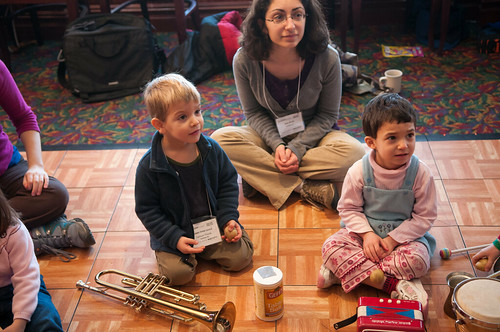
There is no greater example of the greater mission of KlezKamp than in it’s “KlezKids” program. Originally set up for the children of adult participants, it celebrated the milestone last year with as large an enrollment as did the whole event in it’s first year. Sapoznik explains, “We took the outmoded, socialist ‘kindershule’ model which celebrated Yiddish culture but which took no note of traditional folk literacy and reintroduced the old time music, song and other elements of the historic culture and created age appropriate kid programming. This not only served the short term function of allowing their parents to take advantage of the full KK programs, but also positioned Yiddish culture to be cool and hip to these kids and, miracle of miracles, set up out own “farm” system from where these kids grew up to be teachers and musicians themselves, not only at KlezKamp but in their home communities.” 
"Ooomchiks," future proud Yidn


It’s been an outstanding success on many levels. “We replaced the eye-rolling ennui of most kids to the culture and values of their parents and hot housed a generation of eager, motivated and culturally equipped young people for whom Yiddish culture is not seen as a burden but a valued birthright,” notes Sapoznik. 

Over the years the musical staff of Klezkamp has acted in a double capacity in first providing a lecture demonstration setting for older master musicians to teach and be appreciated but also to create a workshop environment for younger generation players to foster their creativity. Nearly all the of ‘leading lights’ of modern “klezmer” music got their start there, and almost all began simply as students. Sucessful bands have formed, performing careers started and lifelong musical relationships have cemented in the hallways and classrooms of the Paramount. However true to it’s founding principals the KlezKamp world, like on the bandstand at a dance, is musical mertiocracy first and foremost where there is often little distinction between the teacher and the student. Much like that session in County Cork, the music is for once now created within its natural habitat. It provides a depth of experience and understanding that cannot be replaced in a classroom setting. Thus many gifted young musicians find themselves carted up on the bandstand for the evening dances, playing right along side the greats. And there have been many greats. Clarinetists Max Epstein, Sid Beckerman, Ray Musiker and German Goldenshteyn. Sax giants Howie Lees and Paul Pincus. Drummer Elaine Hoffman and.Pianist/arranger/raconteur Pete Socolow. Many of whom had until they came onto staff, thought their usefulness over and their contributions largely ignored. 

A unique hurdle for the KlezKamp staff to contend with is the “500 pound Gorilla” of Yiddish Cultural context; it’s unavoidable attachment to the Jewish religion. Observant or not, Yiddish culture has always been intertwined with Jewish religious custom and practice. “You can’t have a Jewish event that some Jews can’t go to.” Says Sapoznik. Thus for instance, the meals served are Kosher and there’s no work (or playing of instruments) on the Sabbath in large public spaces. To the non-Jew, and many assimilated Jews as it turns out, it comes as quite a shock when depending on the calendar, the whole event comes to a complete halt to from sundown Friday to sundown Saturday night. But because it is replaced with equally compelling, and culturally compelling programming, even the most music-centric camper has plenty learning available to soak up. 
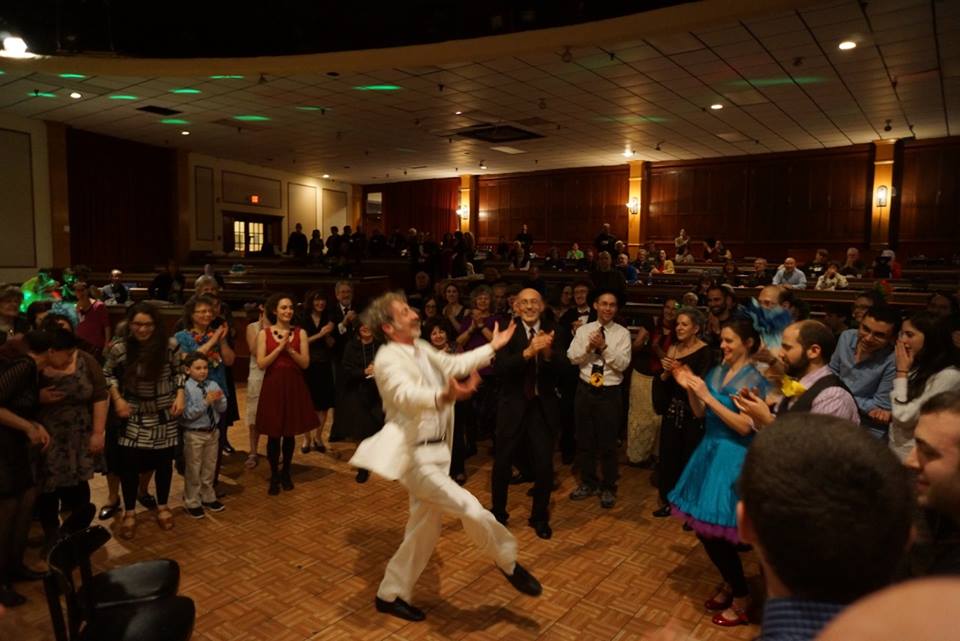
Tanzmeister Steven Weintraub


You certainly don’t have to be Jewish to attend, but as the old joke goes, it certainly helps. Music and dance fans of all back rounds have made the trek to the Catskills and come away just as affected. “The people who have the biggest paradigm shift are non Jews who are experiencing Jewish culture in possibly a new way. They actually appreciate the fact that it’s Kosher, not “Kosher-style,” its actually as close as they will get,” notes Sapoznik. European klezmer enthusiasts have probably made the most impact by means of diversity over the years. With not just a little bit of irony, a great many of the Europeans who regularly attend KlezKamp are from places where the original culture in fact never existed or, like Germany, where this very culture was all but destroyed. At this year’sKamp you will find classes taught a very fine Jewish clarinetist, well versed in Yiddish performance styles, who just happens be from Germany who just happens to be named “Christian.” Irony hides around every corner. 

This pressure cooker environment, coupled with the claustrophobic confines of the resort setting, has led many participants to what some call a “Klez Kamp Moment.” That moment when all the wheels of the Kamp activities events have been spinning for a few days, and all the dots have been connected, to where the depth of the culture that is being presented finally sinks in. It can create a deeply personal and moving experience for some. An experience made even more bittersweet when you realize how much of that life as disappeared through attrition, anilhilation and assimilation. Much like a “Yiddish Marine Corps,” a successful kamper comes stripped away of his preconceived notions and then is thoughtfully rebuilt ground up seeing themselves as a member of a greater, living world of Yiddish expression. 


Sherry Mayrent, Founding Director of the Mayrent Institute
The “mother ship” of KlezKamp was lost in 1999 when the Paramount Hotel burnt to the ground in an electrical fire. When the owners announced they were not rebuilding, the staff was left with a dilemma. Thanks to the intercession of a veteran KlezKamper, in a bold move the entire event was relocated to Cherry Hill NJ, a traditionally Jewish suburb of Philadelphia. This period also marked the world premiere of Sapoznik’s “Yiddish Radio Project” which went on to air nationwide on NPR, representing the widest audience to ever experience Yiddish language and culture in the United States. A well-received stage version, featuring a stage band made up of both master musicians and their students, toured nationally afterwards. 2001 saw the arrival of Sherry Mayrent as the new Executive Director, as Lorin Sklamberg stepped down to tour his increasingly popular Klezmatics. But like the loss of the "Old World" in favor of the new, many verteran Klezkampers bemoaned the decamping from the Catskills in favor of an industrial strength hotel in a Pennsylvania strip mall. In 2003, the event returned to their ancestral homeland of the old Yiddish Resorts and now resides at the old "Granite" Resort, now known as the Hudson Valley Resort Center in Kerhonsken NY.

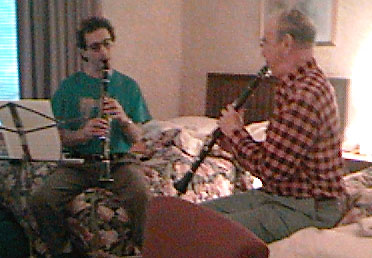
Living Traditions, the parent organization of KlezKamp has recently started a record label dedicated to preserving some of the musical moments that have occurred at Kamp over the years. The most recent release may be it’s most important one yet, a collection of the repertoire of Moldavian clarinetist German Goldensteyn. German’s playing brings to a new generation of students the sounds and songs of the Moldavian-Russian Jewish experience. Orphaned by the Nazi’s, and a veteran Red Army Bandsman, German’s music notebooks contained literally hundreds of Jewish tunes heretofore unknown to American audiences. Long time kamper-turned-instructor Alex Kontorovich, a Jewish Russian émigré and clarinetist himself, served as German’s translator and “second” for several years on staff, carefully studying his style and techniques. With Kontorovich as producer and converting an unused bedroom into a makeshift studio, German and members of the KlezKamp staff recorded a scant 20 tunes from his repertoire during lunch and dinner breaks. German Goldenshteyn’s debut recording “A Living Tradition” was released commercially only a few months later. Tragically German died of a heart attack while on a fishing trip only a few days before a European concert tour. He was only 71. Kontorovich is currently overseeing the publishing of a collection German’s music books to insure his rich legacy will be disemminated. His is but one example of just how ephemeral culture can be. Without the living breathing tradition bearers in our midst and available for comment and context, the work of KlezKamp becomes all the more essential. 
The first Klezkamp release


In recent years the growing acknowledgement of interest in things “klezmer,” a situation KlezKamp can rightly be credited with, it has spurred quite a few imitators. If as the poet says, imitation is an expression of flattery, KlezKamp is a very flattered event indeed. Today you will find similarly fashioned events all over the US and the globe from, Canada to England and even points east. (In one notorious example, KlezKamp sing along songbooks were handed out at a copy-cat “Kamp” with only the Living Traditions letterhead clumsily whited out.) With its 22nd anniversary this December, KlezKamp now has come to a place of some sardonic irony. It has actually become so successful, so transparent in its stated goals of reviving and nurturing a living breathing Yiddish culture, than in fact it is now pretty much taken for granted. Taken for granted in many cases even those whose professional musical careers were born and informed there. By remaining true to it’s stated mission: fostering a holistic “ground up” approach to cultural presentation and preservation, and then purposely eschewing a “star personality” policy in their staff hiring, KlezKamp has in some ways made itself passé within it’s own community. 

The “Village,” or “shetl” more properly, that KlezKamp has created continues every year to feed and support what has now become an international re-appreciation of the totality of Yiddish Cultural Arts. After so many years of so successfully creating culturally literate “graduates,” a typical participant is more often not surrounded in class by people who will one day in fact have learned the lessons taught there, expand upon them and then return to give back to a new generation of campers. With the precious few living masters of Yiddish life leaving us every day, German Goldenshteyn our most recent example, the depth of experience that KlezKamp offers becomes all the more poignant and important. “We can only hope that through this process, we have enabled selfless translators of the continuity. If we done our job well then we’ll have that continuance for future generations,” says Sapoznik. 


The final Catskills KlezKamp will be at the Hudson Valley Resort, Kerhonkson NY, December 23-29, 2014 

Visit http://www.klezkamp.org for details.


11/3/09

Identity: the Other Europeans. Jews, Gypsies and beyond...

For the last 2 years I was fortunate enough to be involved in the “Other Europeans,” project based in Weimar Germany with side trips to Vienna and Krakow. You can visit the website set up for the project and it’s attendant seminars and there’s even a site dedicated to the band The Other Europeans itself. Follow the links for back round.

But all you really need to know is that pianist/composer Alan Bern has assembled an amazing collection of some of
(can’t be all of, as I was involved so that sends the curve down a bit) the planet’s greatest “Yiddish” and “Lautari” musicians. Those were the terms that we came up with to describe the musical traditions of the east European Jewish and Rroma communities for our working purposes. Truthfully, the monikers “klezmer” and “gypsy” are a mixture of inaccurate, mal-abused and frankly racist so it was important to name ourselves and control the conversation.

The first year was all about defining within our two separate groups just what was it that made our music either “Yiddish” or “Lautari,” and that was easier said than done. Jewish music had been recorded commercially in Europe since the earliest days of recording technology. But then there’s that “difficult period” as they call it in Germany between 1933-1945, where we lost direct connection to the context in which all this music functioned. Whatever tattered bits that remained was stitched together after wards, Dead Sea Scroll-like had further had to contend with the twin towers of devastation: assimilation into the American fold and the active replication of Hebrew and Israeli culture. Yiddish life fared much worse in that air than anyone could possibly imagine ("That language grates in my ears," Ben Gurion on his mother tongue.) Our Rroma buddies, as devastated as they were too in the fascist roundups, had the meager benefit of a continued context (like, it’s just as bad today for Romani people in Europe as it ever was, for instance,) but were ignored by the recording industry entirely.
Thus we have a decent window on what Jews sounded like a long time ago and we know what Rromanis sound like today, so finding the “core” sounds and repertoire was mighty difficult to say the least. At first we did our separate workshops and put together 2 very fine representative ensembles of each tradition that performed to much acclaim at the KlezMore Festival, the Festival of Jewish Culture and along with 2 concerts 2 weeks of intensive workshops and panels at Yiddish Summer Weimar.
I came home with quite a few of my basic conceits about Jewish music challenged, in a good way I think. I also arrived with a whole new approach to not just Jewish music but music and further, life itself not to be too awful melodramatic about it. There’s just something so positive and edifying to be sitting in a room with some of the no-shit best musicians working on the planet. Being in the musical sphere around Petar Ralchev or Kalman Balogh alone should be life changing if you are paying attention. But then to meet the Moldavian contingent, and to be able to lock in so well both onstage and off WITHOUT ANY COMMON LANGUAGE OTHER THAN PICKIN’? The mind boggles actually.
It pains me greatly, embarrasses me really, that I was unable to find a sponsor to fund my participation in the field work trip to Edinets Moldova, the home of many of the finest Lautaris and one time home of Jewish Clarinet Giant Dave Tarras. Why Edinet, you ask? Well, submitted for your consideration are the two following recordings with roots there. The first, a very well known tune called “Hangu lui Nicu Chitac” by the Edinets based Lautari band Ciocarlia. The second, Dave Tarras recorded in the about the same time (late 1950’s) with the Abe Ellstein Orchestra called “Lo Mir Freilachsein.” Hmmm. What do you think? A connection maybe? (oh, can't post the mp3's. email me offline and I'll send them to you.)
For reasons I still cannot properly reconcile, my own Jewish community here in Austin feels not even the slightest connection to this endeavor. And in fact my attempt to raise interest, and hopefully funding, has been met either complete indifference or even open hostility. “How can we talk even about Eastern Europe right now when there’s so much anti-Israel bias going around…” was a direct quote from one of the folks I solicited for funds. This prevailing attitude in American Jewry belies a further discussion, and we’ll get around to eventually I’m sure. But suffice it to say when even the local Yid’n are not one bit on board with your version of Jewish Life and Culture, then you have a very tough road to hoe indeed.

On a more positive track, this years Other European project, ironically funded by the EU no less, included a Winter rehearsal in Weimar where the two ensembles attempted to meld into some kind of cohesive orchestra and explain musically our research. The sessions, in the middle of a frozen German February, were grueling and difficult. But the end result, highlighted by an amazing concert, was more than I had hoped for.


We gathered again in Vienna in July to further rehearse and then share our research if you will with concerts at the same three festivals we played last year. If it was even possible, these concerts were way beyond what I think any of us could have anticipated, and the performance in the Reform Synagogue in Kazimerz (Krakow, Poland) was one for the books; possibly a personal best thus far. Luckily for all of us, the concert was broadcast on television and is archived in streaming format here.
What are we to gather from all this?
I’m still processing it I must admit. Searching clumsily for analogies at a seminar, I proffered that the Yiddish and Lautari music’s were at one time drinking from a very similar well, with our communities close in both cultural and physical proximity. Marin Bunea reminds us that these music’s exist devoid of a required nationality or religion. In Edinets, he relates, the finest regarded Lautari was in fact a Jew and vice versa. But much in the same way that Bluegrass* music took off as a hyper-charged, polished and citified version of it’s more unsophisticated Old Time Country roots, Lautari music exists today in the same sort of context: concertized, virtuosic and harmonically advanced. Poor little Yiddish music remains stunted, attached more to the simcha and dance traditions and much like Old Time played today, devoid of it’s life giving context played by musical recidivists as if it’s a Jewish "Civil War re-creationist music." Or worse still, used only as a name checked home base of style and repertoire, used to create some kind of clumsy admixture using Yiddish melodies as a Tabula Rasa for whatever the artist (usually someone unable to enter the music business any other way strangely enough) wishes to project. Insert one of literally HUNDRED’s of acts in either slot. It’s OK. We have plenty of time…
That all said, I think that now is as fine a time to note that I’m pretty much done with attempting to make people agree with my take on Jewish music anymore. It's tiring and evidently ineffective. I’ll take a gig when they come, but my personal identification as a “klezmer” (oh how I do despise that term!) musician has thus concluded. I walked away from a popular and commercially successful music group almost a decade ago, in no small part to better devote myself to the reconstitution of Yiddish and other traditional music’s. But as anyone who has been working in this field could tell you, it’s not a parnossa. I reckon I made more scratch playing my own music for 90 minutes last week than Michael Winograd banked all last year. And he’s friggin’ great. And he’s only one of about three dozen amazing cats I know who have done the hard work and play the good music, with wit and skill. But what they didn’t learn, as they were way too busy learning music and culture correctly, was how to hustle a a good paying gig and write a grant that appeals to the current version of mainstream Jewish thought.
But that’s the environment we find ourselves in today, and I feel that I’m personally unable to in my opinion degrade this music, any music actually, to the level that is currently required to operate effectively. Frankly, I feel the same way about Bluegrass, the music of my upbringing as well; I just can’t reconcile what it has become today with what I know to be my own experience.
Ultimately, I think we get the culture that we deserve. I have no children, so ultimately I have no dog in this hunt. And I plan on having a much more care free life now that the "why don't you to think like I do" portion of my career has now thankfully concluded.

*I wish to go on record that Zev Feldman called my analogy “brilliant,” but only after he amended it.

2/10/09

Jewish Self Loathing, music edition....

To paraphrase William S. Burroughs, much like the man dressed as a woman to board the last life boat leaving the ship Titanic, we now have a new measure for deeply ingrained self loathing.

Can it be that we, the comfortably assimilated Jewry of America, have drifted so far from our roots that we must now tear down anyone who chooses to cling to them?

Submitted for your review and comment is this article from the Jewish Chronicle (UK,) entitled "Turn off the klezmer and turn up the Ramones" by Paul Lester.

(Besides being poorly written, an important affectation of "Rock" writing in England in the new post-Modernist world, it could be the very first time I've ever had an occasion to ever read the rag.)

Dig this chestnut:

There are plenty of musicians who today play very little other than the music of past centuries. Some play it for its eternal qualities. Others, however, are more concerned to convey “authenticity”.

Such musicians peddle klezmer as though it were the truest expression of the Jewish experience. They perhaps even imagine that, if there is a Jewish “voice” in music, klezmer captures it best.

But, for me, the best Jewish music — or rather, the best music by Jews — reflects the moment and is somehow a response to the times in which it was made. And if there is a “Jewish voice”, it is not to be heard in klezmer, maybe because it is being drowned out by all those clarinets, violins and accordions.

Right.

Tell Frank London that to his face. Or Aaron Alexander, or Alex Kontorovich, or... I could go on and on. Here's an authentic Jewish voice for you: Are you high?

Well, lets be honest here, there are some mighty crappy bands that "peddle" pap as culture. Yale Strom's clumsy horror show is a fine example of poor scholarship wedded to poor musicianship and presented in a an overly precious package. And there's a whole genre of low-brow, low-rent"klezmer" acts out there: Maxwell Street, Yiddiche Cup, Best Little Klezmer Band in Texas, ect..I was in one of these dog-and-pony-shows for a time (Austin Klezmorim) so I know of what I speak. I'm sure if all you had heard was that, I reckon the article's thesis would ring true. As Earl Scruggs once famously remarked when asked why Bluegrass music wasn't as popular in the 70's as it was a generation before, "It because of the lousy Bluegrass bands playing today." Emmis.

This reminds me of a similar polarization in criticism in the African American community when discussions of "jazz" and the sort of expressive musics of the avaunt guard. To my mind, this essay, like those critics, reject anything that smacks of "plantation" (or concentration camp) and promotes only those art forms which reflect the values of the dominant culture. And much like our African brothers, we kikes routinely beat the pants off the goyim even playing by their rules (see author of "White Christmas," and "Easter Parade.") Accomplishments to be rightly proud of. But here it sounds like the rant of what Black writers would call a "porch nigger" (or my favorite curse, a "kapo.") Mr. Lester has chosen an "either/or" scenario that doesn't exist in the real world.

I'm guessing too, and this is simply a guess, that Mr. Lester has never been denied admittance into a public pool for being Jewish. Nor has he has a swastika painted on his door, or a cross burnt in his lawn. Nor was he regularly quizzed about his personal association with the death of Jesus in English class. Like many today, he displays an attitude born of a life of complete enfranchisement, comfortable and safe in his identity. Nu?

And I guess I should note that I myself, a Yiddish music musician, the very kind that this writer rails against, has spent a life engrossed entirely reflective of the modern music of the culture around me. I have roadied for the Flaming Lips, provided a PA and a crash pad for Black Flag and Husker Du. My bands have opened for the Butthole Surfers, sold out shows at CBGB's and No Doubt once opened for me. I have played honky tonks across Texas with Dale Watson, Wayne Hancock, the Derailers and Don Walser (Google 'em, yankees.) I recorded a Grammy nominated CD for Tex-Mex accordion legend Santiago Jimenez, and have played festivals with members of the Savoy Family of Eunice LA. I am a first call musician in the Czech and Polish dance bands around greater Houston.

Not bragging folks, just try to explain that those of us who choose to listen to and respect the cultural gifts of our heritage generally live entirely in the here and now. And we love accordions. And clarinets. And we aren't one bit ashamed to say so. Oh, and by the way we rock out better then anyone too.

With "writers" with this sort of agenda supported by the mainstream Jewish press, it seems what I feared for many years really is true: my own community actively rejects me and my work. Why else then is it that to perform Yiddish music, I must travel back to old Europe, sometimes standing on the very spot of my extended family's destruction, to find an appreciative audience? Conversely, I have performed for my local JCC a total of 3 occasions in 15 years. How sad can it be that the children of the murderers find meaning in my culture when the children of the murdered actively despise it. I'll let Mr. Lester (ne' Lowenstein, maybe?) work that out on the couch years from now when the vacuousness of the Goldyne lands shallow consumer culture finally leaves him flat. By then, there may not be anybody left to say a kaddish. ("It doesn't really reflect the true Jewish sentiment of today" one imagines they might be heard to say.)

Once, I was told by a nice little old lady (and one time guest of the nice folks at Bergen-Belsen) once that "who needs Hitler? We have plenty enough Jews eager to end Yiddish life."

1/14/09

A personal appeal for support of Yiddish Culture

From world reknown klezmer fiddler, and single mother of 2, Marlene Segelstein:

To all of our friends, students and fans;

As you know, musicians and other self employed folks are getting socked in today's trying economic times. We've been hit really hard with tours cancelling, gigs drying up, and performance series being cut short. Those of us who make our living playing and teaching our instruments (including voice and dance!) travel the globe to play concerts and teach at workshops, and to pass along our knowledge of this music and dance that was almost wiped out in the last century. We form collaborations, sometimes with those from other cultures, to keep this art alive, and find new ways to keep it vibrant. When you see us at Klezkamp, Klezkanada, Klezfest London, Weimar,we are always happy to give as much as of our time, energy and knowledge. When possible, we are giving extra (free) lessons to folks; under the staircase, in a lobby, even in our own rooms, often when we are in a state beyond exhaustion. And of course it doesn't stop there.

At least once a day and often much more, I am answering a query to help someone with a dissertation by answering a questionnaire, providing chords for a tune, sending a copy of a sound file, or sheet music to students, friends of students, people who have found my name on the internet. Often the queries are very polite and filled with thanks, but just as often, they are two liners with no greeting, for example (a real email!):

I got your name from your website. I need the music for Hora Midor.
Please send asap.

And of course I have the music. We recorded it, and I transcribed it. And I sell it in a book that I self published. These little things are how I make my living. Now of course, I love what I do. I must. I struggle to pay my health insurance, live at a below the lower middle class level, and have sacrificed a MUCH more comfortable lifestyle to do what I love the most, play music with and for friends.

Think back. Has anyone in this small Jewish music community helped you by giving you a little extra lesson, even 15 minutes (the going rate for private lessons in the east coast are $75-100 an hour)? Has anyone helped you with your research? Filled out a questionnaire for your dissertation? Provided you with a chart? Spent extra time with you showing you a dance step? Sent you rare soundfile? Helped you fix your instrument? Generally enriched your musical life?

No, I'm not asking you to send money. I'm asking you to support us by buying our products. If you already have bought CD's and books, many thanks! Now think about buying more as gifts.

We appreciate all of the wonderful support we have received over the years from many of our friends, students and fans, and I never want to think twice about helping someone who emails or calls me with a query. I am just asking that you give back by supporting those of us who are your teachers, your favorite bands, and your friends.

Cookie Segelstein

8/3/07

The Amazing Yiddish World of Michael Wex

Here's Mr. Wex in performance at the KlezKamp Roadshow at Block & Hexter Center on July 31st. He's reciting an excerpt from his soon to be released book "Just Say Nu." I think he's speaking on the Yiddish phrase "hoch a chanuk:"


I really was trying to get a good picture of him, but you just can't hit a moving target. Like the old sorry joke: How do you get a Jew to shut up? Make him sit on his hands......

Wex is piss-your-pants-funny every time I hear him. He writes a monthly newsletter which you should go ahead and sign up for. And buy the damn book when it comes out. And you should really find his first book "Schlepping the Exile" which I still like most of all.

4/18/07

"Klezmer." My pain. My joy.

OK, it's happened again.

Some nice lady asked me a simple little question and without thinking too much or remembering to hit "delete," I send this along. The question referred to the weather or not non-Jews had any business playing "Jewish Klezmer," which I find as ridiculous a notion as can White people play the Blues. (Oh dear, a whole other essay is forming, but I digress..) Nope, I never did hear back from her either.

"Klezmer" is a term only genuinely applied to the recent revival of Yiddish dance music. It's a construct, a re-imagination, made up in some cases whole up cloth from people who have only a tangential relationship to the culture that the music originally sprang from. For instance, no self respecting Yiddish musician would have ever referred to themselves as a "klezmer," which is point of fact a derogatory term for a not very good musician, yet it's the very term than modern players use to describe what they do. (Pretty ironic, huh?) I believe that's called a cultural disconnect. Many of these modern day practitioners have clumsily, and wrong headedly, incorporated smorgasbord-like and wide panoply of Yiddish Folk Song and Yiddish Art Song into their performances as well, further distancing themselves from any actual tradition.

Which brings me to there is no "klezmer" music, there is simply a Yiddish vernacular performance style. Thus, any tune can conceivably be played in a Yiddish style and thus made Yiddish, when filtered through the experience of the Yiddish speaking Jews of Eastern Europe. One of my favorite dance numbers around here started life as a Mariachi march for instance.
Utter BS, and stolen to boot.


The music that we know as Yiddish dance comes from many sources, incorporating the many places Yiddish speaking Jews lived and the sort of cultures Jews came into regular contact with (Oriental Greeks, Ukrainians, Romanians, Turks and various Rroma tribes for instance.) Some come straight from Cantorial and Chassidic traditions, but as we know from recorded evidence that many of these melodies were lifted from someplace else as well. The folk and art song traditions have long complex stories all their own, which intersect and are sometimes influenced by the instrumental tradition but are in fact separate distinct traditions unto themselves.

Further, this is a purely secular musical expression. It's the advent of a Yiddish speaking Jewish population, not a strictly religious expression. Non Jews have been involved in Yiddish music from day one, and many of the best players we have today are in fact not Jewish, nor do they wish to become so. True, there is a spiritual element in any music really, 
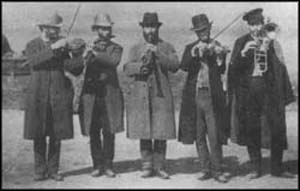
We can only imagine what they sounded like
and you cannot divest Yiddish culture from Jewish practice. However, any attempt to cast Yiddish music in that light is purely a post-modern thought. And probably a wholly American phenomenon, much the same way a socio-political concept like Zionism is used wholesale to express religiosity for many fully assimilated Jews .

To me personally I find it kind of sad that such a rich cultural tradition being misused in this way. Better Jews keep the sabbath than try and make dance music substitute for religious practice. That's my 2 cents anyway. I doubt if I'm in the majority opinion here.


1/26/07

The "K" word.

That is the word "klezmer." And why it hocks my chanuck .

So my local JCAA has this annual event called the Tapestry of Jewish Learning centered around Jewish practice and culture which I was honored enough to come and speak at in it's innaugral year. Truthfully, the only thing I am remotely qualified to speak about, other than the best BBQ joints within a 120 mile range of Austin and the finer points of explaining why the Jews killed Jesus to your gym coach, is possibly Jewish-American party music. At least as far as the J is concerned anyway. My synagogue, or better put the synagogue that puts up with me showing up to daven without paying membership, has a similar little baby version of this concept called the Thinking Adult Persons seminars (get it, "Tap"...cool huh?) and this year I was asked to speak there as well.

I did my shtik to an enthusiastic crowd and as I was leaving to catch the bus I spied a catalog for this years Tapestry. The event actually didn't occur as it was iced out, but out of professional curiosity I took a peek anyway. I saw this interesting subject, presented by some one I had never heard of: "Klezmer: What makes it Jewish?"

Boy howdy, do I wish I could have made that one. (Refer to On "klezmer" music.) Again out of curiosity, I inquired who this gal was that was giving the talk. Best I can tell she was at one time the second chair of a civic orchestra in Reno Nevada, but none of my pals in Jew-Music-World had encountered her. But I guess the title kind of says it all. In the world of Martial Arts there is a term for dubious "masters" who open karate dojos. It's called "bullshido" and there are websites that actively "out" these ersatz cultural interperters. As I've come to find in my career, any two-bit bar mitzvah band with a Kammen song folio playing Israeli circle dances is concidered "klezmer" these days, which is just fine in some respects. Helps us quickly identify those who's hearts are in it and those who are simply looking to turn a coin for the unsuspecting hooples. This here could be the worse I've encountered however, a black-face minstral show version of Jewish culture ground out for a ready audience of like minded Yankee transplants and assorted self loathers. But I digress...

After my inquiriy I was asked innocently enough by J's cultural director why those of us who have dedicated some part of our musical life to exploring Yiddish musical traditions are not comfortable the term "klezmer." I reckon now is as good a time that I should go public with my response and my thinking on the subject. Thus:

"That's a deep question actually which speaks to my personal motivations for working in Jewish music rather than make a living wage playing something people actually pay for. You might look for the latest issue (Volume 50#4 – Winter `07) of Sing Out! magazine where I have a major article on Klez Kamp and the thorny path of cultural connectedness.

The fact is the textbook versus the vernactular definitions of the term "klezmer" couldn't be further apart, and no one who has even a glancing knowledge of our musical traditions would describe it with such a vulgar term. And I do mean vulgar, as unpleasant in it's use as the "N" word to black folks. If you're not hip to something so basic, then what else don't you know, dig? (I see no lectures scheduled on kosher recipes for pork for instance to use a possibly poor analogy)

Duke Ellington addressed a similar situation back in the 1920's when the term "jazz" was applied to his art. What most folks today don't know is that "Jazz" in the language of the day meant quite literally the smell associated of the after effect of sexual congress. A street walkers jargon. As vulgar and low a description as you could imagine, created by white people to describe black culture. Ellington was stumping for the more correct tern "Afro-American Classical Music," but by the 30's it was too late and the true meaning of the term was lost. He still knew though.

Same goes for us, but sadly we have only ourselves to blame. The "revivalist" bands of the early 70's started mixing instrumental music, folks songs and theater songs into a clumsy patchwork quilt of music and called it "klezmer" simply beacause, as they have since told me, they were too scared to call it "Jewish." A "klezmer" is a, and I'm quoting from Dave Tarras here, "a no talent bum who could scrape out a note or two on a fiddle and fool the unsophisticated clients that he was an actual musician." It's also recognized in Yiddish musician and gangster jargon as someone who underbids on jobs as well. If someone self identifies themselves as a "klezmer," then you can pretty well assume they they are either willfully unaware of the basics of the culture that creates our music. Or simply put, the depth of their experience is only as deep as the groove of the record they learned from. Post modernists and other post-hippie era musicians grew up essentially removed from the Yiddish speaking world, so they have no handle for the context of the word, much less the environment that spawned the music which ultimately is only one tiny facet of the diamond of Yiddish culture.

To not put too fine a point on it, in my opinion we didn't crawl out of the ovens and DP camps so that one day we could comfortable enough to either forget everything or worse still, to remember it all wrong. Who needs Nazi's when you have assimilation and willful forgetfulness? There is no hechtser for what's Jewish culture, and maybe ultimately that's a good thing. But all my teachers called themselves "muzikant" and they called their music "yiddish." They're all dead now too. That's why I don't like to use the "K" word.

Respectfully, your servant,

Mark"