Showing posts with label danny barnes. Show all posts

4/25/18

From the Bad Livers Archives : Sing OUT Magazine 1995


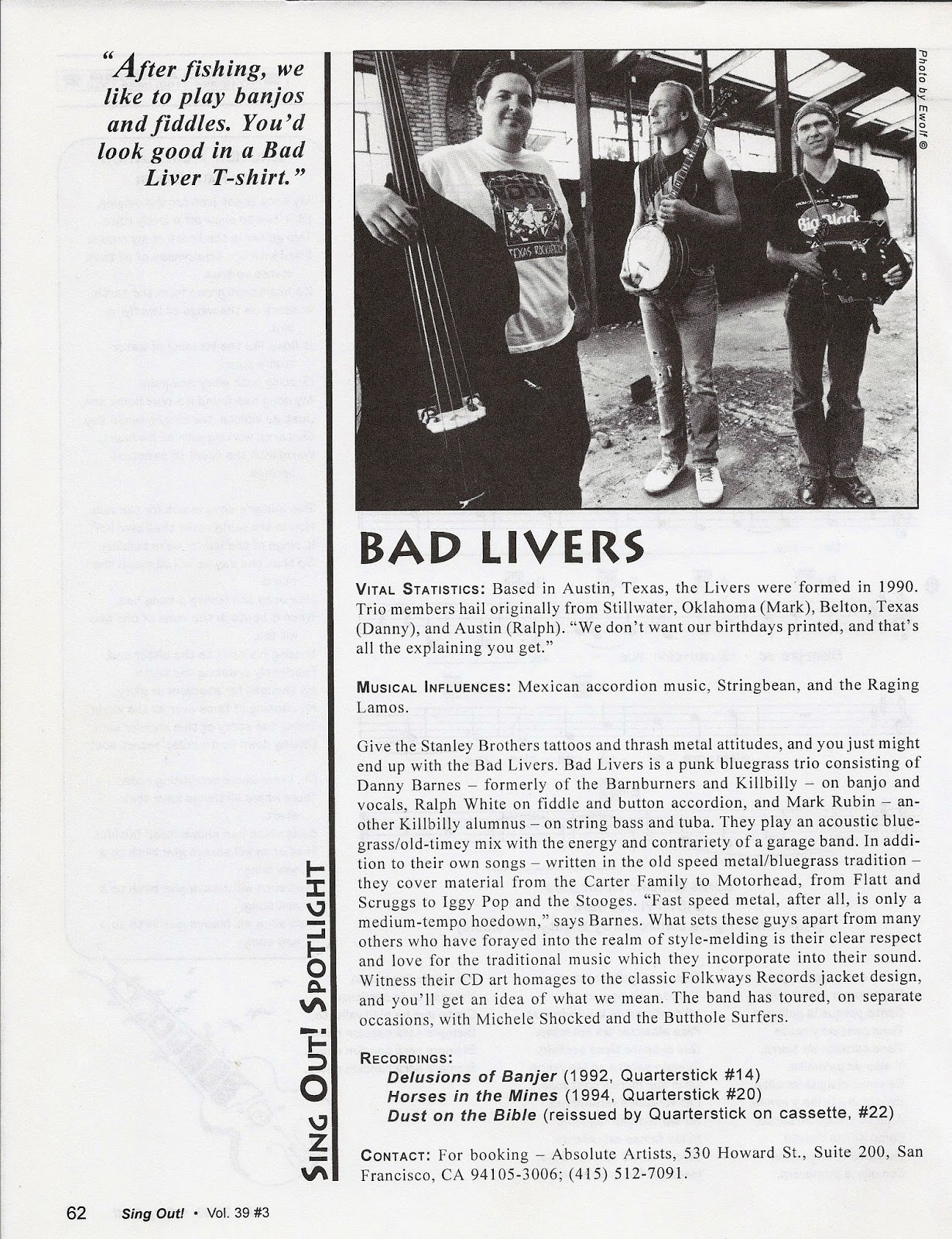
BAD LIVERS

VITAL STATISTICS: Based in Austin, Texas, the Livers were formed in 1990. Trio members hail originally from Stillwater, Oklahoma (Mark), Belton, Texas (Danny), and Austin (Ralph). “We don't want our birthdays printed, and that's all the explaining you get.”


MUSICAL INFLUENCES: Mexican accordion music, Stringbean, and the Raging Lamos.


Give the Stanley Brothers tattoos and thrash metal attitudes, and you just might end up with the Bad Livers. Bad Livers is a punk bluegrass trio consisting of Danny Barnes - formerly of the Barnburners and Killbilly - on banjo and vocals, Ralph White on fiddle and button accordion, and Mark Rubin - another Killbilly alumnus – on string bass and tuba. They play an acoustic bluegrass/old-timey mix with the energy and contrariety of a garage band. In addition to their own songs – written in the old speed metal/bluegrass tradition – they cover material from the Carter Family to Motorhead, from Flatt and Scruggs to Iggy Pop and the Stooges. “Fast speed metal, after all, is only a medium-tempo hoedown,” says Barnes. What sets these guys apart from many others who have forayed into the realm of style-melding is their clear respect and love for the traditional music which they incorporate into their sound.

Witness their CD art homages to the classic Folkways Records jacket design, and you'll get an idea of what we mean. The band has toured, on separate occasions, with Michelle Shocked and the Butthole Surfers.


RECORDINGS:
Delusions of Banjer (1992, Quarterstick #14). Horses in the Mines (1994, Quarterstick #20) Dust on the Bible (reissued by Quarterstick on cassette, #22)

4/18/18

From the Bad Livers Archives: "Bad Livers cross the line between Bluegrass and Punk"


Matty Karras, Longbranch Press, Longbranch NJ, 1995

As you might expect of a band that finds it appropriate to link a Johnny Cash (“Ring of Fire'') and a Motorhead song (“Jailbait”) in a medley simply because they're in the same key, the banjo-bearing, fiddle-flying, tattoo-toting Bad Livers sometimes find themselves on stage in rustic folk halls and other times in raucous punk clubs.
It's all a question of what club booked them first in any given town, according to upright bass and tuba player Mark Rubin.
“In a town like Denver, we played this little folk club the first time we played there, and from here on out we'll play that little folk club,” Rubin said.
At the Jersey Shore, on the other hand, the Livers debuted a few years back at the Fast Lane, a punk-rock cave, opening for the Butthole Surfers. Their gigs since then have all been at the Brighton Bar, the Long Branch punk haven where they will return Monday night.
“Have you ever been backstage (at a punk club)?” Rubin asked. “You know how there's graffiti all over the walls? This is the new thing we're gonna do now. We're gonna take a bucket of Lysol, we're gonna paint all the walls white and leave a potted plant. That's how punk-rock Bad Livers are."
But no matter who or what they're playing for, the Bad Livers sound and smell the same: like a banjo-and-fiddle based bluegrass band that writes sad ballads and happy banjo blitzkriegs with old-time Appalachian mountain flavors, and plays them with the virtuosity of great bluegrass musicians and the devil-may-care attitude of punk rockers. The fast songs on the band's most recent album, "Horses in the Mines,” are jumping testimonials to fingers flying on strings and blizzards of words sung lovingly through singer Danny Barnes' nose; the slow ones have a fervor that recalls gospel music.
The three Bad Livers are by now used to the sideways looks they get from new audiences, but those looks usually turn to foot-shuffling smiles once they start playing. “We're really happy about what we're playing, and I think the audience can see that," Rubin said. And now that the Austin, Texas, band has spent several years crisscrossing the country in their van, playing whatever small town would have them, he said, “We've got it down to where people know us and we don't have to explain ourselves every time”


Not that there should be that much to explain. Despite the Appalachian flavor, Rubin's basic explanation for the Livers is: We're from Texas. (Or, in his case: "I'm from Oklahoma. And everyone from Oklahoma moves to Texas as soon as they can.") In the Lone Star State, he said, “We speak a particular language, and it's the kind of environment we fit in. We're students of history and students of music. And you can devote yourself to Texas music and spend your whole life and never get tired.
"Look. We're playing the Old Settler's Bluegrass and Fiddler's Convention in Red Rock, Texas (at the end of the current tour), and once a month we're at Emo's (Austin's reigning punk-rock joint). We are the house band. You can't get more disparate than that."


The band's records and live reputation have won it some prestigious spots on its current tour - opening for Los Lobos in Detroit and for the Band at the legendary Wolf Trap in Virginia – but it has remained loyal to tiny Quarterstick Records, where its label mates include punk's veteran commercial failures the Mekons.
“In Detroit, a good quarter of the the audience was already familiar with us, and the other three-quarters was exceptionally receptive," Rubin said. “That validated a concept I've had for a long time: Our music could compete on a much higher level, on a commercial level, without changing anything."
But he said he doubts any major record label is ready to agree. There have been offers, he said, “but it's business, and in business you make someone the sucker deal right off the bat."
For now the Livers are all working part-time day jobs - Rubin is a computer systems operator for Ticketmaster (but thinks Pearl Jam is right on the mark" in its crusade against the ticket agency's high prices) — and collecting ideas for future records and side projects, such as a third Bad Livers album, due about a year from now.
"It takes time,” Rubin said, “when you've gotta go work 20 hours a week, and then you've got fishing. For every hour of work, you've gotta fish at least 20 minutes."
Rubin, the band's resident gabber, who has played bass and other rhythm instruments ever since picking up a sousaphone when a marching band coach pointed to a pile of instruments and said, "Pick up the biggest instrument you can,” hardly has to explain what he's usually after when he casts his rod.
Largemouth bass, of course.

4/11/18

From the Bad Livers Archive: Telluride Bluegrass Festival Program 1994

Bad Livers : Expect a Full Meal
David Owen, Telluride Bluegrass Festival Program 1994

A lot of different terms have been used to describe Bad Livers – everything from acoustic, speed-metal, bluegrass, thrash to cowpunk. All these terms, however, mean little to the Livers, whose focus is on just playing what comes naturally and relying on the principle that good music cannot be kept down for long.
Born from the Austin, Texas, gig scene, Bad Livers came together in 1990 as much out of attrition as out of any master plan. Banjo player Danny Barnes began booking himself as the “Danny Barnes Trio” around the town. The established sound of this title was misleading, because the trio consisted of whomever Barnes could scrape together to play that night. Over time, Ralph White and Mark Rubin fell into place to round out the group, as the three discovered their mutual influences and interest in musical history.
While all three have backgrounds that include forays into the punk, reggae and Cajun scenes, Rubin says it is their collective interest in history and their respect for their instruments that keeps the music pure.
“Some musicians who play the traditional instruments play almost as if they are apologizing for them,” Rubin said while pumping nickels into a Lake Tahoe slot machine. “We like and respect the instruments and the music we play. We don't feel any need to lose any of that."
The other thing that stands out about Bad Livers is that they are committed, above all, to making the music that feels right to them with no concessions to those who would try to pigeonhole them into one industry slot or another. Whether paying homage to Flatt and Scruggs, Bill Monroe, Metallica or the Stooges, the band is true to its roots and will not adjust its musical focus at the expense of . any of its other foundations. As one journalist once put it, “Listening to Bad Livers is like entering a parallel universe, where bluegrass is the only musical language. But it's expansive enough to accomodate everything from Johnny Cash to Jimi Hendrix.”
“We have had all sorts of temptations dangled in front of us by people who wanted us to become something we are not,” Rubin said. “The compromises have been too great.
We have a friend who is a blues player and record companies are always asking him to ‘put on the blues suit.' Those are allowances I just can't make. I am absolutely incapable of putting on the suit."
Fortunately for the band, they have found a record company, Touch & Go – the label for bands like Therapy? and Pegboy – that is willing to take them for what they are and make no demands.
“They give us just enough rope to hang ourselves with,” said Rubin. “We send them a tape and they put it out backed by whatever resources they have available."
Despite the frustrations of classification and the occasional novelty act tag that follows them, Rubin said the band knows what is most important is the music, and ultimately, that is what makes the difficult times worth it. “The only reason the greats like Bill Monroe ever made it, was because they were bullheaded and stayed in the ballgame," said Rubin. “They realized that you can't keep good music down. Our one accomplishment is that we are still here after three records and over 1,000 shows."
Their latest album, Horses in the Mines, was recorded in a wood shed on an old analog 8-track. “We didn't do it that way because we thought it would sound special or to be cool; it was because it was all we could afford," Rubin said. "But, the end result is something we are really proud of. I think it captured more of our live feel than our last album. It sounds a little like we set up in your living room."Bad Livers will also continue to tour as long as it remains feasible, knowing that the stage is their most powerful ally.
"We have had a range of experiences few can boast, from playing established folk rooms to premier punk clubs — and that has allowed us to touch a lot of different types," Rubin said. “It has also given us the opportunity to turn younger audiences on to the older artists who we respect and admire, turn them on to what turns us on."
"No matter what draws people in or what preconceived notion they have of us, it will not change how we act on stage. They are still going to get two full hours of Bad Livers," Rubin concluded. "We have never had an audience we didn't like, regardless of how they showed up. Good music cannot be denied."


Bad Livers will be performing at 12:30 p.m. Saturday..

4/4/18

From the Bad Livers Archive : fRoots UK Review of Industry & Thrift, 12/1998


BAD LIVERS Industry & Thrift,  Sugar Hill The nucleus the Bad Livers may now just be two guys, Danny Barnes and Mark Rubin, but with the aid of producer Lloyd Maines they're finally producing a mighty, full and cohesive sound. Working on the fringes of old-time and bluegrass, but crossing over with all sorts of raw roots from klezmer to country blues and honky tonk, they've finally got away from their earlier lo-fi fetish and do full justice to their singular vision. Whether it's driven by tuba and banjo (Lumpy, Beanpole & Dirt) or totally manic flat-pick guitar and slapped string bass (Brand New Hat, or the Doc Watson-on-uppers Cannonball Rag), they've now worked out how to capture the energy and fertile imagination that previously seemed to be the wishful thinking of the press release. Elsewhere, mandolins, clarinets, fiddles, squeezeboxes, bottleneck and pedal steel guitars layer in and out, and the only regret in the whole package is the complete lack of who-plays-what credits. Oh, and there's the obligatory uncredited extra track on the end, where banjo and bass go wiggy.
An important, landmark album from a band long admired more for their absence of rules than what they actually achieved.

6/16/15

Danny Barnes "if I was you, I'd get this..."

Danny took time out his his touring schedule to scribble a few thoughts about my debut solo release "Southern Discomfort," now available on iTunes and CD Baby:


bad livers, 2000
"mark rubin is a very smart and talented fellow. i feel we are like brothers...that grew up together in a van, driving around the US. i've been really excited for him to put out these great songs because he's got a lot to say with his art and he has a great vision for it. we all have to just keep putting the music where our mouth is and keep putting stuff out, there's really nothing else to do. or that can be done, we have to keep working and improving. he sounds really great here and has a good eye for the overall effect. if i was you, i'd get this."

Keep up with Danny at his blog and check out his cassette Only label Minner Bucket Records.


6/5/15

Shinyribs chimes in on "Southern Discomfort"

There are few people in music that I've known longer than Kevin Russell. Way back in the late 80's, he lead the Picket Line Coyotes in Shreveport, then Dallas where we neighbors. I had just joined the brand new Killbilly and both bands found ourselves playing together often, even sharing a booking agent for a time. When Dallas seemed to lose its steam, we we both landed in Austin around the same time where I founded Bad Livers with Danny Barnes and not long after he got his Gourds rolling. Always close by, always doing something cool. 

I always tried to doing something musical with my buds, and he had me come and play on his first solo outing for Sugar Hill Records when he was still transitioning as "Kev Russell," not fully Shinyribbed yet. Even took me to Holland to play a festival, where the show was running late and I played the tuba for three tunes; to date the furthest I've gone to be paid so well to do the least. Years later I've played a few dates with him in a fun acoustic trio version of Shinyribs before he found his current groove and recorded another record. He's expanded into more of a rock and roll show these day and has released a fine CD "Okra Candy" you should check out. Seems like he's on a roll lately and it couldn't happen to a nicer guy. However he took time out from his mighty busy schedule to listen to my debut release and here's what he had to say:


"Mark Rubin has created a masterpiece of American dark humor and grief. A bucket of personal history thrown into the wagons,mixed with the southern subterranean gravy of love and loathing. Since leaving Austin for New Orleans he has somehow managed to position himself as the Godzilla of Gypsy Juke N' Tuba Two-Step."


Thanks Kev!


12/31/14

Ending the year on a positive note....

"Some people are afraid of new ideas, but I'm afraid of old ideas. Because them old ideas are set up to make you suffer." - Jamaican singer Jesse Royal.

2014 seemed to contain more than a few well thought out discussions about how the confusing state of the so-called "music business." I'm sure many of you have been clicking on quite a few arguments about how music will be made and distributed in our newly disrupted society, most of which are based entirely on failed premises to begin with if you ask me. I've read nearly everyone of them, finding the obvious in each. As anyone who's been in a recovery program will tell you; it's pretty easy to talk about what the problem, the conversation really should be centered around what to do to make it better. 

To that point, may I direct you to my old pal Danny Barnes' model for music production and distribution. I should report that I personally released a title on his Minner Bucket label and to date it is the most return I've ever received on an investment producing music. This business model is as simple as it is effective, every deal a win-win. 

So as we reflect on the last year, please take time out to recall what is hopeful and optimistic about the future, which is in fact just a bright as you care to make it.

10/6/14

Bad Livers "Ghost Train" Sheet Music from Sing OUT! Magazine, Jan. 1995

In hindsight, we gave mighty snarky responses to the venerable old folkie magazine. Didn't stop them from publishing our music, giving us consistently positive reviews (up until Blood and Mood which stopped everybody in its tracks,) and eventually hiring me to write not one but two major pieces for them. (The Klezkamp Mitzvah and Charlie Poole: the Man at America's Country Roots.) They did get back at us by outing Danny and myself as members of Dallas' Killbilly, which we hadn't been in for nearly 6 years by this point, but that's about the speed of light travels in folk land it seems.

The "you look good in a Bad Liver T-shirt" was our constant mantra, BTW. Shows up frequently in our interviews. We sold so many t-shirts, really crazy amounts that people today can't imagine. It was for many years our largest source of income and allowed us the creative freedom to do whatever we liked. 
On to the original article:


10/1/14

Interview as a Bad Liver for a Macedonian Punk rock fanzine, 1996

Bad Livers Interview for "Factory Smog is a Sign of Progress," most likely the very first emailed interview for print media I had done. There's a few laugh riots to be found. Enjoy!

(PS: the three quotes at the end of this article were lifted from my email signature.)


8/18/14

Please sign up for my Email List

It's my birthday and all I really want from you is your email address.

No really, that's it. Just scroll down to bottom and plug it in. Thanks!


By Dan Piarro, Ironically a Facebook "friend"
I'm turning 48 today and very soon will be shuttering my Facebook account. It will stay up, and my Twitter and Blogger accounts will be linked to it. But I won't be looking at it and surely not responding to any of its many stimulus's, much less checking its email. Call me a 
fuddy-duddy or a moldy fig, but I've come to realize that I've grown uncomfortable with the false sense of intimacy that social media tends to create and really don't need the extra souris. As a dear friend just noted to me just today "I have to really work on keeping a very mellow scene between my ears." Me too!

I realize there's people who use Facebook as an aspect of, if not the basis of, their "business" model, But frankly I haven't seen it raise my fortunes any. The only thing I have to sell is my music presented in digital files, and even old fashioned CDs too, to a public increasingly uninterested in owning any of it, much less pay for it. And for some folks, more and more it seems, it has become the basis of their "actual" social lives. In the words of my pal Danny Barnes, who left Facebook for good himself recently, "Yikes!" It's like a lot of things: some folks have the discipline to make this tool work out for them. I just have to acknowledge I don't and that's OK.


Tell you a story:

When I was about 14 or so, right about the time my father passed away, I recall how my mother's custom was to be glued to the telephone from the moment she got home from work until late at night, chatting with all manner of girlfriends, hours at a time. Not once did it occur to her to get out of bed and go less than a mile a way to actually visit any of the people she was calling. This was a smallish college town that I biked across daily, BTW, you could walk literally anywhere. It seemed strange to me, even in a very strange household. It was about that time as well, I started noticing girls. Amazingly there was even a neighborhood girl who would actually call me at home and talk to me, sometime for hours about all manner of important 14 year old stuff. But every time I saw her at school, or even out in the neighborhood, she barely acknowledged my presence. It was hurtful and confusing that someone would share so much over a telephone line and then be so cold and distant in person. When I left my home for my own apartment at 17, a didn't get a phone line. In fact, my friends from Norman will attest, I never had a phone. 
Yeah, in WW2 it was a Naval Air Training Center. weird?


My reasoning was simple: its a small town, come visit. And it worked, my true friends found me or at least left notes saying that they'd stopped in. (This was infuriating however for the many punk rock bands who ended up crashing at my place over the years. They had to trek down to the nearest laundromat and use the old pay phone there. Ask Boche from Billions. He booked an entire tour for Das Damen there one weekend, poor guy.) 

Didn't get one until I had moved to Dallas years later and then only grudgingly. Strangely, I am an early user of smart devices (Remember the Sharp Wizard? I had the 2400 baud modem and checked my AOL account on the road,) the cell phone (Sprint customer since '96) and even webpages, where www.badlivers.com was recognized as amongst the first 500 links ever collected by Google. Hmmm. Burned out? Not sure. But even one of the inventors of the Internet thinks it eventually destroyed the Middle Class and makes us all idiots. Oh well, I digress...

In all this thought and consideration, it occurs to me that there's a great many folks who follow me in social media that would actually like to hear from me and keep up from time time, to stop in and "visit" as it were. So I established an email list with Mail Chimp and every 3 months or so I plan on composing a little note about whatever it is I am up to. That's it, I won't sell it or give it away, it's just for us, promise. And this doesn't mean I'm dropping off the face of the Earth either, I fully expect to hear from you too! Just not on a public forum anymore, I hope you understand. I have a Twitter account, a Blog that I contribute to regularly and an informative Homepage, so I should be able to find, right?

When I made the painful move from Austin to NOLA, I was pleased to note that 3 sets of folks stopped by to say howdy and welcome me here all within being here just a few days. Happy to report we do accept visitors here quite frequently, so you'd be welcome to stop in.


7/11/14

Charlie Haden - RIP

I've seen online, without confirmation, that bassist/composer Charlie Haden has passed. Let's assume he hasn't, because that would represent a major loss to the firmament of American music and would make me very sad, but allow me to share my experiences with him assuming it's not true.

When Bad Livers were out there all by our lonesome, charting new courses out in the music world, we had the occasion to run into Mr. Haden more than a few times. He was always gracious, cordial and friendly and took a real interest in my playing, giving me much needed encouragement. When we first met we were both backstage at a street festival in Atlanta. He came from a folk music family and he told us how he appreciated what Danny and I were doing to live within the music, yet propel it forward, making it relevant to contemporary audiences. On one occasion in NYC, he was to be interviewed by the Jazz DJ and we were playing a live set for tail end the Folk DJs show.

At that time Danny and I had stripped the live show down to just banjo and bass, with long stream of conscious jams, weaving together our tunes with material Big Bill Broozy, Monk, Jimmy Martin and Sun Ra. Going out on  limb every time. There he was, behind the glass standing up as to catch the scene. Dark glasses in the middle of the day, with a huge smile plastered on his face. "Man, that was out of sight guys." he told us as we were packing up to make way. "You were cookin'." He was a bit of a gear freak, as many bassists are. "Hey man, I see you got Golden Spirals on your D and G. Good choice. So, hey, uh you got anymore?" LaBella stopped making these nylon wrapped gut strings a few years earlier and no other string on the market then was even close. "Why yes sir, I do." I reached into my case and pulled out a brand new-dead stock G string I had found in ratty box of odd strings in Lawrence KS just the week before. "With my compliments," I said as I laid it on him. I reckoned he could make better use of it than I.

I guess I should also mention that I saw Charlie many many years earlier, but had no idea what I was seeing. I had come to see the minutemen in Santa Monica in 1984. Still not sure what I saw however.

I'll be dialing up "Steal Away" tonight and remember a really class act.


7/2/14

"Free Jazz"

....or whatever that meant to Bad Livers

Maestro
I've worked with many many wonderful jazz musicians over the years, in many many wonderful situations. But for some reason, none of these cats ever once considered me a "jazz" man nor ever hired me to play improvisational or spontaneously composed musics.* I was always "the bluegrass guy" or the "klezmer guy" or the "polka guy" or worst of all "the Trad guy." Was I incapable or that level of craft? Maybe so. But please understand however that even I realize that I was entirely responsible for that opinion of me and must take full responsibility for. I sure went out of my way to let folks know what opinion I held the "self expressive" free jazz and jam band musics I had encountered. Talked my way into a box I reckon. Hell, I take exception to the very term "jazz," but that's another blog post entirely.


But recently I was reminded of my short lesson with Buell Neidlinger, (this gets its own story soon)  who I met in Pt. Townsend Washington at a Bad Livers show. And from that recollection I was led to remember the dreamlike state and entirely unspoken level of total creative "freedom" that I felt and expressed onstage musically for a great many years with my Bad Livers musical partner Danny Barnes. Only now through the filter of time can I get a good picture on what a gift it was to share music in that way. Damn glad I left myself kvell a bit about it. It's good to give yourself a break, if you can.

I present the attached video for your consideration. For contexts sake, bear this in mind. This was videoed in 2009. Aside from a single 45 minute set at the Hardly Strictly Bluegrass Festival the year before, this was the first time we stepped onstage in 9 years. 8 of those with no communication of any kind, at all. When we last worked with each other, Bad Liver shows had evolved into a 2 hour stream of consciousness presentation of musical dexterity and humor, anti-academic alternative histories and narrative delivered unironically entirely informed by the deep traditions of Southern elocution and storytelling and a really great stand up act, honed by a decade of 200+ dates a year on the road in front of mostly confused, sometimes charmed but oft unpleasant audiences. 

For our 2nd set this night in SF. We just walked out, looked each other in the eye and started. It starts with Monk and ends with Narciso Martinez, much like one of our mix tapes in the rental car, usually board tapes from my "Overnight" shift on KUT Radio for a decade.  Nobody ever trusted me more than Barnes. I'd take a bullet for him, even today. For reals.


Years earlier, we tried to capture that live show vibe on tape by setting up a couple mics in my old wooden house in Austin (nestled in the Ridgetop neighborhood, hence the name.) My little pal Lance the Wonder Korgi wrapped himself around the mic stand at my feet and we hit record on a DAT machine. Got a call from my old pal Dan Foster, and Lance speaks up a few times, but other wise it's just exactly what we presented live for at least the prior 3 years. We called it "The Ridgetop Sessions," and it's still available today on CD Baby. (yeah, the Mad Cat Trio CD got re-issued too!) :


* I make the notable exception of composer/percussionist Aaron Alexander, who did in fact put his trust in me and made a member of his "Midrash Mish Mosh" ensemble in 2004. He and his compositions loom large in my psyche and I am forever grateful.

1/11/11

Personal confusion over the term "Folk."

(I wrote this essay in January or 2011. Not sure why I didn't publish, but whatever, here ya go:)

I was recalling when I was a last minute replacement speaker on a panel at the Folk Alliance
conference was held in Austin in 2006. The panel was called "What is Folk" and it was the opening session. When it came around to my turn after hearing all the music professionals; artists, presenters, writers and a DJ, my definition was greeted with quite a bit less enthusiasm as I had hoped.

Brian Marshall at the Houston Polish Fest

I proffered the opinion that the definition of "folk music" was music played by people who didn't want to be left out of the party going on. Music of community functions and families traditions. Its a voice of a living culture, often times filtered and some times entirely drowned out by the consumerist narrative. It's a concept my pal Tex-Polish fiddler Brian Marshall laid on me years ago, and ultimately it's as good a definition as I have yet encountered: "I didn't want to be left out of the fun, so I joined in."
There was an audible and awkward silence amongst the assembled. From the best I can gather, this description didn't sit too well with many "performing songwriters" in attendance, who I have since come to find hold a much different opinion from a vastly different world view. What I came to find that day was that we are talking about two very different narratives and concepts that today share the same public moniker. Confusion and hurt feelings can mount up quite a bit when you realize that you use the same term to describe different things, especially when they exist at such odds with one another.
 

From my possibly limited experience, a "folk" artist is in fact a cultural craftsman who's only attachment to music is serving a function of his/her culture as a whole, music only being a slight fraction of the equation; language, faith, dance, cuisine are all intertwined and carried along by music which is definitely not the myopic focus. It appears that the narrative a great many people who describe themselves as "Folk" artists as if "Folk" was simply a slot they hope to fill in a record shop, or a radio format. For short hand we can use the brilliant parody film "A Mighty Wind" as an example of this perspective.

The "Folk singer" in the consumer narrative is in many respects no different that a Pop singer, save for their setting and instrumentation which appears to "acoustic." Ironically it is

always a guitar made to look like an acoustic model, but in fact must be plugged in electronically to function, much the same way that the "folk" aspects of the presentation (costume, instrumentation, etc.)  is simply a conceit to give the visual image of "traditional" folk craftsmen. Often time what you in fact encounter in this milieu is a pop songwriter who is not yet financially prosperous to field a rock band onstage, and uses the "folk" niche to simply mark time until they can climb the ladder of the music business and "make it big." They embark on a commercial career and if they don't make their dreams come true, they eventually stop and go back to whatever "Plan B" they have in their back pocket, no harm no foul back into the warm comfy waters of the dominant narrative. 

Conversely, the traditional folk musician is way too busy living a life inside a culture, and just happens to play music and most likely will for all of their lives, whether or not they are every examined outside of their community. They couldn't care less in most cases. I learned this by shepherding tradition bearer fiddlers up from Texas to the Festival of American Fiddle Tunes. Rather than help curate and teach with the instructors, I spent most of my time out of class sitting on the porches of our housing trying to explain the motivations of the our students to the confused fiddlers. "Um, again tell me why it is these people want to know this music? Are they Catholic? Do they play dances where they'll need to learn this stuff?" Time and time again we encountered students who desperately wanted to learn a new tune, but seemed entirely uninterested, oft even hostile to the suggestion, that the fiddle tune went with a dance, which went with a party which went with a Church that went with pirogi's and vodka that went with conservative political values, etc... It got ugly on more than one occasion, as these misunderstandings tend to get. In the search for "authenticity," you must take the baby with the bathwater however, weather or not it suits your personal views. The people who taught me Bluegrass in Oklahoma were oft times Klansmen, but that didn't stop me from enjoining in a jam session. You take what you find and do the best you can with it.

In my most jaundiced moments I've felt that when you scratch a "Folk" performer, you tend  to find someone who has either wittingly (or unwittingly) rejected their own culture's narratives and traditions only to then cleave to a some bubbling proto-culture that doesn't challenge their personal values and shares their world view to fill the void. The Jam band scene, bluegrass clubs and the communities that spring up around Festivals are good examples of this expression for culture and traditions. And to be sure, over time this eventually creates it's own "culture," of a sort. For many, it becomes how the define themselves every day and contributes their self image. Far be it for me to rain on anybodies parade. As I go further down this track, I get a lot my forgiving and compassionate for what I find distasteful. I do draw a line pretty clearly however.

It's my feeling that all too often we encounter what are essentially crude burlesques of other peoples cultures. Really no different from a Coon Show in intent, uniformly populated by by the advantaged playfully adopting only the music of the disadvantaged without any understanding or even interest in what makes the music that way in the first place. George Carlin famously noted about why white men had no right in his opinion to play blues "not because its about what are the right notes to play. Its WHY those are the right notes." Time and again it seems and the participants of such imitation versions cheerfully identify themselves as dilettantes, which not a pejorative to the dominant consumer culture with its impenetrable bubble of privilege. As I know from experience, if you presented working traditional musician to this tribe, they uniformly recoil in terror. Possibly recognizing that deep down they actually do not much care for the culture from which the music was born and is a part of, they're far more interested in supporting fellow dilettantes, keeping the savage at arms length.  Danny Barnes' essay on "I know why you're not into music" points out that there's "plenty of music for people who hate music, books for people who hate books, etc." I realize for a great many people my own band Bad Livers fulfilled this same role. While we were trying to get people to check out Stanley Bros. or Don Stover, time and again the kids said they liked us better than the people who inspired us. I recall an interview with Jerry Garcia bemoaning his fans not ever picking up on the great American songbook they were simply trying to expose to a new audience, relating only instead to his clumsy renditions. Could drive a sensitive person to heroin, no?

Danny also told me years ago in reference to the explosion of "we started as a punk band but now we're traditional C &W" bands that overran Austin in the late 80's:


 "All these cats are all hot to play "country music," but none of 'em would dare go out into the country have to deal with the people who like country music. They do alright with the hipsters in town, but I'd like to see them deal with the drunks at the Satin Sabre in LaGrange for instance.

Truthfully, all they ever really did was create a self referential "scene" where out-of-work musicians play for other out-of-work musicians and the waitresses who support them. I should know, as I've participated tangentially performing in the local "blues" and "country" clubs that African American and blue collar WASP's can scarcely be found.  If anyone describes a "scene," this is most likely what they are talking about; a fully inward looking proto-culture, with it's own customs and code of conduct. "Scenes." Like "Rock-a-Billy," or "jazz" or whatever self imposed social club a group of people tend to create for themselves. And it's important to note that if you gather any group together long enough, and they share enough of a world view and "viola'!" you have a safely contained, consumer manufactured proto-culture, no less as genuine as any other. The Juggalos come to mind, as do other cult-like followers of bands and even habitual music festival attendees. No less authentic, truly, they are however more akin to GMO and hydroponic vegetables removed from Mother Earth and natural world.

To further confuse the matter, there have been periods of American history where authentic culture as also been "popular" and thus
commercially successful. Flatt and Scruggs were chart toppers in the wake the "Bonnie and Clyde" soundtrack and Beverly Hillbillies. Ever since "Bluegrass" music, the musical innovation of a single artist, has waxed and waned in the American public consciousness between a vocational and avocational pursuit . 


There was the sweet yet brief moment when Jewish "klezmer" music was elevated by
violinist Itzak Perelman's single album and subsequent tour, which was forgotten as easily as it came on the radar, dashing the aspirations of a whole generation of artists who thought they had finally broke through to be counted as a American culture and not simply a marginalized corner of an even more marginalized community. Any folk musician likes to be appreciated and "hitting the big time" (whatever that means to every individual) is certainly understandable and even laudable, especially when it exposes the musicians greater culture in hopes of not just financial, but hopefully some measure of acceptance by the dominant narrative. But then again, they may only dress you up in Klan outfit when you sing your signature song....

I had this whole conversation with a fellow who's been trying to force fit an instrument from one tradition into another tradition's dance music for decades now with only an embarrassing admixture to show for it. As a "folkie,"and lets be honest here we are talking about people with white skin who speak English almost entirely, he's fully empowered by his wealth and his privilege to see culture as a smorgasbord; where he can pick and choose what elements suit his personal musical vision. How could he see it any way really, having had only consumerism and advertising as a cultural legacy? It is often argued that it's just these sort of people that propel traditions forward and there is indeed some truth in that line of thinking.

However, the important
element, missing in this performers thesis,  is how does this change come to a tradition? From within a community with its own internal standards? Is there a community of like minded, language, custom and faith connected people who within their own experience accepted change from within? Or is it the outlander who imposes their concept onto a culture he stumbles across, or is the natural curiosity of the tradition bearer feuling the innovation? The steel guitar entered French speaking "Cajun" music many years ago, as did the accordion before it, naturally and from internal experimentation. Same for the arrival of the Greek bouzouki in Ireland and the button accordion to the Spanish speaking south west US. Revolutionary as their introductions may have been, they arose as a reaction of a community well versed in their own traditions and as a community welcome to internal innovations. I'm a traditionalist personally, but even I must accept the adoption of American instrumentation in Yiddish music and I foresee a lexicon of authentic Yiddish guitar in my lifetime. That's a conversation from inside our community, and thus is nobodies business but ours.

Done their homework
My pal Henry Sapoznik has a litmus test for who's coming from inside the music and who haven't done their homework. It's really easy: walk up to a band playing "klezmer-punk" or "klezmer-jazz" or some other clumsy fusion, hold a Colt 1911 .45 up against the band leaders temple and say "Play me an old fashioned Yiddish Bulgar, one my zayde would recognize." 9 times out of 10, sadly, the test doesn't end well. But within communities there are indeed master musicians who have imbibed the totality of their own cultures, assuming a collective voice and then and only then are capable of making truly revolutionary music that would in fact speak to the aspirations of a people while propelling them forward. 

To reach back to the opening paragraph, there was an earnest young Folk singer who responded to my definition at that Folk Alliance panel with the plea, "But I'm a white middle class American, raised without attachment to any of the heritages that make up my family's story. What am I to do with your definition then?" That knocked me back on my heels. I didn't have an answer for him, nor did I have one. Maybe I'm lucky that my identity was clearly identified for me so early on that I possibly don't even possess the tools to understand why folks don't see it my way. Just as I can't understand why they treat culture and it's byproducts as nothing more than a commodity. I'll allow further that I may be the only human on the face of the Earth that these issues seem to bother, and I'll be working to let it bother me less, seeing as I am in the great minority in these views. 

Rolf & Beate Sieker
But even my thesis falls apart in the complexities of everyday life it seems. There's a really great banjo player living in Texas named Rolf Sieker. When I say really good, I mean you have maybe heard different, but you won't hear better. I met Rolf in 1991 when he drove down from Hamburg to see Bad Livers play in a club in what formerly housed the Gestapo HQ in Berlin. Many years later we reconnected when he moved to the US, naturalized and set out to play bluegrass professionally with his wife Beate as the Seiker Band. (Check 'em out, I love them.) Rolf is so good, playing American music from the inside, not like a tourist but with real old school feel, I had to ask a) why did he play banjo and b) why not German music? I'm not going to bore you with the details, because Rolf's story should be his own, but he really couldn't enjoin with his family's long tradition of music making. Rolf told me that his father, and his father before him were all Bards from the Thurnigen Forest, singing songs passed down generation to generation, accompanied upon the Waldzither. 


But by 1933 the National Socialists had co-opted these songs and traditions and had perverted them for their own purposes. After the war, simply whistling the melodies was an indication that you preferred the Third Reich. Papa put his instrument under the bed and never sang those songs again. But Rolf was lucky. His mother listened to Armed Forced Radio and became (like many post war Germans strangely) a HUGE Johnny Cash fan. In hopes of hearing the Man in Black, Momma Sieker kept the radio on, and that's when Flatt & Scruggs came blaring through the ether. Young Sieker was entranced, so much so that he eventually founded arguably Germany's only decent Bluegrass band, going on to tour with Bill Monroe (even sleeping in the same bed, but like I said Rolf should tell these tales himself!) Brutally disconnected from his own traditions, he cleaved to this foreign one and made it fully his own, following his passions from Hamburg to Nashville and eventually Texas today. Is it any coincidence that his father's instrument, has five courses and is tuned to an open G chord? I think not.

To close, let me share this one anecdote from my childhood. My family was very close with a group of young Native American artists who were engaged in complete re-examination about what was "Native" art? They took all the tools of classical western art and focused it back onto their own cultural narrative in a bold and exciting new way, unbound by what outsiders considered "traditional." My family would host shows form them when the non-Native owed galleries pronounced their output at "not Indian" enough. They established themselves by word of mouth and hard work driving all over the country showing their canvases to whoever would look at them. The "Indian" Art  world came around to accept them finally, we would go to their showings quite a bit, sometimes all the way out to Santa Fe the big art fair. I saw my buddy Ben Harjo Jr. setting up a few new prints.
Ben Harjo, Jr. at work
I was struck with one, a figure of a woman enveloped in a swarm of yellow honey bees. I knew that Ben's art almost always related to a story of a legend. He said "It's a story about a spirit who wants to visit the world, so she becomes a beautiful woman. But men come upon her and rape her. Confused and angry, she turns herself into a swarm of bees and kills the men. It's a story about medicine and women and how you should always honor them." "But Ben, " I inquired, "what is medicine. I hear you talk about it all the time, but what is it?" He gave me a big smile, patted me on the head and said "Oh, this is our medicine, it is not meant for you. You have your own medicine, with your people. Go and study that."


What am I getting at? All I recommend is that when you enter some ones home, you try and do like your parents taught you to and be respectful. Every human on Earth has their own medicine. Go and study yours. It could very well be staring you in the face right now. You may be surprised what treasures you will find.


PS:

Oh, I guess I should make a pitch for Hank Bradley's ground breaking essay on this very subject called "Counterfeiting, Stealing, and Cultural Plundering: a manual for applied ethnomusicologists with 12 tunes for fiddle composed by the author" 1989. Available from the author. It was very helpful me in understanding motivations when I was just starting out searching and engaging in cultures other than my own.