2/26/15
My 1st ever review
7/14/14
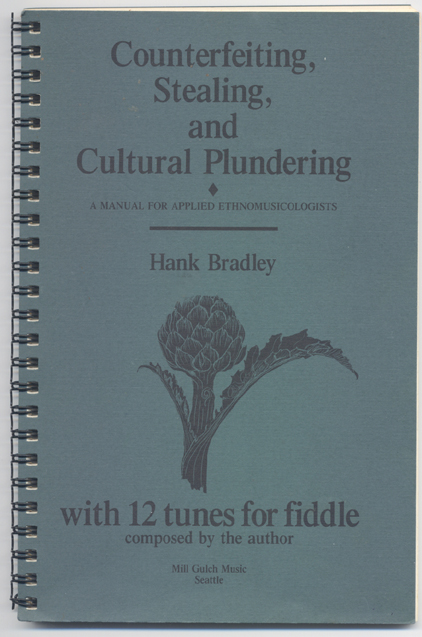
Hank Bradley's Counterfeiting, Stealing, and Cultural Plundering: a Manual for Applied Ethnomusicologists, with 12 Tunes for Fiddle
Counterfeiting, Stealing, and Cultural Plundering:
A Manual for Applied Ethnomusicologists, with 12 Tunes for Fiddle by Hank Bradley
Hank Bradley, AKA The Poison Coyote Kid, is a multi-instrumentalist/cultural critic of ferocious talent and intellect living and playing in the Seattle area.
At a jam session I attended many years ago he played
hours of guitar backing up Romanian and Greek fiddlers in oft impenetrable time signatures
and then turned to me, whipped out a fiddle and ripped through Bob Wills' most arcane and modal version of "Done
Gone," just my kind of player. A wise music fan would be on the lookout for his singular LP release,
"The Return of the Poison Coyote Kid," which features the greatest song ever penned about a Hot Dog stand ("The Mayor Is A Good Old Boy.")Mr. Bradley hinted to me that little book got him in a bit of "trouble" when it was first published as many folks still avoid eye contact or give him a wide berth at festivals and other gatherings of "folkniks." As he explained it to me, he intended it simply to be a handbook of good manners designed for those folks who ran off into the hinterlands looking for old people they could hassle about music. His reflections on cultural differences between the applied ethnomusicologist (Yankee in this case) and the tradition bearer (a Southerner, closer to my experience) especially caught my attention, using "Villages" to stand in for cultures:
"Consider a Brooklyn bluegrasser at a 1970 Virginia Fiddlers Convention. A northern villager knows you're supposed to take public transportation, resist US war involvement, minimize meat and junk food consumption, excoriate polluters, and meet women and all socially conscious people as fellow and equals.
![]() |
| Oh yes, Bad Livers are in part responsible for this, I'll cop to it. |
If these villagers stick to musical topics, all will go well enough socially, but if not it is easy to see how a heartfelt opinion on either side might lead to hurt feelings and hostility on the other."
As a Southern Jewish Bluegrass musician, I often found myself in the presence of folks at a picking session who would normally be burning a cross on my front lawn, (not a joke, BTW) so I could really relate. And these many years later, very sad to report, Bradley's warnings still seems to hold true. Just last year (2013,) a Texas fiddler I brought up to instruct at a very well known fiddle camp in the economically well off, socially "liberal" North West US had more than a few attendees going out of their way to make him feel very uncomfortable for holding the very sorts of opinions that in fact made him an authentic, living voice of his community. Lead to some mighty "hurt feelings" all around, I can assure you.
For some in the "traditional folk" community today it appears, there is still a glaring disconnect between the creative output of a living culture and what it is that actually makes the life that creates that culture's very output. "Just teach me the tune, I don't need to hear about what the tune is for..." is a phrase I've heard more than once as an instructor at a music camp. It's expressed in a way that I think isn't intentionally malicious, but sure could be seen that way. And worst still, its needlessly pointless, as it contributes to drawing people apart rather than focusing on the one thing music does best: bring us all together. **
| White Top Mountaineers, maybe TOO authentic? |
Not that long ago it was literally impossible for me to interest my local folk club in Austin TX in a rare performance by actual traditional bearer fiddlers from White Top Mountain in sponsoring even a little house concert, but they got real worked up about a foreign immigrant who plays their own version of American music. What's the take away from that? Must traditions be filtered and refined by outsiders before they are fit to be enjoined with? It's hard not to see racial and class prejudice behind such glaring disconnects, as the tradition bearers themselves never seem to mind who comes to learn from them. It's a troubling question on many levels.
But Mr. Bradley is wisely unburdened by others baggage as well. Hank is famous (infamous?) for presenting his original fiddle tunes as "learned from some old master he found in the hills somewhere," duping a hoople in the process and teaching them a fine lesson all at the same time. The last chapter of this thin tome includes 12 of these tunes with titles like "Dance of the Music Critics" and "Chase the Squid," and they are well worth your time in learning. Chock full of interesting insights on the process of the "folk revival," and a overall great read.
Copies can be secured contacting the publisher, 8033 14th Ave NE, Seattle WA 98115. Or simply email him here.
** (Possibly the "camp" model contributes to this contextual break, knowing full well these pointed political jabs would be very much out of place where this music is created and nurtured? Another conversation for another time. I run a camp of my own now, so its something I think a lot about.) :-)
8/10/11
Great Romanian Accordionist playing "Live"
And this short Sirba:
And here's a cameo in a Romanian film:
Here he's probably just playing along to a track, but no matter, its "live" of a sort:
I'm sorry to make you suffer a whole minute of Zamfir on the pan pipes (which he rocks BTW) so that you can see the great Vasile Pandelescu at work :
Really and truly I've been checking out Viorel Fundament a lot lately, so dig :
Here's a more modern approach to the music from two of the hottest Young Bloods on the scene,
Ionică Minuneand Marian Mexicanu :
Here's Emil Kroitor, ex-Moldova now living in Tel Aviv. He has been described to me by every Moldovar lautari I've encountered as the greatest of them all. He collected and in some cases composed the vast majority of tunes that are played by lautari today.
Just found this cat, and he can really throw down in the rustic school. Mighty!:
This still remains one of my favorite performances, entirely give it's circumstances! :
3/15/11
Atomic Duo @ Folk Alliance Conference, 2011
As it turns out, lots of folks do! Had a wonderful meeting with Si Kahn, who has been an inspiration for many years, and picked up quite a few pointers from him. Saw lots of truly amazing and talented acts; Jerron Paxton, Two Man Gentleman Band, Betse Ellis and every single band who performed at the Steam Powered Preservation Society's informal showcases, (follow the link to hear two live tunes from us.) Got quite a bit of jamming in with friends old and new. And saw soooo much good music being made by genuinely nice people that it puts to lie the tired yarn that "there's no good music today."
Here's a few little highlights:
First up, from a "Rooted Traditions" showcase hosted by roots guitar maestro Andy Cohen, we were asked to perform only tunes by our "masters." We chose Gil Scott Herron (w/ our jugband rendition of "Whitey On The Moon") and this lovely little Scott Joplin gem, "Scott Joplin's New Rag."
And here's the first tune from our formal showcase, the world debut of Silas' new composition "Trickle Down."
Here's the lyrics (all rights reserved, c Silas Lowe.):
Verse
My mother raised me up alone
working three jobs at a time
Barely made enough each week
to put away a dime
So I don’t want to hear about
the wealthy’s pain and woes
Cause they ain’t trickled nothing down
to help the working poor
Chorus
They talk about trickle down
but I ain’t seen a drop
They say they worked the hardest
for all the things they got
But they don’t know the pain to raise a
failing dust bowl crop
It’s time things started flowing
from the bottom to the top
Verse
They trickled all the money
to banks in Switzerland
They trickled all our children
to fight Afghanistan
They trickled all the good jobs
down to Mexico
But they ain’t trickled nothing down
to help the working poor
They talk about trickle down
but I ain’t seen a drop
They say they worked the hardest
for all the things they got
They ain’t lived a lifetime pushing
round a dusty mop
It’s time things started flowing
from the bottom to the top
Verse
The pressure sure is building
and something’s gonna crash
the credit cards are all maxed out
and no one uses cash
Things had best start changing soon
cause the bottoms gonna blow
and they won’t like what boils up
from the starving poor
They talk about trickle down
but I ain’t seen a drop
They say they worked the hardest
for all the things they got
But they don’t hungry child whose
crying just won’t stop
It’s time things started flowing
from the bottom to the top
1/11/11
Personal confusion over the term "Folk."
I was recalling when I was a last minute replacement speaker on a panel at the Folk Alliance conference was held in Austin in 2006. The panel was called "What is Folk" and it was the opening session. When it came around to my turn after hearing all the music professionals; artists, presenters, writers and a DJ, my definition was greeted with quite a bit less enthusiasm as I had hoped.
![]() |
| Brian Marshall at the Houston Polish Fest |
I proffered the opinion that the definition of "folk music" was music played by people who didn't want to be left out of the party going on. Music of community functions and families traditions. Its a voice of a living culture, often times filtered and some times entirely drowned out by the consumerist narrative. It's a concept my pal Tex-Polish fiddler Brian Marshall laid on me years ago, and ultimately it's as good a definition as I have yet encountered: "I didn't want to be left out of the fun, so I joined in."
There was an audible and awkward silence amongst the assembled. From the best I can gather, this description didn't sit too well with many "performing songwriters" in attendance, who I have since come to find hold a much different opinion from a vastly different world view. What I came to find that day was that we are talking about two very different narratives and concepts that today share the same public moniker. Confusion and hurt feelings can mount up quite a bit when you realize that you use the same term to describe different things, especially when they exist at such odds with one another.
From my possibly limited experience, a "folk" artist is in fact a cultural craftsman who's only attachment to music is serving a function of his/her culture as a whole, music only being a slight fraction of the equation; language, faith, dance, cuisine are all intertwined and carried along by music which is definitely not the myopic focus. It appears that the narrative a great many people who describe themselves as "Folk" artists as if "Folk" was simply a slot they hope to fill in a record shop, or a radio format. For short hand we can use the brilliant parody film "A Mighty Wind" as an example of this perspective.
The "Folk singer" in the consumer narrative is in many respects no different that a Pop singer, save for their setting and instrumentation which appears to "acoustic." Ironically it is
always a guitar made to look like an acoustic model, but in fact must be plugged in electronically to function, much the same way that the "folk" aspects of the presentation (costume, instrumentation, etc.) is simply a conceit to give the visual image of "traditional" folk craftsmen. Often time what you in fact encounter in this milieu is a pop songwriter who is not yet financially prosperous to field a rock band onstage, and uses the "folk" niche to simply mark time until they can climb the ladder of the music business and "make it big." They embark on a commercial career and if they don't make their dreams come true, they eventually stop and go back to whatever "Plan B" they have in their back pocket, no harm no foul back into the warm comfy waters of the dominant narrative.
Conversely, the traditional folk musician is way too busy living a life inside a culture, and just happens to play music and most likely will for all of their lives, whether or not they are every examined outside of their community. They couldn't care less in most cases. I learned this by shepherding tradition bearer fiddlers up from Texas to the Festival of American Fiddle Tunes. Rather than help curate and teach with the instructors, I spent most of my time out of class sitting on the porches of our housing trying to explain the motivations of the our students to the confused fiddlers. "Um, again tell me why it is these people want to know this music? Are they Catholic? Do they play dances where they'll need to learn this stuff?" Time and time again we encountered students who desperately wanted to learn a new tune, but seemed entirely uninterested, oft even hostile to the suggestion, that the fiddle tune went with a dance, which went with a party which went with a Church that went with pirogi's and vodka that went with conservative political values, etc... It got ugly on more than one occasion, as these misunderstandings tend to get. In the search for "authenticity," you must take the baby with the bathwater however, weather or not it suits your personal views. The people who taught me Bluegrass in Oklahoma were oft times Klansmen, but that didn't stop me from enjoining in a jam session. You take what you find and do the best you can with it.
In my most jaundiced moments I've felt that when you scratch a "Folk" performer, you tend to find someone who has either wittingly (or unwittingly) rejected their own culture's narratives and traditions only to then cleave to a some bubbling proto-culture that doesn't challenge their personal values and shares their world view to fill the void. The Jam band scene, bluegrass clubs and the communities that spring up around Festivals are good examples of this expression for culture and traditions. And to be sure, over time this eventually creates it's own "culture," of a sort. For many, it becomes how the define themselves every day and contributes their self image. Far be it for me to rain on anybodies parade. As I go further down this track, I get a lot my forgiving and compassionate for what I find distasteful. I do draw a line pretty clearly however.
It's my feeling that all too often we encounter what are essentially crude burlesques of other peoples cultures. Really no different from a Coon Show in intent, uniformly populated by by the advantaged playfully adopting only the music of the disadvantaged without any understanding or even interest in what makes the music that way in the first place. George Carlin famously noted about why white men had no right in his opinion to play blues "not because its about what are the right notes to play. Its WHY those are the right notes." Time and again it seems and the participants of such imitation versions cheerfully identify themselves as dilettantes, which not a pejorative to the dominant consumer culture with its impenetrable bubble of privilege. As I know from experience, if you presented working traditional musician to this tribe, they uniformly recoil in terror. Possibly recognizing that deep down they actually do not much care for the culture from which the music was born and is a part of, they're far more interested in supporting fellow dilettantes, keeping the savage at arms length. Danny Barnes' essay on "I know why you're not into music" points out that there's "plenty of music for people who hate music, books for people who hate books, etc." I realize for a great many people my own band Bad Livers fulfilled this same role. While we were trying to get people to check out Stanley Bros. or Don Stover, time and again the kids said they liked us better than the people who inspired us. I recall an interview with Jerry Garcia bemoaning his fans not ever picking up on the great American songbook they were simply trying to expose to a new audience, relating only instead to his clumsy renditions. Could drive a sensitive person to heroin, no?
Danny also told me years ago in reference to the explosion of "we started as a punk band but now we're traditional C &W" bands that overran Austin in the late 80's:
"All these cats are all hot to play "country music," but none of 'em would dare go out into the country have to deal with the people who like country music. They do alright with the hipsters in town, but I'd like to see them deal with the drunks at the Satin Sabre in LaGrange for instance." Truthfully, all they ever really did was create a self referential "scene" where out-of-work musicians play for other out-of-work musicians and the waitresses who support them. I should know, as I've participated tangentially performing in the local "blues" and "country" clubs that African American and blue collar WASP's can scarcely be found. If anyone describes a "scene," this is most likely what they are talking about; a fully inward looking proto-culture, with it's own customs and code of conduct. "Scenes." Like "Rock-a-Billy," or "jazz" or whatever self imposed social club a group of people tend to create for themselves. And it's important to note that if you gather any group together long enough, and they share enough of a world view and "viola'!" you have a safely contained, consumer manufactured proto-culture, no less as genuine as any other. The Juggalos come to mind, as do other cult-like followers of bands and even habitual music festival attendees. No less authentic, truly, they are however more akin to GMO and hydroponic vegetables removed from Mother Earth and natural world.
To further confuse the matter, there have been periods of American history where authentic culture as also been "popular" and thus
There was the sweet yet brief moment when Jewish "klezmer" music was elevated by
violinist Itzak Perelman's single album and subsequent tour, which was forgotten as easily as it came on the radar, dashing the aspirations of a whole generation of artists who thought they had finally broke through to be counted as a American culture and not simply a marginalized corner of an even more marginalized community. Any folk musician likes to be appreciated and "hitting the big time" (whatever that means to every individual) is certainly understandable and even laudable, especially when it exposes the musicians greater culture in hopes of not just financial, but hopefully some measure of acceptance by the dominant narrative. But then again, they may only dress you up in Klan outfit when you sing your signature song....
I had this whole conversation with a fellow who's been trying to force fit an instrument from one tradition into another tradition's dance music for decades now with only an embarrassing admixture to show for it. As a "folkie,"and lets be honest here we are talking about people with white skin who speak English almost entirely, he's fully empowered by his wealth and his privilege to see culture as a smorgasbord; where he can pick and choose what elements suit his personal musical vision. How could he see it any way really, having had only consumerism and advertising as a cultural legacy? It is often argued that it's just these sort of people that propel traditions forward and there is indeed some truth in that line of thinking.
However, the important element, missing in this performers thesis, is how does this change come to a tradition? From within a community with its own internal standards? Is there a community of like minded, language, custom and faith connected people who within their own experience accepted change from within? Or is it the outlander who imposes their concept onto a culture he stumbles across, or is the natural curiosity of the tradition bearer feuling the innovation? The steel guitar entered French speaking "Cajun" music many years ago, as did the accordion before it, naturally and from internal experimentation. Same for the arrival of the Greek bouzouki in Ireland and the button accordion to the Spanish speaking south west US. Revolutionary as their introductions may have been, they arose as a reaction of a community well versed in their own traditions and as a community welcome to internal innovations. I'm a traditionalist personally, but even I must accept the adoption of American instrumentation in Yiddish music and I foresee a lexicon of authentic Yiddish guitar in my lifetime. That's a conversation from inside our community, and thus is nobodies business but ours.
![]() | |
| Done their homework |
To reach back to the opening paragraph, there was an earnest young Folk singer who responded to my definition at that Folk Alliance panel with the plea, "But I'm a white middle class American, raised without attachment to any of the heritages that make up my family's story. What am I to do with your definition then?" That knocked me back on my heels. I didn't have an answer for him, nor did I have one. Maybe I'm lucky that my identity was clearly identified for me so early on that I possibly don't even possess the tools to understand why folks don't see it my way. Just as I can't understand why they treat culture and it's byproducts as nothing more than a commodity. I'll allow further that I may be the only human on the face of the Earth that these issues seem to bother, and I'll be working to let it bother me less, seeing as I am in the great minority in these views.
| Rolf & Beate Sieker |
But by 1933 the National Socialists had co-opted these songs and traditions and had perverted them for their own purposes. After the war, simply whistling the melodies was an indication that you preferred the Third Reich. Papa put his instrument under the bed and never sang those songs again. But Rolf was lucky. His mother listened to Armed Forced Radio and became (like many post war Germans strangely) a HUGE Johnny Cash fan. In hopes of hearing the Man in Black, Momma Sieker kept the radio on, and that's when Flatt & Scruggs came blaring through the ether. Young Sieker was entranced, so much so that he eventually founded arguably Germany's only decent Bluegrass band, going on to tour with Bill Monroe (even sleeping in the same bed, but like I said Rolf should tell these tales himself!) Brutally disconnected from his own traditions, he cleaved to this foreign one and made it fully his own, following his passions from Hamburg to Nashville and eventually Texas today. Is it any coincidence that his father's instrument, has five courses and is tuned to an open G chord? I think not.
To close, let me share this one anecdote from my childhood. My family was very close with a group of young Native American artists who were engaged in complete re-examination about what was "Native" art? They took all the tools of classical western art and focused it back onto their own cultural narrative in a bold and exciting new way, unbound by what outsiders considered "traditional." My family would host shows form them when the non-Native owed galleries pronounced their output at "not Indian" enough. They established themselves by word of mouth and hard work driving all over the country showing their canvases to whoever would look at them. The "Indian" Art world came around to accept them finally, we would go to their showings quite a bit, sometimes all the way out to Santa Fe the big art fair. I saw my buddy Ben Harjo Jr. setting up a few new prints.
| Ben Harjo, Jr. at work |
What am I getting at? All I recommend is that when you enter some ones home, you try and do like your parents taught you to and be respectful. Every human on Earth has their own medicine. Go and study yours. It could very well be staring you in the face right now. You may be surprised what treasures you will find.
PS:
Oh, I guess I should make a pitch for Hank Bradley's ground breaking essay on this very subject called "Counterfeiting, Stealing, and Cultural Plundering: a manual for applied ethnomusicologists with 12 tunes for fiddle composed by the author" 1989. Available from the author. It was very helpful me in understanding motivations when I was just starting out searching and engaging in cultures other than my own.
5/29/99
On the Subject of "Bluegrass"
Mark Rubin, bass and tuba player for Bad Livers, has this advice:
"Anyone who sets off on that path has to be aware of the fact that there is only a certain amount of economic recompense. The people I know who are the happiest at this stuff do it as part of a familial tradition, or a cultural tradition. That's where it's rewarding."
According to Rubin, unreasonable expectations are what lead many practitioners to fret at the state of bluegrass in today's popular music market.
"The bluegrass music industry is in a state of operative denial," states Rubin. "The operative denial that's in place is that bluegrass is a commercial music. The fact of the matter is it's not. It hasn't been since the mid-Sixties when Flatt & Scruggs stopped having hits with Bob Dylan covers. Like many musics that are based in traditional forms, at one time it was a commercial entity."
When contemporary artists discover these old forms of music and are so inspired by them that they attempt to copy or revive them, the resurgence of artistic interest, combined with the lack of a commercial interest, brings the music into the realm of the folkloric. For example, bluegrass is a folkloric art, while swing jazz is not. With respect to bluegrass, many of the form's originators and first wave of practitioners are still around, offering tips and wisdom to those looking to keep the music alive. But, with bluegrass, it doesn't come easy.
"Bluegrass music requires the study of a lifetime," says Rubin. "That's the problem. You end up trying to commercialize all this effort and you run into a brick wall. So, within the bluegrass music scene is the attempt to somehow improve bluegrass -- the catch phrases are 'Expand its horizons' or 'Push the tradition.' A friend of mine calls that rearranging the deck chairs on the Titanic.
"I think that's exceptionally misguided, because you have to be awake with the modern age and understand that once you're in the study of bluegrass music it's akin to the Civil War recreation or the Society for Creative Anachronism. It's only going to be a hobby. Tom Ludwick and [Leon Valley Bluegrass] epitomize what bluegrass music is today. They are people who are music fans who got turned on to this particular art form and then devoted themselves to it as an all-consuming hobby, which then becomes a lifestyle."
![]() |
| Leon Valley Bluegrass |
Rather, both Rubin and Barnes were well-versed in bluegrass and went on to develop their own style of music, which was based as much in the ethos of punk rock as it was in the style or instrumentation of bluegrass. While it's tempting to relate banjo music to bluegrass as a means of discussing the music of Bad Livers, the weight and focus carried by the bluegrass tradition makes its title something to be taken more seriously than a word like, say, "rock."
"It's like the word 'folk,'" continues Rubin. "Folk now includes these pathetic singer-songwriters telling you all about their girlfriend. The whole detestable singer-songwriter phenomenon now goes under the moniker 'folk.' I think Big Bill Broonzy is a folk artist, not this stuff. Just because the whole situation today is jive doesn't mean the terminology has to follow it too."