Showing posts with label mark rubin. Show all posts

4/29/18

From the Rubin Archive: Austin's "Goodwill Ambassador" 1998

Austin Chronicle Best of 1998 issue
Best Ambassador of Goodwill (Music)
Mark Rubin

A person with this many opinions isn't usually this endearing, but it's hard to ignore Mark Rubin. Whether behind stand-up bass for the Bad Livers, tooting on tuba for his klezmer group, Rubinchik's Orkestyr, or sitting in for John Aielli on KUT-FM as he did recently, Rubin is disarmingly frank, charmingly opinionated, and enormously talented. Could it be we're just saying this because we like him? Yew betcha.


4/25/18

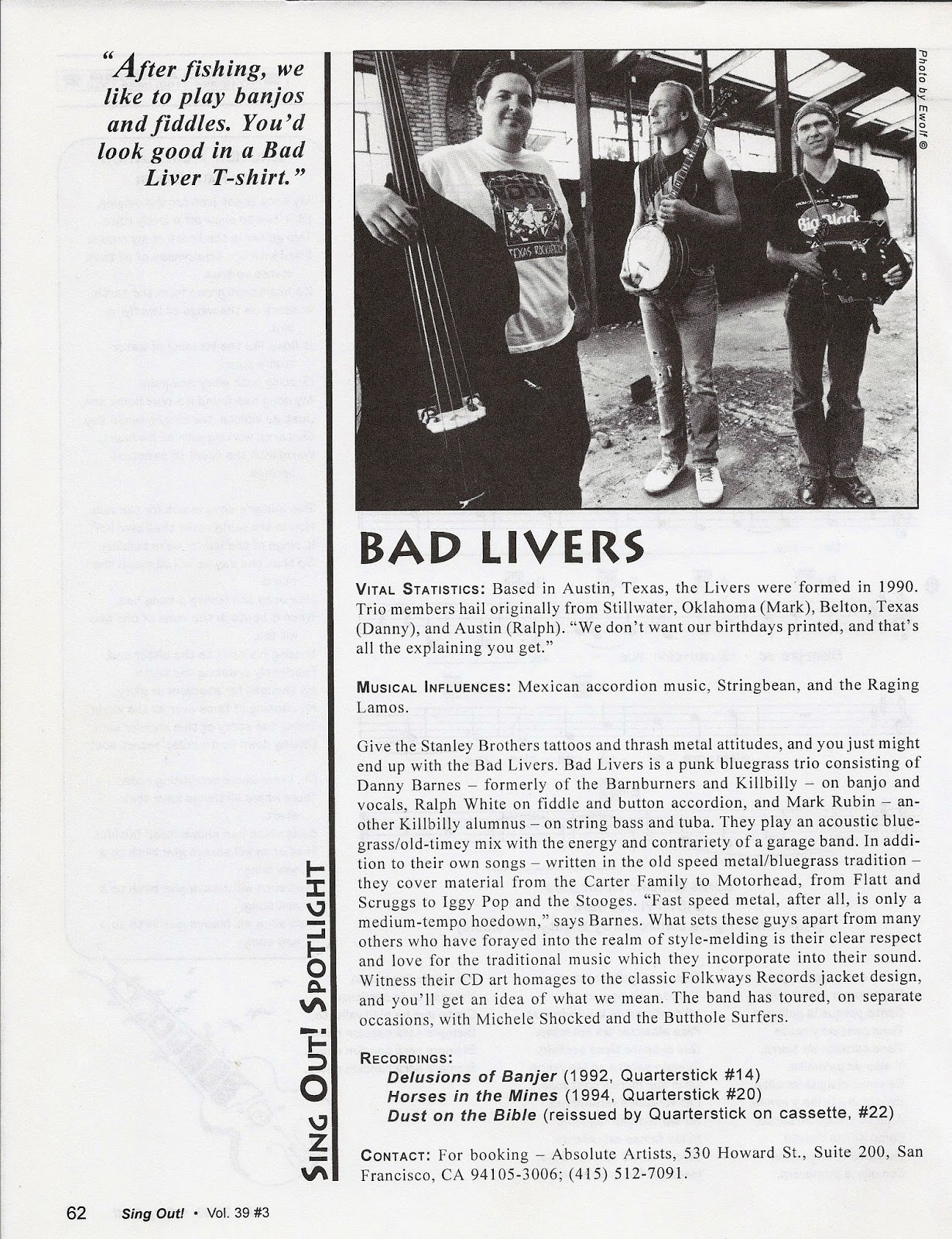
From the Bad Livers Archives : Sing OUT Magazine 1995


BAD LIVERS

VITAL STATISTICS: Based in Austin, Texas, the Livers were formed in 1990. Trio members hail originally from Stillwater, Oklahoma (Mark), Belton, Texas (Danny), and Austin (Ralph). “We don't want our birthdays printed, and that's all the explaining you get.”


MUSICAL INFLUENCES: Mexican accordion music, Stringbean, and the Raging Lamos.


Give the Stanley Brothers tattoos and thrash metal attitudes, and you just might end up with the Bad Livers. Bad Livers is a punk bluegrass trio consisting of Danny Barnes - formerly of the Barnburners and Killbilly - on banjo and vocals, Ralph White on fiddle and button accordion, and Mark Rubin - another Killbilly alumnus – on string bass and tuba. They play an acoustic bluegrass/old-timey mix with the energy and contrariety of a garage band. In addition to their own songs – written in the old speed metal/bluegrass tradition – they cover material from the Carter Family to Motorhead, from Flatt and Scruggs to Iggy Pop and the Stooges. “Fast speed metal, after all, is only a medium-tempo hoedown,” says Barnes. What sets these guys apart from many others who have forayed into the realm of style-melding is their clear respect and love for the traditional music which they incorporate into their sound.

Witness their CD art homages to the classic Folkways Records jacket design, and you'll get an idea of what we mean. The band has toured, on separate occasions, with Michelle Shocked and the Butthole Surfers.


RECORDINGS:
Delusions of Banjer (1992, Quarterstick #14). Horses in the Mines (1994, Quarterstick #20) Dust on the Bible (reissued by Quarterstick on cassette, #22)

4/18/18

From the Bad Livers Archives: "Bad Livers cross the line between Bluegrass and Punk"


Matty Karras, Longbranch Press, Longbranch NJ, 1995

As you might expect of a band that finds it appropriate to link a Johnny Cash (“Ring of Fire'') and a Motorhead song (“Jailbait”) in a medley simply because they're in the same key, the banjo-bearing, fiddle-flying, tattoo-toting Bad Livers sometimes find themselves on stage in rustic folk halls and other times in raucous punk clubs.
It's all a question of what club booked them first in any given town, according to upright bass and tuba player Mark Rubin.
“In a town like Denver, we played this little folk club the first time we played there, and from here on out we'll play that little folk club,” Rubin said.
At the Jersey Shore, on the other hand, the Livers debuted a few years back at the Fast Lane, a punk-rock cave, opening for the Butthole Surfers. Their gigs since then have all been at the Brighton Bar, the Long Branch punk haven where they will return Monday night.
“Have you ever been backstage (at a punk club)?” Rubin asked. “You know how there's graffiti all over the walls? This is the new thing we're gonna do now. We're gonna take a bucket of Lysol, we're gonna paint all the walls white and leave a potted plant. That's how punk-rock Bad Livers are."
But no matter who or what they're playing for, the Bad Livers sound and smell the same: like a banjo-and-fiddle based bluegrass band that writes sad ballads and happy banjo blitzkriegs with old-time Appalachian mountain flavors, and plays them with the virtuosity of great bluegrass musicians and the devil-may-care attitude of punk rockers. The fast songs on the band's most recent album, "Horses in the Mines,” are jumping testimonials to fingers flying on strings and blizzards of words sung lovingly through singer Danny Barnes' nose; the slow ones have a fervor that recalls gospel music.
The three Bad Livers are by now used to the sideways looks they get from new audiences, but those looks usually turn to foot-shuffling smiles once they start playing. “We're really happy about what we're playing, and I think the audience can see that," Rubin said. And now that the Austin, Texas, band has spent several years crisscrossing the country in their van, playing whatever small town would have them, he said, “We've got it down to where people know us and we don't have to explain ourselves every time”


Not that there should be that much to explain. Despite the Appalachian flavor, Rubin's basic explanation for the Livers is: We're from Texas. (Or, in his case: "I'm from Oklahoma. And everyone from Oklahoma moves to Texas as soon as they can.") In the Lone Star State, he said, “We speak a particular language, and it's the kind of environment we fit in. We're students of history and students of music. And you can devote yourself to Texas music and spend your whole life and never get tired.
"Look. We're playing the Old Settler's Bluegrass and Fiddler's Convention in Red Rock, Texas (at the end of the current tour), and once a month we're at Emo's (Austin's reigning punk-rock joint). We are the house band. You can't get more disparate than that."


The band's records and live reputation have won it some prestigious spots on its current tour - opening for Los Lobos in Detroit and for the Band at the legendary Wolf Trap in Virginia – but it has remained loyal to tiny Quarterstick Records, where its label mates include punk's veteran commercial failures the Mekons.
“In Detroit, a good quarter of the the audience was already familiar with us, and the other three-quarters was exceptionally receptive," Rubin said. “That validated a concept I've had for a long time: Our music could compete on a much higher level, on a commercial level, without changing anything."
But he said he doubts any major record label is ready to agree. There have been offers, he said, “but it's business, and in business you make someone the sucker deal right off the bat."
For now the Livers are all working part-time day jobs - Rubin is a computer systems operator for Ticketmaster (but thinks Pearl Jam is right on the mark" in its crusade against the ticket agency's high prices) — and collecting ideas for future records and side projects, such as a third Bad Livers album, due about a year from now.
"It takes time,” Rubin said, “when you've gotta go work 20 hours a week, and then you've got fishing. For every hour of work, you've gotta fish at least 20 minutes."
Rubin, the band's resident gabber, who has played bass and other rhythm instruments ever since picking up a sousaphone when a marching band coach pointed to a pile of instruments and said, "Pick up the biggest instrument you can,” hardly has to explain what he's usually after when he casts his rod.
Largemouth bass, of course.

4/11/18

From the Bad Livers Archive: Telluride Bluegrass Festival Program 1994

Bad Livers : Expect a Full Meal
David Owen, Telluride Bluegrass Festival Program 1994

A lot of different terms have been used to describe Bad Livers – everything from acoustic, speed-metal, bluegrass, thrash to cowpunk. All these terms, however, mean little to the Livers, whose focus is on just playing what comes naturally and relying on the principle that good music cannot be kept down for long.
Born from the Austin, Texas, gig scene, Bad Livers came together in 1990 as much out of attrition as out of any master plan. Banjo player Danny Barnes began booking himself as the “Danny Barnes Trio” around the town. The established sound of this title was misleading, because the trio consisted of whomever Barnes could scrape together to play that night. Over time, Ralph White and Mark Rubin fell into place to round out the group, as the three discovered their mutual influences and interest in musical history.
While all three have backgrounds that include forays into the punk, reggae and Cajun scenes, Rubin says it is their collective interest in history and their respect for their instruments that keeps the music pure.
“Some musicians who play the traditional instruments play almost as if they are apologizing for them,” Rubin said while pumping nickels into a Lake Tahoe slot machine. “We like and respect the instruments and the music we play. We don't feel any need to lose any of that."
The other thing that stands out about Bad Livers is that they are committed, above all, to making the music that feels right to them with no concessions to those who would try to pigeonhole them into one industry slot or another. Whether paying homage to Flatt and Scruggs, Bill Monroe, Metallica or the Stooges, the band is true to its roots and will not adjust its musical focus at the expense of . any of its other foundations. As one journalist once put it, “Listening to Bad Livers is like entering a parallel universe, where bluegrass is the only musical language. But it's expansive enough to accomodate everything from Johnny Cash to Jimi Hendrix.”
“We have had all sorts of temptations dangled in front of us by people who wanted us to become something we are not,” Rubin said. “The compromises have been too great.
We have a friend who is a blues player and record companies are always asking him to ‘put on the blues suit.' Those are allowances I just can't make. I am absolutely incapable of putting on the suit."
Fortunately for the band, they have found a record company, Touch & Go – the label for bands like Therapy? and Pegboy – that is willing to take them for what they are and make no demands.
“They give us just enough rope to hang ourselves with,” said Rubin. “We send them a tape and they put it out backed by whatever resources they have available."
Despite the frustrations of classification and the occasional novelty act tag that follows them, Rubin said the band knows what is most important is the music, and ultimately, that is what makes the difficult times worth it. “The only reason the greats like Bill Monroe ever made it, was because they were bullheaded and stayed in the ballgame," said Rubin. “They realized that you can't keep good music down. Our one accomplishment is that we are still here after three records and over 1,000 shows."
Their latest album, Horses in the Mines, was recorded in a wood shed on an old analog 8-track. “We didn't do it that way because we thought it would sound special or to be cool; it was because it was all we could afford," Rubin said. "But, the end result is something we are really proud of. I think it captured more of our live feel than our last album. It sounds a little like we set up in your living room."Bad Livers will also continue to tour as long as it remains feasible, knowing that the stage is their most powerful ally.
"We have had a range of experiences few can boast, from playing established folk rooms to premier punk clubs — and that has allowed us to touch a lot of different types," Rubin said. “It has also given us the opportunity to turn younger audiences on to the older artists who we respect and admire, turn them on to what turns us on."
"No matter what draws people in or what preconceived notion they have of us, it will not change how we act on stage. They are still going to get two full hours of Bad Livers," Rubin concluded. "We have never had an audience we didn't like, regardless of how they showed up. Good music cannot be denied."


Bad Livers will be performing at 12:30 p.m. Saturday..

4/4/18

From the Bad Livers Archive : fRoots UK Review of Industry & Thrift, 12/1998


BAD LIVERS Industry & Thrift,  Sugar Hill The nucleus the Bad Livers may now just be two guys, Danny Barnes and Mark Rubin, but with the aid of producer Lloyd Maines they're finally producing a mighty, full and cohesive sound. Working on the fringes of old-time and bluegrass, but crossing over with all sorts of raw roots from klezmer to country blues and honky tonk, they've finally got away from their earlier lo-fi fetish and do full justice to their singular vision. Whether it's driven by tuba and banjo (Lumpy, Beanpole & Dirt) or totally manic flat-pick guitar and slapped string bass (Brand New Hat, or the Doc Watson-on-uppers Cannonball Rag), they've now worked out how to capture the energy and fertile imagination that previously seemed to be the wishful thinking of the press release. Elsewhere, mandolins, clarinets, fiddles, squeezeboxes, bottleneck and pedal steel guitars layer in and out, and the only regret in the whole package is the complete lack of who-plays-what credits. Oh, and there's the obligatory uncredited extra track on the end, where banjo and bass go wiggy.
An important, landmark album from a band long admired more for their absence of rules than what they actually achieved.

3/20/18

Goodnight Facebook

If you're reading this its a good chance you got my note about shuttering my Facebook account. I appreciate that you took the time to follow me over here. Here, Master of my own domain. I get to set my own rules and I'm not sharing your info with anybody. Promise. (If you should take issue with my posts, note that I'm factually incorrect or have some relevant commentary that you feel like sharing, please feel free to contact me.)

Before I start cranking out observations and opinions here  that would have gone over there, please do me this one favor. Check out my new website, www.JewofOklahoma.com. When you're there you can find a link to my latest release. I'm super proud of it and I'd like you to hear it at least and download it free for nuthin'.


So! Welcome to the place I used to share my stories with before I got derailed by MySpace, er, I mean Facebook.


Thanks!

Mark
New Orleans LA

12/2/16

Remember that time when the skin head tried to kill you with a ball peen hammer?


From Flipside magazine, 9/1994 edition. An interview with one of about a 100 touring bands who crashed at my house in Norman OK in the mid-80's Hardcore culture. The deal we had in Norman was we'd try and find a venue, have the Flaming Lips run the PA and open up (and believe me, back then they weren't what they are lately,) we'd buy 'em a pizza on Campus Corner and then they'd crash at my place.


When Touch and Go touring band Killdozer came through, we had secured an arrangement with a local business man who opened up and "all ages" club on the main drag, called "The Jailhouse" and served soft drinks and foosball. The Lips set up their ramshackle, patched together "PA" and then played the a medley of their favorite hard rock licks for 25 minutes. Then Killdozer played a ripping set in front of about 7 people, including the 4 piece Lips and the people who set up the show. Coming in and then being thrown out again for being way too tweeked on meth, was the town skinhead (who should get his own posting really.) On his last way out, he told me he was gonna come to my house and kill me. I wasn't worried too much because this was not a new threat and he usually passed out before he could do any real damage. That was to change profoundly this evening.


In this article the band is being interviewed fully 7 years after the "incident" after their show, and it seems to have lodged well into their touring "lore." 


Every word is true:


He swung hard and wild with a ball peen hammer he found in my toolbox just outside on my porch. I just laughed at him lunged at me, seriously laughing my ass off. This totally wasn't what he expected and after he wore himself out flailing the hammer, he looked around, smashed a window and departed. The poor Killdozer dudes were so freaked out, they slipped out and I never saw them again. But here, years later, they relate the tale. And I lived another day :-)


8/14/15

The Murder of Leo Frank, 100 years ago this week.

There's quite a few Jewish people involved in the study and performance of American old time musical traditions. As it happens, I'm one of them. I could do literally hundreds of essays about the curious nature of this strange truth, which I found to be not limited to the American experience but actually happens world wide; Jews seem to be at the vanguard of nearly every great cultural output around the globe. 

Well, yes, um, nearly every one save their own Yiddish culture it seems. Rather than address that confusing conundrum, I chose rather to focus on a dark chapter of Southern American history that I hope would bring context to this disconnect in a way that would have some resonance, and maybe give my fellow claw-hammer banjo slinging Hebrews a new lens with which to view their place in the narrative that created the "old time" music so many of us have participated in for so long.

Years ago I was reading a article on Georgia Fiddle styles. I was genuinely shocked when I came across an aside about the influential and media savvy fiddler John Carson, where it was reported that he would serenade the crowds gathered outside of the Atlanta Courthouse during the Leo Frank trial , composing songs designed to whip up the anti-Semitic sentiments of the crowd, including a little ditty sung by the assembled "Hang the Little Jew."

Hmmmm.


"Wonder how many folks know that story?" I thought to myself. So I looked up the YouTube video for John Carsons' "Little Mary Phagan," where I made the mistake of reading the comments section. 


OK, right. So here we are 100 years after the fact and nearly NO Jewish person I know knows literally anything about it, yet rage filled bigots are all over the interwebs using the the event as if happened last week and proves every evil narrative against the Jews that you could possibly imagine. It would be hilarious if it were not so real. What do you do when presented with that kind of hatred? Not "long ago" hatred, but RIGHT NOW TODAY hatred.

I'm a folk singer, so my only response naturally is a folk song:


Though it's only gotten less than 200 plays, Its already been singled out by the twitter account that runs www.leofrank.org as "Jewish pedophile convicted of murdering a child is romanticized by anti-Gentile Jewish activist bard." Classy.


As I note in the song, August 17th marks his yahrtzeit and by extension, the eventual founding of the Anti-Defamation League. I'll be singing this ballad this Monday at a local ADL meeting here in NOLA. Maybe somewhere, someplace else, there will be a landsman who will also sing of Leo Frank and maybe want to learn a nice Yiddish fiddle tune, rather than one more North Georgia tune. Maybe.


6/16/15

Danny Barnes "if I was you, I'd get this..."

Danny took time out his his touring schedule to scribble a few thoughts about my debut solo release "Southern Discomfort," now available on iTunes and CD Baby:


bad livers, 2000
"mark rubin is a very smart and talented fellow. i feel we are like brothers...that grew up together in a van, driving around the US. i've been really excited for him to put out these great songs because he's got a lot to say with his art and he has a great vision for it. we all have to just keep putting the music where our mouth is and keep putting stuff out, there's really nothing else to do. or that can be done, we have to keep working and improving. he sounds really great here and has a good eye for the overall effect. if i was you, i'd get this."

Keep up with Danny at his blog and check out his cassette Only label Minner Bucket Records.


6/5/15

Shinyribs chimes in on "Southern Discomfort"

There are few people in music that I've known longer than Kevin Russell. Way back in the late 80's, he lead the Picket Line Coyotes in Shreveport, then Dallas where we neighbors. I had just joined the brand new Killbilly and both bands found ourselves playing together often, even sharing a booking agent for a time. When Dallas seemed to lose its steam, we we both landed in Austin around the same time where I founded Bad Livers with Danny Barnes and not long after he got his Gourds rolling. Always close by, always doing something cool. 

I always tried to doing something musical with my buds, and he had me come and play on his first solo outing for Sugar Hill Records when he was still transitioning as "Kev Russell," not fully Shinyribbed yet. Even took me to Holland to play a festival, where the show was running late and I played the tuba for three tunes; to date the furthest I've gone to be paid so well to do the least. Years later I've played a few dates with him in a fun acoustic trio version of Shinyribs before he found his current groove and recorded another record. He's expanded into more of a rock and roll show these day and has released a fine CD "Okra Candy" you should check out. Seems like he's on a roll lately and it couldn't happen to a nicer guy. However he took time out from his mighty busy schedule to listen to my debut release and here's what he had to say:


"Mark Rubin has created a masterpiece of American dark humor and grief. A bucket of personal history thrown into the wagons,mixed with the southern subterranean gravy of love and loathing. Since leaving Austin for New Orleans he has somehow managed to position himself as the Godzilla of Gypsy Juke N' Tuba Two-Step."


Thanks Kev!


4/14/15

Slaid Cleves on "Southern Discomfort" "Delightfully disturbing, or disturbingly delightful?"

I don't have the kind of finances that allow me to hire a publicist to "work" the release of my solo CD, I just have myself and my friends to rely on. But that doesn't really worry me, because even if I did the whole music industry is so confused right now I could just be setting the money on fire for all I know. When I started out making music, we were entirely on our own with no infrastructure or roadmap, making venues where we could find them and printing up our own 'zines. We didn't get our music out to everybody, sure. But we got it out to the other music freaks, just like us, and that's who we wanted to be connecting with in the first place.

When the internet came along, we jumped on it (Bad Livers had a website up in 1993, before I had a browser to even see it.) It was a great tool to communicate directly with our fans and circumnavigate the normal channels that were, and are, frankly toxic to good music making.

Oh how the times have changed, and the disruptions of the web based economies have made what once looked like a great way to connect appear today to be a swampy morass, with its once flowing pipes now choked with pap and dreck and the good stuff seemingly just as hard to access as ever. Sometimes it feels like its built that way on purpose.

Good thing I have such great friends who I'm hoping with turn their friends on to my music. Slaid Cleves is one of those friends. I sent him a copy of my debut CD, with trepidation as Slaid is a wonderful storyteller and songwriter and this was my very first songwriting effort. Here's his response:


"Hey Mark,

Great job, man.  That's one to be proud of.  I don't know if you were looking for quotes, but it certainly did inspire a few:

That's the least boring album I've heard in a long time.  Jam packed with sweetness and angst, it's delightfully disturbing (or maybe disturbingly delightful).  One thing it's not is subtle.  Recommended for any roots music/Americana fan who's been a little bored lately."


Thanks Slaid!

(I have another really great review from my pal Papa Mali, but that's going to be published in the Austin Chronicle soon!)

Here's me backing Slaid singing a Don Walser tune at the Broken Spoke:


2/26/15

My 1st ever review


So, here it is. There very first words written about the very first music I have released under my own name. The author is Devon Leger and its from his "5 Artists to Discover at Folk Alliance" blog posting at his popular Kithfolk Blog. (Look for a full interview in a future issue of his Kithfolk Quarterly Roots Music Magazine.)

Mark Rubin


Mark Rubin is another uncompromising voice in American roots music. An endlessly curious musical explorer, it would be impossible to catalogue all the bands he's been a part of and all the American musical traditions he can basically call his own. He's well known for his work in The Bad Livers, an early punk-grass band that paved the way for a lot of underground roots music to this day. He's also well known now for his brutally honest voice on the scene, calling bullshit on hypocrisy in the folk scene. At Folk Alliance, he'll be running their extensive music camp, so I don't think he'll actually be performing that much, which is why he gets bonus mention here. Mark's releasing a new solo album in 2015, Southern Discomfort, and it is a brutal and unflinching, but ultimately fascinating and deserved, look at American culture today through the prism of American roots music. A few songs come over from Mark's fabulous and under-rated earlier band The Atomic Duo (a bitter ode to rental warfare and classism with "Key Chain Blues" and a pure genius cover of Gil Scott Heron's "Whitey's On the Moon" as a jug band song), but the rest are new.


The most brutal song is "The Murder of Leo Frank", a murder ballad written in the old broadside style that chronicles the horrific mob lynching in 1915 of Northern Jewish factory superintendent Leo Frank in Georgia. You can read the details on Wikipedia, but the gist is that Frank's murder casts a light on the bitter reality of anti-semitism in the 20th century. Aside from the topical nature of much of Mark's songwriting, there are songs here that are just great fun. "Seriously (Too Much Weed)" is a ridiculously big band jass romp through weed lovin' and kudos for the sweet and charming "Don't Wake Up Jesse Lege" about touring with great older masters like Cajun accordionist Lege. Mark's a great writer aside from his songwriting, and I recommend his blog for interesting asides and opinions. Any way you cut it, Mark's voice cuts deep but is necessary in a roots music industry that's become increasingly complacent and self-congratulatory. Ignore him at your peril.


2/5/15

Rubin’s First Dictum of Cultural Arts:

There’s a poseur version of every great cultural output on Earth. 

And, given the option, the public uniformly prefers it to the original.


1/18/15

"Southern Discomfort" Radio Documentary, now in English!

Producer Paul Brody of Berlin has graciously provided me with an all English version of the WDR Feature on yours truly called "Southern Discomfort," not coincidently the title of my debut release. 

We travelled from New Orleans and Austin and back, listen to KBON, played at a bluegrass jam at the Hi-Ho Lounge, remember life changing nights at an Einstunzende Neubauten gig, my recent diagnosis with BiPolar 2 (and the ugly public scenes that lead up to it,) hit the road with the Hot Nut Riveters, record my new CD, and talk extensively about my life growing up Jewish in small town Oklahoma. Fun times.

Follow THIS LINK to listen in, and then after that if you would be so kind, maybe order the new CD (info below) as well!

Thanks!


MR

11/17/14

The "Blataphone"

Or as a local instrument repair man calls them, "Fartaphones." 

New Orleans may rightly claim to the be Sousaphone Capital of the Western World but, if truth be told, it's actually the Fiberglass Sousaphone Capital of the World. They're cheaper, lighter and seemingly all stolen from a school band in Mississippi (ok, not true but true enough to be funny.) Most seem to be held together with duct tape and good intensions and I've never seen one ever even close to a hard case, much less a gig bag. The cats who play them in the street bands don their best to pump as much air through them as they can, producing, well, a great blatting roar. 

I've played them, but they're never my first choice. I was loaned a lovely older King, like the one pictured in the William Bell ad here, when I was teaching at Klez Fest UK in London. And the NCTA provided me one for my appearances with Frank London's Klezmer Brass
W/ Susan Watts @ Richmond Folk Festival
All Stars. Which was a good thing too because at the American Folk Festival in Bangor, a coastal storm came up out of nowhere during our main stage performance, making the band scatter but for reasons I'm still not sure about I just kept playing in the driving rain. I guess I subconsciously realized that wrapped in plastic, I'd be safe from a lightning strike.


I don't own one of these, but I wouldn't turn one down if you have one sitting in you garage or attic. Seriously.


11/4/14

Ross Daly on Modal Music and much, much more.

Rubinchik's Orkestyr (z"ll)
In 1996 I had the pleasure of taking my little Yiddish music band from Austin TX all the way to the south of France for a short tour and a series of performances at Le Nuits Atypiques de Langon. It's an amazing festival, curated not just musically but socially, and the musicians I interacted with there have informed much of what I know about music as a living culture. I had been there before, in 1993 as bassist for Santiago Jimenez, Jr., and was primed for this festivals tradition of purposeful admixture and cultural dialog. One of the featured artists in '96 was Ross Daly

I was really struck with him and his approach to music and collaboration. There was a young cellist from NYC who had been hired by Daly to come and perform with him, yet he had never met him before in person. The cellist, the very talented Rufus Cappadocia confessed to me how spooked he was to show up to a major event unrehearsed and just play with the featured act. But I saw the initial duet set between him and Daly that was frankly incredible, natural and real; some of the best music making I had ever encountered to that date. 

Daly showed up at the festival with a group of musicians from varied back rounds, including among others a Persian Zarb player who had at one time played for the Shah of Iran and then Khomeni after the revolution, and presented what was to all the world a very cohesive and musical presentation. A very deep cat, who I enjoyed hanging and conversing with quite a bit the week we were there.

I was just reminded of him today when a pal forwarded me his TED talk, in which he hits many of the notes that I personally have had a hard time expressing. I'm including this lecture as core material to my music students and recommend you take the short bit of time to check him out. Ross is kinda droll in his approach, but hang in there as he makes some observations that really ring true to my experience in music making and cultural connections.


Ross Daly on Modal Music:


10/6/14

Bad Livers "Ghost Train" Sheet Music from Sing OUT! Magazine, Jan. 1995

In hindsight, we gave mighty snarky responses to the venerable old folkie magazine. Didn't stop them from publishing our music, giving us consistently positive reviews (up until Blood and Mood which stopped everybody in its tracks,) and eventually hiring me to write not one but two major pieces for them. (The Klezkamp Mitzvah and Charlie Poole: the Man at America's Country Roots.) They did get back at us by outing Danny and myself as members of Dallas' Killbilly, which we hadn't been in for nearly 6 years by this point, but that's about the speed of light travels in folk land it seems.

The "you look good in a Bad Liver T-shirt" was our constant mantra, BTW. Shows up frequently in our interviews. We sold so many t-shirts, really crazy amounts that people today can't imagine. It was for many years our largest source of income and allowed us the creative freedom to do whatever we liked. 
On to the original article: