4/18/07

"Klezmer." My pain. My joy.

OK, it's happened again.

Some nice lady asked me a simple little question and without thinking too much or remembering to hit "delete," I send this along. The question referred to the weather or not non-Jews had any business playing "Jewish Klezmer," which I find as ridiculous a notion as can White people play the Blues. (Oh dear, a whole other essay is forming, but I digress..) Nope, I never did hear back from her either.

"Klezmer" is a term only genuinely applied to the recent revival of Yiddish dance music. It's a construct, a re-imagination, made up in some cases whole up cloth from people who have only a tangential relationship to the culture that the music originally sprang from. For instance, no self respecting Yiddish musician would have ever referred to themselves as a "klezmer," which is point of fact a derogatory term for a not very good musician, yet it's the very term than modern players use to describe what they do. (Pretty ironic, huh?) I believe that's called a cultural disconnect. Many of these modern day practitioners have clumsily, and wrong headedly, incorporated smorgasbord-like and wide panoply of Yiddish Folk Song and Yiddish Art Song into their performances as well, further distancing themselves from any actual tradition.

Which brings me to there is no "klezmer" music, there is simply a Yiddish vernacular performance style. Thus, any tune can conceivably be played in a Yiddish style and thus made Yiddish, when filtered through the experience of the Yiddish speaking Jews of Eastern Europe. One of my favorite dance numbers around here started life as a Mariachi march for instance.
Utter BS, and stolen to boot.


The music that we know as Yiddish dance comes from many sources, incorporating the many places Yiddish speaking Jews lived and the sort of cultures Jews came into regular contact with (Oriental Greeks, Ukrainians, Romanians, Turks and various Rroma tribes for instance.) Some come straight from Cantorial and Chassidic traditions, but as we know from recorded evidence that many of these melodies were lifted from someplace else as well. The folk and art song traditions have long complex stories all their own, which intersect and are sometimes influenced by the instrumental tradition but are in fact separate distinct traditions unto themselves.

Further, this is a purely secular musical expression. It's the advent of a Yiddish speaking Jewish population, not a strictly religious expression. Non Jews have been involved in Yiddish music from day one, and many of the best players we have today are in fact not Jewish, nor do they wish to become so. True, there is a spiritual element in any music really, 
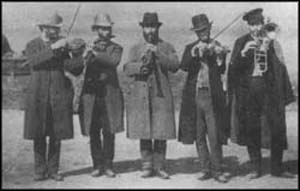
We can only imagine what they sounded like
and you cannot divest Yiddish culture from Jewish practice. However, any attempt to cast Yiddish music in that light is purely a post-modern thought. And probably a wholly American phenomenon, much the same way a socio-political concept like Zionism is used wholesale to express religiosity for many fully assimilated Jews .

To me personally I find it kind of sad that such a rich cultural tradition being misused in this way. Better Jews keep the sabbath than try and make dance music substitute for religious practice. That's my 2 cents anyway. I doubt if I'm in the majority opinion here.


4/9/07

It's Official...I'm OBSESSED

It started small enough, searching for the roots of the Jewish music that I get hired to teach people how to play. For the last decade, I've combed through stacks of Ukranian fiddlers, Hutsul cimbolm bands and Serbian Brass orchestras. It all changed for me last year however. That's when I came across Prof. Garfias' website with rare recordings of cintec de pahar singers from Romania. Rather than bore you with that annoying ethnomusicology horsecrap you can find online. I'll just let Rominca and Gabi state thier case, all in B&W Romanian State TV glory:

Fist off, I could kiss the cat who published this stuff (and more) on YouTube.

I am one dissapointment away from expatriating and devoting the rest of my life to this stuff.

No foolin'.

OH SHIT!!!!!

I JUST stumbled on THIS!!!!!!

3/28/07

Old-Time Music: Better Than It Sounds


Well, once again my writing makes the cover of the Austin Chronicle. That's 2 for 2 thus far, not to gloat. This time I try and explain the phenomena of Old Time music here in Austin across the generations.

The tag line is not my conceit however, but that's what happens in the editing process. I wrote 5000 words for this piece, but there was only room for 2350, which really helps me understand better how this whole writing gig works. You have to tell you story clearly and concisely, 2 things those of you who have suffered my drunken story telling can certainly attest.

(Next article, if they let me, should be on the explosion of hip Cajun culture in South Louisiana.)

3/18/07

March Against the Iraq War, 2007

Well, by golly, we lead the parade again for this years "Million Musician March" from the Texas State Capitol to Austin City Hall. The Jericho Brass Band, for which I am only the nominal leader-organizer, ably lead by trumper Oliver Steck sounded wonderful and numbered maybe 50 pieces this time out.


I even convinced a few out of towners who were in Austin to perform for SXSW to attend, like my Klezmer Brass All Stars pal trombonist Curtis Hasslebring. (He played a great set with his band Golem that night. But got a fine sunburn on the march.)

More pictures of the event can be found posted here.

Let's pray that there will be no need to march next year as well.

3/12/07

Last Minute SXSW Showcases + Peace March

To qoute the Godfather, "but they just keep pulling me back in..."

The Ridgetop Syncopators will be holding down a 7-9pm slot at Threadgills Original Old No.1 on N. Lamar (walking distance from my house as it happens) which we hope to make a regular occurance. No wristband, no badges. Come hungry as I think Chicken Fried Steak is the special for the night.

Then as a last minute fill in for a band that couldn't clear Homeland Security for SXSW, I'll be playing bass with Kamran Hooshman's 1001 Nights Orchestra on a World Music showcase Friday evening at the Copa nightclub (2nd & Congress.) We'll be doing a lively mix of Arabic, Armenian and Persian musics.


Saturday at noon however I recommend you join me and the Jericho Brass Band as we lead the parade against the US War in Iraq.
"Every gun that is made, every warship launched, every rocket fired, signifies in the final sense a theft from those who hunger and are not fed, those who are cold and are not clothed."
- Dwight D. Eisenhower

2/23/07

Panorama Brass Band rolling Mardi Gras '07

Folks,

Since you most likely missed it, here's the Panorama Brass Band parading with the St. Anthony Ramblers in the French Quarter. We're just leaving the church on Jackson Square and headed down Charters. The tune is a Sher, can't recall the title, but from the Yiddish repertoire. I'm the 2nd tenor torn player. Yes, in this band, I'm happy to the tenor horn man.


Look about 2 minutes in where I run into another Krewes musicians, who quite cooincidentally turns out under his mask is a fellow Austinite and band mate of mine in the Monkey Butlers Oliver Steck. You see where I hand him a flask of 20 year old home brewed Slivovitz provided to me by a dear friend from Serbia, and saved for toasting this very occasion.

I hope all of you can come celebrate the rebuliding of New Orleans, both phsyically and spiritually in years to come.

2/10/07

Mardi Gras Schedule, 2007

I can hardly contain myself. A few short days, a trip to the rental car joint, and then it's I-10 West to New Orleans to roll with the Panorama Brass Band.

Here's where you'll find me:

Parading with Panorama Brass Band

February 15, Knights of Babylon, Uptown, rolls at 5:45pm
February 16, Krewe of Morpheus, rolls at 7:45pm
Cafe Brazil, post parade shindig
February 17, post-Edmyion party, Rusty Nail, Lee Circle, 9pm
February 18, Box of Wine, Garden District, rolls at 4:30pm
February 19, busking in Jackson Square, 11am-2pm
Mimi's (Franklin & Royal,) 9am-12am

February 20, MARDI GRAS, all over the French Quarter

Let's hope we see you out!

1/26/07

The "K" word.

That is the word "klezmer." And why it hocks my chanuck .

So my local JCAA has this annual event called the Tapestry of Jewish Learning centered around Jewish practice and culture which I was honored enough to come and speak at in it's innaugral year. Truthfully, the only thing I am remotely qualified to speak about, other than the best BBQ joints within a 120 mile range of Austin and the finer points of explaining why the Jews killed Jesus to your gym coach, is possibly Jewish-American party music. At least as far as the J is concerned anyway. My synagogue, or better put the synagogue that puts up with me showing up to daven without paying membership, has a similar little baby version of this concept called the Thinking Adult Persons seminars (get it, "Tap"...cool huh?) and this year I was asked to speak there as well.

I did my shtik to an enthusiastic crowd and as I was leaving to catch the bus I spied a catalog for this years Tapestry. The event actually didn't occur as it was iced out, but out of professional curiosity I took a peek anyway. I saw this interesting subject, presented by some one I had never heard of: "Klezmer: What makes it Jewish?"

Boy howdy, do I wish I could have made that one. (Refer to On "klezmer" music.) Again out of curiosity, I inquired who this gal was that was giving the talk. Best I can tell she was at one time the second chair of a civic orchestra in Reno Nevada, but none of my pals in Jew-Music-World had encountered her. But I guess the title kind of says it all. In the world of Martial Arts there is a term for dubious "masters" who open karate dojos. It's called "bullshido" and there are websites that actively "out" these ersatz cultural interperters. As I've come to find in my career, any two-bit bar mitzvah band with a Kammen song folio playing Israeli circle dances is concidered "klezmer" these days, which is just fine in some respects. Helps us quickly identify those who's hearts are in it and those who are simply looking to turn a coin for the unsuspecting hooples. This here could be the worse I've encountered however, a black-face minstral show version of Jewish culture ground out for a ready audience of like minded Yankee transplants and assorted self loathers. But I digress...

After my inquiriy I was asked innocently enough by J's cultural director why those of us who have dedicated some part of our musical life to exploring Yiddish musical traditions are not comfortable the term "klezmer." I reckon now is as good a time that I should go public with my response and my thinking on the subject. Thus:

"That's a deep question actually which speaks to my personal motivations for working in Jewish music rather than make a living wage playing something people actually pay for. You might look for the latest issue (Volume 50#4 – Winter `07) of Sing Out! magazine where I have a major article on Klez Kamp and the thorny path of cultural connectedness.

The fact is the textbook versus the vernactular definitions of the term "klezmer" couldn't be further apart, and no one who has even a glancing knowledge of our musical traditions would describe it with such a vulgar term. And I do mean vulgar, as unpleasant in it's use as the "N" word to black folks. If you're not hip to something so basic, then what else don't you know, dig? (I see no lectures scheduled on kosher recipes for pork for instance to use a possibly poor analogy)

Duke Ellington addressed a similar situation back in the 1920's when the term "jazz" was applied to his art. What most folks today don't know is that "Jazz" in the language of the day meant quite literally the smell associated of the after effect of sexual congress. A street walkers jargon. As vulgar and low a description as you could imagine, created by white people to describe black culture. Ellington was stumping for the more correct tern "Afro-American Classical Music," but by the 30's it was too late and the true meaning of the term was lost. He still knew though.

Same goes for us, but sadly we have only ourselves to blame. The "revivalist" bands of the early 70's started mixing instrumental music, folks songs and theater songs into a clumsy patchwork quilt of music and called it "klezmer" simply beacause, as they have since told me, they were too scared to call it "Jewish." A "klezmer" is a, and I'm quoting from Dave Tarras here, "a no talent bum who could scrape out a note or two on a fiddle and fool the unsophisticated clients that he was an actual musician." It's also recognized in Yiddish musician and gangster jargon as someone who underbids on jobs as well. If someone self identifies themselves as a "klezmer," then you can pretty well assume they they are either willfully unaware of the basics of the culture that creates our music. Or simply put, the depth of their experience is only as deep as the groove of the record they learned from. Post modernists and other post-hippie era musicians grew up essentially removed from the Yiddish speaking world, so they have no handle for the context of the word, much less the environment that spawned the music which ultimately is only one tiny facet of the diamond of Yiddish culture.

To not put too fine a point on it, in my opinion we didn't crawl out of the ovens and DP camps so that one day we could comfortable enough to either forget everything or worse still, to remember it all wrong. Who needs Nazi's when you have assimilation and willful forgetfulness? There is no hechtser for what's Jewish culture, and maybe ultimately that's a good thing. But all my teachers called themselves "muzikant" and they called their music "yiddish." They're all dead now too. That's why I don't like to use the "K" word.

Respectfully, your servant,

Mark"

1/10/07

My Father's Yartzeit, January 11th

I just left my buddy Gurf Morlix's house today, where he laid on me a CD of a Don Walser project we've been working on together. I played it when I got home and truthfully I'm not sure if I can release it. I recorded it in his house many years ago, sitting next to his wife Patricia, just him and his old guitar singing a mess of songs that he had written over the years and for whatever reason never recorded with his band. It's just so naked and honest and sweet, I'm not certain that folks who didn't know Don will find it at all interesting. Me? I cried like a baby...

I also noted that today is the anniversary of my own father's passing, what we Jews call a yartzeit, a day of rememberence. Don and my father will always be intermixed in my mind, so much I wrote about it extensively on an obituary I wrote for Don not a few months ago.

My father has been gone since 1983 now, and every year his image gets a bit dimmer in my memory. So I went through my old photo albums and pulled out these pictures of my old man that I thought I'd share with you.

His dad is in the Pacific, a Lt. Coronel leading an all black engineering battalion as Jewish officers weren't concidered fit to lead "whites."


Those who know my love of ridiculous head gear and dandy outfits can now see that I come by it naturally. Dad spent a few years living in Mexico, where his old man was a silver miner and part time cowboy. Some where I have a pic of him in this "traje" sitting on a pony.


It's 1954 and he's in the family business, this time a Cold Warrior. He's a language specialist (German, Russian and Romanian) and radio operator stationed in West Berlin, get my drift?


Here's my first birthday party, 1967 in front of the first family home in Stillwater Oklahoma.


Tallis, kippah and Torah. This is how I remember him most. Leading services at the Hillel Foundation in Norman Oklahoma.

Here's his last portrait, in 1982 just prior to entering the hospital.


I'll be saying the Kadish this morning and I'll study Torah in his memory. I was lucky to have him the short time I did.

On a recent trip I was able to stop in and visit his grave in south Oklahoma City for the first time since it's unveiling. You might note that the head stone is not your normal granite slab. My family was very involved with promoting Native American artists, and when they learned of his passing several them insisted that they collaborate to make tribute to him. The circle is an important emblem of the cycle of life, while the trees represent the biblical referrences to the cedars of Lebanon and the palms of peace. Etched in the center are the tablets of the Ten Commandments. There is no name, or date which I think is just fine. The white stone at his feet is the US Army provided marker given to all veterans and tells the details. I think the art says so much more. For the record, I'd like something similar.

1/6/07

Photos from Klez Kamp 2006

Getting in a few tunes with the Youngers of Zion, Yiddishland's finest old time string band. Henry Sapoznik on tenor guitar and vocals, Cookie Segelstein on fiddle and ass-kicking and me. (And yes that's a 3 string cello. That's how I roll.)


Longtime attenee Bob Blacksburg took these pics as well and I'm in a few of them. Check it out. You'll get a good feel for event.

1/3/07

Klez Kamp 2006 Wrap Up

Well, rather than mirror it all here, just go to the official Klez Kamp Blog of which I was one of many contributors. Stuff happened. Quite a lot actually. Some of which I will relate here (and there) when I get back to Texas.

Tonight however I find myself in Guthrie Oklahoma, home to the Jazz Banjo Hall of Fame and Byron Berline's Double Stop Fiddle shop. Both of which I hope to be visiting after breakfast.

And no, I didn't stop in Stillwater on the way home either...Link

12/15/06

In those Oklahoma Hills where I was born....

Folks, I am not a big "letter to the editor" writer but I felt compelled to chime in on this little piece that a fellow emailed me. First read the article, then read my letter. Or not. It's all my own mishegoss really:


Dear Editor,

I was just today directed to your article dated Dec. 8th in reference to the opening of a Hillel Foundation at OSU.

I myself was born and raised in Stillwater where my father Robert Rubin was at varying times the Executive Director of Kappa Kappa Psi National Marching Band Fraternity, head of the OSU International Student Association and for many years the announcer for the mighty Cowboy Marching Band. We were also at the time (1961-1976) one of the few practicing Jewish families in Stillwater or at the University.

To clarify Dr. Gethner's point: “A decision was made about 50 years ago not to ask the SGA for money, due to the anti-Semitism in the air at the time.” That "air" was in fact the same I took my first breaths with. I can speak with pointed experience that unabashed anti-Semitism was a part of daily life growing up there as late as the 1970's, ranging in exposure from the personal to the institutional. From no admission to the local Country Club or fraternal orders, to Protestant Christian doctrine taught daily in the public schools, to swastikas painted on the family home's door and odd brick thrown through the window emblazed with "Juden Gerauch." The "Protocols of the Elders of Zion" was available free of charge at the barber shop on 6th Street where I got my first haircut, and on more than one occasion I was asked by my more devout Christian school mates to show them my horns.

Now, it wasn't simply Jews singled out for abuse mind you, this xenophobia extended to anyone outside of the "traditional American" mold. I recall with great sadness that the children of Hindu and Pakistani OSU students where routinely singled out for ridicule and exclusion in the playgrounds of Married Student housing. As were young Native Americans who were yearly forced to dress up as settlers and re-enact the Great Land Rush at school. (Which would essentially be like asking me to dress up in a brown shirt and armband and re-enact Krystalnacht once a year.) Catholics were regularly referred to as "Papists," and it was years until I understood that N-----r was a epithet, having hearing it so often in passing reference to an African American.


Not Borat from Khazakstan. But not so long ago in Payne County OK, USA.

True enough as your writer points out, it was a long way to the synagogues in OKC, Tulsa and even Ponca City where we would gather with the small congregations of dairy farmers, educators and small business owners who made up the Jewish community of my youth. Many of who had only a few decades earlier fled the unspeakable horrors of wartime a Europe only to find the same simplistic prejudices set firmly into the social fabric of small town Oklahoma. Many of these folks, one of whom had as a young man personally funded the establishment of the first Christian Church building in Stillwater, had grown too old to safely travel for services. (A conundrum when you note it's strictly forbidden to travel or work on the Jewish Sabbath, but the desire to worship with fellow believers so strong as to allow a slight bending of the rules.) At bare minimum, most felt completely placed entirely apart from their "gentile" neighbors. For these reasons my father decided to hold regular services there for the faithful in Stillwater in a spare room of the Methodist Student Association, a example of Christian charity and kindness that will be long remembered.

That was until late 1976 when my father was approached to re-open the defunct Hillel Foundation at the University of Oklahoma in Norman, where he served as Director and small "r" rabbi of the Jewish Community there until his passing in 1982. We left OSU and Stillwater and I have never, ever returned. Yes, we found a home in Sooner Land. And say what you will about OU, but no one ever called me a "kike" in Norman.

In conclusion I wish to heartily applaud the efforts of those who wish to revive Hillel at OSU. And pray that, baruch hashem (God willing,) we all work to grow away our bigotry and promote understanding and tolerance wherever we are. Maybe someday I can free myself from own personal biases and again feel welcome to visit the town where I was born.

With respect,


Mark Rubin

Austin TX

11/21/06

The Magic of Digital Distribution

Just in time for the Corporate Gift Giving Season! A spate of re-issued music for you to download and enjoy.

First up is the critically acclaimed 1st CD by central Texas's finest ever Jewish Music ensemble, Rubinchik's Orkestyr. Click on the CD cover and be directed to iTunes, or you can snag a limited edition hard copy at CD Baby.

A rare Bad Livers release is in the works soon as well.