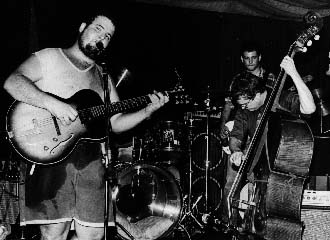
It's my birthday and all I really want from you is your email address. No really, that's it. Just scroll down to bottom and plug it in. Thanks!
By Dan Piarro, Ironically a Facebook "friend"
I'm turning 48 today and very soon will be shuttering my Facebook account. It will stay up, and my Twitter and Blogger accounts will be linked to it. But I won't be looking at it and surely not responding to any of its many stimulus's, much less checking its email. Call me a fuddy-duddy or a moldy fig, but I've come to realize that I've grown uncomfortable with the false sense of intimacy that social media tends to create and really don't need the extra souris. As a dear friend just noted to me just today "I have to really work on keeping a very mellow scene between my ears." Me too! I realize there's people who use Facebook as an aspect of, if not the basis of, their "business" model, But frankly I haven't seen it raise my fortunes any. The only thing I have to sell is my music presented in digital files, and even old fashioned CDs too, to a public increasingly uninterested in owning any of it, much less pay for it. And for some folks, more and more it seems, it has become the basis of their "actual" social lives. In the words of my pal Danny Barnes, who left Facebook for good himself recently, "Yikes!" It's like a lot of things: some folks have the discipline to make this tool work out for them. I just have to acknowledge I don't and that's OK. Tell you a story:
When I was about 14 or so, right about the time my father passed away, I recall how my mother's custom was to be glued to the telephone from the moment she got home from work until late at night, chatting with all manner of girlfriends, hours at a time. Not once did it occur to her to get out of bed and go less than a mile a way to actually visit any of the people she was calling. This was a smallish college town that I biked across daily, BTW, you could walk literally anywhere. It seemed strange to me, even in a very strange household. It was about that time as well, I started noticing girls. Amazingly there was even a neighborhood girl who would actually call me at home and talk to me, sometime for hours about all manner of important 14 year old stuff. But every time I saw her at school, or even out in the neighborhood, she barely acknowledged my presence. It was hurtful and confusing that someone would share so much over a telephone line and then be so cold and distant in person. When I left my home for my own apartment at 17, a didn't get a phone line. In fact, my friends from Norman will attest, I never had a phone.
Yeah, in WW2 it was a Naval Air Training Center. weird?
My reasoning was simple: its a small town, come visit. And it worked, my true friends found me or at least left notes saying that they'd stopped in. (This was infuriating however for the many punk rock bands who ended up crashing at my place over the years. They had to trek down to the nearest laundromat and use the old pay phone there. Ask Boche from Billions. He booked an entire tour for Das Damen there one weekend, poor guy.) Didn't get one until I had moved to Dallas years later and then only grudgingly. Strangely, I am an early user of smart devices (Remember the Sharp Wizard? I had the 2400 baud modem and checked my AOL account on the road,) the cell phone (Sprint customer since '96) and even webpages, where www.badlivers.com was recognized as amongst the first 500 links ever collected by Google. Hmmm. Burned out? Not sure. But even one of the inventors of the Internet thinks it eventually destroyed the Middle Class and makes us all idiots. Oh well, I digress... In all this thought and consideration, it occurs to me that there's a great many folks who follow me in social media that would actually like to hear from me and keep up from time time, to stop in and "visit" as it were. So I established an email list with Mail Chimp and every 3 months or so I plan on composing a little note about whatever it is I am up to. That's it, I won't sell it or give it away, it's just for us, promise. And this doesn't mean I'm dropping off the face of the Earth either, I fully expect to hear from you too! Just not on a public forum anymore, I hope you understand. I have a Twitter account, a Blog that I contribute to regularly and an informative Homepage, so I should be able to find, right? When I made the painful move from Austin to NOLA, I was pleased to note that 3 sets of folks stopped by to say howdy and welcome me here all within being here just a few days. Happy to report we do accept visitors here quite frequently, so you'd be welcome to stop in.
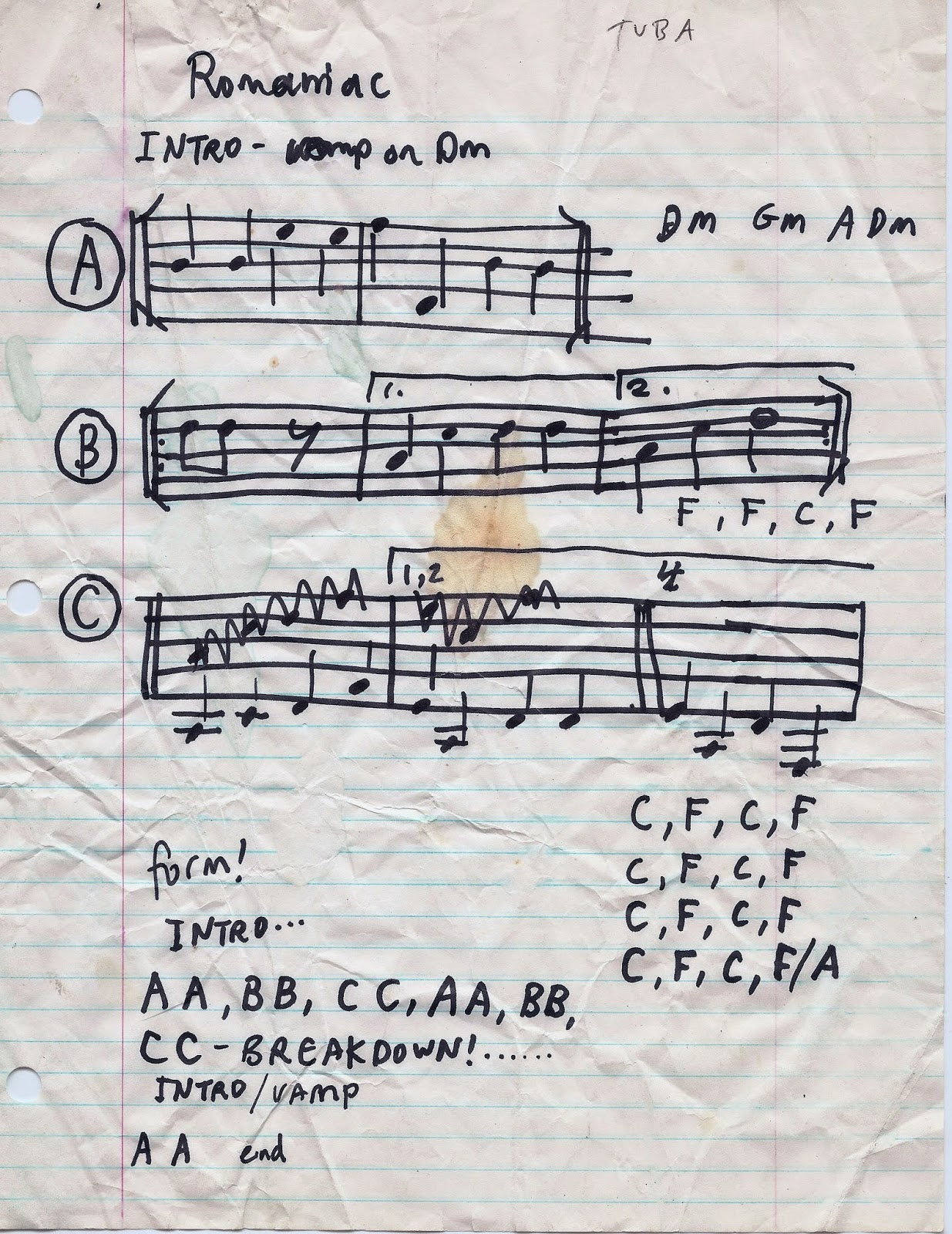
Found crumpled in the bottom of my tuba gig bag. One of a few "charts" written out by Josh "don't call me DJ" Dolgan for a performance at the International Accordion Festival in San Antonio TX, October 2010. I didn't have the heart to tell him I can't read music. But I think this was more a emotional guide more than a musical notation, maybe? I was asked to do a write up for the Arty Semite and it was eventually published.
"Reviving and Reconnecting with a Vanishing Culture" by Mark Rubin Learning about culture and traditions can be a tricky business in the best of circumstances. If you were interested in, say for the sake of example, traditional Irish fiddling, you could theoretically pack up, grab a flight to Ireland and head off to County Cork. There you could to sit in on any one of the innumerable music sessions that can be found at any number of local Pub, soaking in the tunes created entirely within its element. In the course of your time there, you would hear the Gaelic ballads, taste the beer and pie, see the rolling country side and meet the other people there enjoying the good times that the music created with it’s community. If you were lucky, after all the fun you might even get one of the old lads to show you a bowing trick or two. You would come home to New Mexico or Indiana or wherever you come from, probably with a deeper level of understanding of Irish music. It would most likely inform the way you play the Irish tunes and think about Irish culture. For the descendants of E. European Ashkenazic Jews eager for the same experience of connection to one’s traditions, there is however no “old country” to visit. If one were to return to our homelands, outside of overgrown cemeteries and a few disused synagogues, you would hardly find any indication that Jews were ever there, much less find anyone sing us a song or fiddle us a tune. To complicate matters, in the post War years American Jews very successfully assimilated into the greater American culture, shedding their language and great many of their customs in the process. If that wasn’t enough, with the creation of the Jewish State of Israel in 1948, the Hebrew language with it’s attendant “Israeli” music and dance all but effectively replaced what American Jews considered “Jewish” cultural identity, though it is a language and vernacular that our Yiddish and Russian speaking grandparents would hardly recognize. It’s within this conundrum that Living Tradition’s annual “KlezKamp” was born. For the last week of the year, a sleepy corner of the Catskill Mountains is transformed into a Yiddish speaking “Brigadoon” of sorts. There you’ll find the greatest practitioners of what was at one time considered a “dead” language and all the aspects of the culture that sprang from it. Originally billed at the Yiddish Folk Arts Program, it’s founder’s informal nickname “KlezKamp” has stuck and for 22 years its dedicated staff have done nearly the impossible. It has over last two decades effectively rescued, revived and nourished what is today a full blown International re-appreciation of Yiddish Music, Dance and Culture. It’s an unlikely story but the seeds of this Jewish Culture rebirth start in rural Appalachia. KlezKamp founder Henry Sapoznik, known to many in the old-time country revival community as “Hank,“ is noted five-string banjoist having been among the first waves of Yankees who headed to the hills of rural North Carolina in the early seventies, seeking out hill-billy music as played by the genuine articles. As a student of such notables as Tommy Jarrell and Fred Cockerham, Sapoznik had imbibed their playing styles and then in turn helped present them to an eager new audience of Folk music devotees in NYC and other urban areas. As a banjo instructor he attended various music camps that sprouted up in the wake of the Eastern “Folk Scare” and in that experience became aware of the power of the intensive immersion approach to the transmission of culture.
Henry "Hank" Sapoznik, Founder and Director
Conversely, it was at Tommy Jarrell’s innocent prompting (“Don’t you Jews have music of your own?”) that led Sapoznik to examine his own musical heritage, and in doing so a whole new yet familiar path. The son of a famous cantor and a native Yiddish speaker, he hadn’t properly realized that growing up he was completely surrounded by a vibrant Jewish environment, rich with it’s own Yiddish “Tommy Jarrells” as it were. It eventually led his to form Kapelye, a seminal group at the forefront of the clumsily titled “klezmer” music revival, and to a job in 1982 as sound archivist at YIVO, the Yiddish Cultural foundation and archive first founded in Vilna Lithuania in 1925 and now located in New York City after WW2.
These converging streams came together into a single idea. “The model was the music camps, having taught at Jay Ungar’s Fiddle and Dance Camp at Ashokan and then attending a Balkan music camp at the same location. I asked myself: What are they doing? They were almost entirely peer-driven events populated with instructors who were not from the communities of which they were teaching, in other words outsiders teaching other outsiders. One positive thing about having that kind of teacher is that they can present a culture to students on their own terms, they can keep the experience at an arm’s length in some ways.” Many of these “outsiders” were in fact like Sapoznik, Jews themselves. At a camp dedicated to southern old time banjo and fiddle music it’s an easy bet there would be little interest in Jewish tunes. But strangely at the Balkan week, where many of the instructors were also Jewish and well versed in all the many East European folk musics, the very place where you might think East European Jewish music would be well understood even celebrated, you couldn’t find it at all. Ultimately what Sapoznik felt was missing from these music and instrument themed camps was the greater context of the culture that created this “folk” music in the first place. “It seemed a big departure from the way folk traditions are actually passed on. As much as I liked working with my peers” said Sapoznik “I wanted younger players to have the same experience I had: learning directly from senior musicians so they would get an accurate take on what this music was all about.” Additionally, at these camps there seemed to be little recognition that music, ultimately, is only one small facet of the many sided diamond of a complete culture. What Sapoznik realized early on was that to better transmit the essences of Yiddish dance and music, one so endangered in fact, you must also immerse its participants in all the many arts associated with Yiddish life; the visual arts, theatre, poetry, food, customs and literature. His original concept was to have a program of Yiddish cultural events that was the pay-off if you will to be attached to the end of Columbia University’s Six-Week intensive Yiddish Language program. Literally a summer camp, it was envisioned as a week-long event where the contextual framework for the speaking of Yiddish could live in a perfectly natural way. A way that was pretty much in a state overall decline, along with those who spoke it natively. “Our hope was to create this whole cultural environment, a place where the abstract of learning the language could be put into actual practice. The music was the hook, but the bridge was to the language,” said Sapoznik.
Adrienne Cooper (z"l)
By 1984, YIVO’s then assistant director, and noted Yiddish singer, Adrienne Cooper enthusiastically supported the idea, and Sapoznik started to look for instructors. The first slate of staff included the well-known singer-author Ruth Rubin, Romanian violinist Leon Schwartz, singer-folklorist Bronya Sakina, clarinetist Max Epstein as well as the younger revivalist musicians Michael Alpert, Hankus Netsky and Lauren Brody. A one time secular Yiddish summer camp turned New Age retreat was secured and a date set for August, but ultimately fell through when the camp asked for more money at the last minute. Hoping not to loose the momentum, Sapoznik and new KlezKamp coordinator Becky Miller hurriedly retooled for a winter event of the same year, now scheduled for Christmas week in fact. The choice of Christmas week was a novel one, as most Jews were off doing nothing for the Holiday anyway and the resort was wide open for the week. “No other time of the year alienates or marginalizes Jews more” wryly noted Sapoznik. After a long search they located the Paramount Hotel, a faded rose of a Kosher resort in Parksville NY run by an affable man who’s last name “Gasthalter” is actually Yiddish for “Hotel keeper.” The Paramount was an unlikely assemblage of mix-and-match buildings all connected by a labyrinth maze of hallways with low ceilings. Having seen better days, a booking at the slowest week of the year was much appreciated. With its kosher kitchen, mezzuzot on every doorway, an amazing grand ballroom and a Yiddish-speaking Puerto Rican staff, the rural Paramount became the perfect setting for a cultural revival. The first year saw 90 registrants and a staff of 30 and the second year nearly 150. The demographic of the attendees at first closely mirrored that of the younger staff, mostly musicians, but that was to change. As the word spread of a Yiddish outpost poking its head up in the old Catskills, more and more older folks started showing up. These were sixty to eighty year olds, people who had grown up in a Yiddish culture and were now able to celebrate its re-appreciation. As few of these kampers were musicians, the curricula were expanded to include more folklore, historical context and the like. Their mere presence added considerably to the available pool of Yiddish experience and more than one young person, instructors included, were put to rights by someone who actually lived in a Yiddish context. In 1987 Lorin Sklamberg, singer with the Klezmatics and long time Gay rights activist, was brought on to replace the departing Miller as KlezKamp coordinator. This may have led to another notable, if unanticipated, addition to the demographic of attendees with the presence of openly Homosexual Jews. Long left out of Jewish cultural life in most other venues simply because of their sexual preference, and marginalized in leftist circles when Anti-Zionism often masks Anti-Semitism, Gay and Lesbian Jews found a friendly and open environment focused on Yiddish culture, essentially free of any of the traditional prejudices associated with it. As was actually discussed at a KlezKamp lecture one year, the term “klezmer” as it turns out is actually a clumsy one, and not a all accurate. As it turns out, even though it’s Hebrew roots are in the words “Kley” and “Zemir,” meaning literally “vessel of song,” in it’s actual Yiddish context the term would more accurately describe a very poor musician. “Really a bum, you know the kind of guy who can scratch out a tune or two on a fiddle but can’t really play. No real musician would allow himself to be called that,” advised legendary clarinetist Dave Tarras. “I’d pop you one on the nose,” added veteran clarinetist Joe Borrock. The term had been used to describe the re-introduction of a mix of Yiddish music, folk song and theatre music sometime in the 70’s. By then however, the name had been applied to the more appropriately described Yiddish-American music for too long to reel back from the public consciousness. Just one of the many things you pick up from the lectures presented.
Sidney Beckerman and student, 1996
While the music staff has always been high visibility, it was the contextual staff - folklorists, language instructors and folk artists – which gave the program its solid superstructure, The prime directive that teachers of Yiddish should be native speakers themselves has meant that their lucky students have learned the language not from someone who simply studied it in college, but by someone from that world whose regional dialect is still intact adding immeasurably to the student’s learning experience. In the early 90’s these folklorists developed a "Junior Folklorist" program wherein children in the KlezKids program were sent out to interview and document the senior members of the KlezKamp community. Traditional handcrafts (paper cutting, calligraphy, textiles, ect,) and even culinary skills are passed on by senior members of the community or through KlezKamp Staff apprenticeships were with those great Masters.
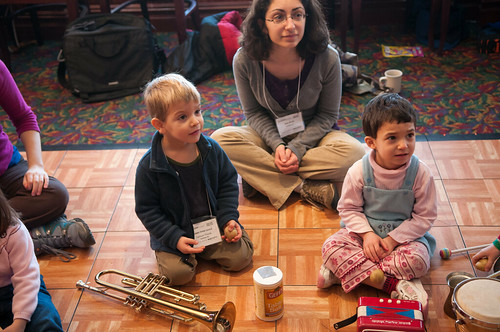
There is no greater example of the greater mission of KlezKamp than in it’s “KlezKids” program. Originally set up for the children of adult participants, it celebrated the milestone last year with as large an enrollment as did the whole event in it’s first year. Sapoznik explains, “We took the outmoded, socialist ‘kindershule’ model which celebrated Yiddish culture but which took no note of traditional folk literacy and reintroduced the old time music, song and other elements of the historic culture and created age appropriate kid programming. This not only served the short term function of allowing their parents to take advantage of the full KK programs, but also positioned Yiddish culture to be cool and hip to these kids and, miracle of miracles, set up out own “farm” system from where these kids grew up to be teachers and musicians themselves, not only at KlezKamp but in their home communities.”
"Ooomchiks," future proud Yidn
It’s been an outstanding success on many levels. “We replaced the eye-rolling ennui of most kids to the culture and values of their parents and hot housed a generation of eager, motivated and culturally equipped young people for whom Yiddish culture is not seen as a burden but a valued birthright,” notes Sapoznik. Over the years the musical staff of Klezkamp has acted in a double capacity in first providing a lecture demonstration setting for older master musicians to teach and be appreciated but also to create a workshop environment for younger generation players to foster their creativity. Nearly all the of ‘leading lights’ of modern “klezmer” music got their start there, and almost all began simply as students. Sucessful bands have formed, performing careers started and lifelong musical relationships have cemented in the hallways and classrooms of the Paramount. However true to it’s founding principals the KlezKamp world, like on the bandstand at a dance, is musical mertiocracy first and foremost where there is often little distinction between the teacher and the student. Much like that session in County Cork, the music is for once now created within its natural habitat. It provides a depth of experience and understanding that cannot be replaced in a classroom setting. Thus many gifted young musicians find themselves carted up on the bandstand for the evening dances, playing right along side the greats.
And there have been many greats. Clarinetists Max Epstein, Sid Beckerman, Ray Musiker and German Goldenshteyn. Sax giants Howie Lees and Paul Pincus. Drummer Elaine Hoffman and.Pianist/arranger/raconteur Pete Socolow. Many of whom had until they came onto staff, thought their usefulness over and their contributions largely ignored. A unique hurdle for the KlezKamp staff to contend with is the “500 pound Gorilla” of Yiddish Cultural context; it’s unavoidable attachment to the Jewish religion. Observant or not, Yiddish culture has always been intertwined with Jewish religious custom and practice. “You can’t have a Jewish event that some Jews can’t go to.” Says Sapoznik. Thus for instance, the meals served are Kosher and there’s no work (or playing of instruments) on the Sabbath in large public spaces. To the non-Jew, and many assimilated Jews as it turns out, it comes as quite a shock when depending on the calendar, the whole event comes to a complete halt to from sundown Friday to sundown Saturday night. But because it is replaced with equally compelling, and culturally compelling programming, even the most music-centric camper has plenty learning available to soak up.
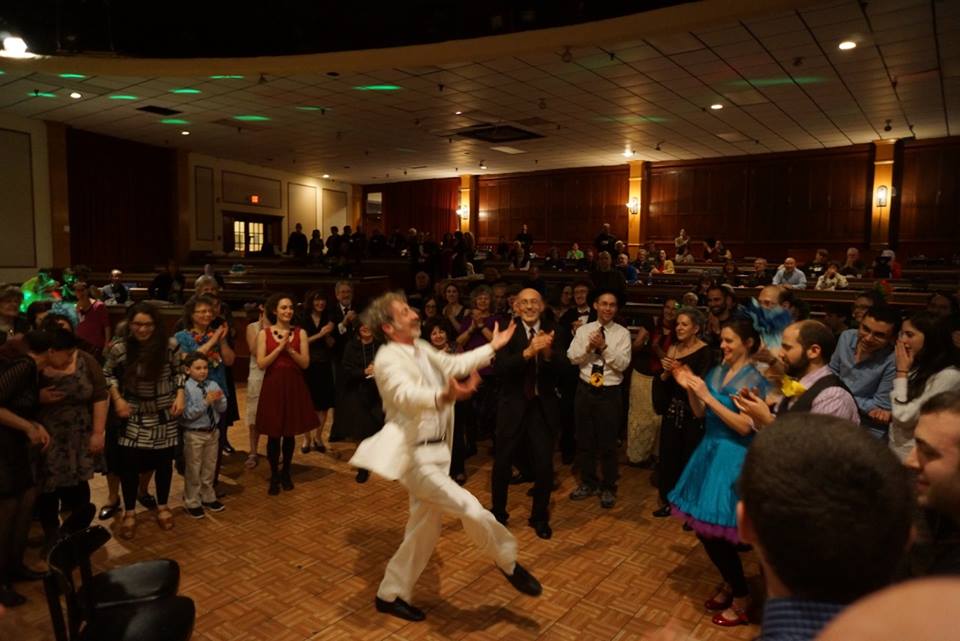
Tanzmeister Steven Weintraub
You certainly don’t have to be Jewish to attend, but as the old joke goes, it certainly helps. Music and dance fans of all back rounds have made the trek to the Catskills and come away just as affected. “The people who have the biggest paradigm shift are non Jews who are experiencing Jewish culture in possibly a new way. They actually appreciate the fact that it’s Kosher, not “Kosher-style,” its actually as close as they will get,” notes Sapoznik. European klezmer enthusiasts have probably made the most impact by means of diversity over the years. With not just a little bit of irony, a great many of the Europeans who regularly attend KlezKamp are from places where the original culture in fact never existed or, like Germany, where this very culture was all but destroyed. At this year’sKamp you will find classes taught a very fine Jewish clarinetist, well versed in Yiddish performance styles, who just happens be from Germany who just happens to be named “Christian.” Irony hides around every corner. This pressure cooker environment, coupled with the claustrophobic confines of the resort setting, has led many participants to what some call a “Klez Kamp Moment.” That moment when all the wheels of the Kamp activities events have been spinning for a few days, and all the dots have been connected, to where the depth of the culture that is being presented finally sinks in. It can create a deeply personal and moving experience for some. An experience made even more bittersweet when you realize how much of that life as disappeared through attrition, anilhilation and assimilation. Much like a “Yiddish Marine Corps,” a successful kamper comes stripped away of his preconceived notions and then is thoughtfully rebuilt ground up seeing themselves as a member of a greater, living world of Yiddish expression.
Sherry Mayrent, Founding Director of the Mayrent Institute
The “mother ship” of KlezKamp was lost in 1999 when the Paramount Hotel burnt to the ground in an electrical fire. When the owners announced they were not rebuilding, the staff was left with a dilemma. Thanks to the intercession of a veteran KlezKamper, in a bold move the entire event was relocated to Cherry Hill NJ, a traditionally Jewish suburb of Philadelphia. This period also marked the world premiere of Sapoznik’s “Yiddish Radio Project” which went on to air nationwide on NPR, representing the widest audience to ever experience Yiddish language and culture in the United States. A well-received stage version, featuring a stage band made up of both master musicians and their students, toured nationally afterwards.
2001 saw the arrival of Sherry Mayrent as the new Executive Director, as Lorin Sklamberg stepped down to tour his increasingly popular Klezmatics. But like the loss of the "Old World" in favor of the new, many verteran Klezkampers bemoaned the decamping from the Catskills in favor of an industrial strength hotel in a Pennsylvania strip mall. In 2003, the event returned to their ancestral homeland of the old Yiddish Resorts and now resides at the old "Granite" Resort, now known as the Hudson Valley Resort Center in Kerhonsken NY. Living Traditions, the parent organization of KlezKamp has recently started a record label dedicated to preserving some of the musical moments that have occurred at Kamp over the years. The most recent release may be it’s most important one yet, a collection of the repertoire of Moldavian clarinetist German Goldensteyn. German’s playing brings to a new generation of students the sounds and songs of the Moldavian-Russian Jewish experience. Orphaned by the Nazi’s, and a veteran Red Army Bandsman, German’s music notebooks contained literally hundreds of Jewish tunes heretofore unknown to American audiences. Long time kamper-turned-instructor Alex Kontorovich, a Jewish Russian émigré and clarinetist himself, served as German’s translator and “second” for several years on staff, carefully studying his style and techniques. With Kontorovich as producer and converting an unused bedroom into a makeshift studio, German and members of the KlezKamp staff recorded a scant 20 tunes from his repertoire during lunch and dinner breaks. German Goldenshteyn’s debut recording “A Living Tradition” was released commercially only a few months later. Tragically German died of a heart attack while on a fishing trip only a few days before a European concert tour. He was only 71. Kontorovich is currently overseeing the publishing of a collection German’s music books to insure his rich legacy will be disemminated. His is but one example of just how ephemeral culture can be. Without the living breathing tradition bearers in our midst and available for comment and context, the work of KlezKamp becomes all the more essential.
The first Klezkamp release
In recent years the growing acknowledgement of interest in things “klezmer,” a situation KlezKamp can rightly be credited with, it has spurred quite a few imitators. If as the poet says, imitation is an expression of flattery, KlezKamp is a very flattered event indeed. Today you will find similarly fashioned events all over the US and the globe from, Canada to England and even points east. (In one notorious example, KlezKamp sing along songbooks were handed out at a copy-cat “Kamp” with only the Living Traditions letterhead clumsily whited out.) With its 22nd anniversary this December, KlezKamp now has come to a place of some sardonic irony. It has actually become so successful, so transparent in its stated goals of reviving and nurturing a living breathing Yiddish culture, than in fact it is now pretty much taken for granted. Taken for granted in many cases even those whose professional musical careers were born and informed there. By remaining true to it’s stated mission: fostering a holistic “ground up” approach to cultural presentation and preservation, and then purposely eschewing a “star personality” policy in their staff hiring, KlezKamp has in some ways made itself passé within it’s own community. The “Village,” or “shetl” more properly, that KlezKamp has created continues every year to feed and support what has now become an international re-appreciation of the totality of Yiddish Cultural Arts. After so many years of so successfully creating culturally literate “graduates,” a typical participant is more often not surrounded in class by people who will one day in fact have learned the lessons taught there, expand upon them and then return to give back to a new generation of campers. With the precious few living masters of Yiddish life leaving us every day, German Goldenshteyn our most recent example, the depth of experience that KlezKamp offers becomes all the more poignant and important.
“We can only hope that through this process, we have enabled selfless translators of the continuity. If we done our job well then we’ll have that continuance for future generations,” says Sapoznik.
The final Catskills KlezKamp will be at the Hudson Valley Resort, Kerhonkson NY, December 23-29, 2014
From the BDAA Newsletter, "the Official Journal of the Balalaika and Domra Association of America," September 1997.
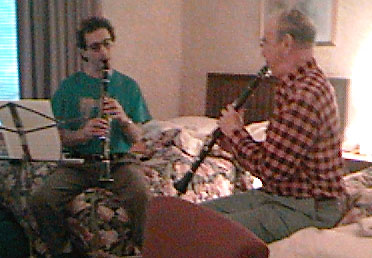
Shared here today is an interview with Jewish Moldovan musician Martin Kalisky. Interesting conversation which evidently included mandolinist Mike Marshall and touches on Andy Statman's beginnings in East European music. When I was first interested in the mandolin in "klezmer" music, several folks in the "International Folk Dance" community recommended I find Mr. Kalisky, but alas he passed before I could meet him. His influence lives today however in the hands of anyone playing Yiddish music on the mandolin.
Note: The live music business is at its slowest during these hot summer weeks here in New Orleans. If you're a tourist you're in luck because you have the whole town to yourself. But for those of us in the live music industry, well, lets say this is a "quiet" time. Good time however to look back at the old MarkRubin.com website & revisit a few topics. This week I found this review of Hank Bradley's book from over 15 years ago and it holds up well over all time. I understand Mr. Bradley even has a gig in Seattle this week (7/17/14) that if you can attend, you shouldn't miss.
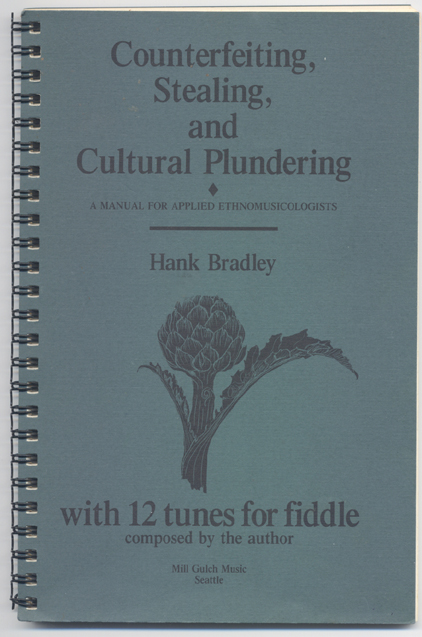
Counterfeiting,
Stealing, and Cultural Plundering: A Manual for Applied Ethnomusicologists,
with 12 Tunes for Fiddleby Hank Bradley
Mill Gulch Music Press, Seattle
WA 1989
Hank Bradley, AKA The Poison
Coyote Kid, is a multi-instrumentalist/cultural critic of ferocious talent and intellect living
and playing in the Seattle area. At a jam session I attended many years ago he played
hours of guitar backing up Romanian and Greek fiddlers in oft impenetrable time signatures
and then turned to me, whipped out a fiddle and ripped through Bob Wills' most arcane and modal version of "Done
Gone," just my kind of player. A wise music fan would be on the lookout for his singular LP release,
"The Return of the Poison Coyote Kid," which features the greatest song ever penned about a Hot Dog stand ("The Mayor Is A Good Old Boy.")
Mr. Bradley hinted to me that little book got him
in a bit of "trouble" when it was first published as many folks still
avoid eye contact or give him a wide berth at festivals and other
gatherings of "folkniks." As he explained it to me, he intended it simply
to be a handbook of good manners designed for those folks who ran off into
the hinterlands looking for old people they could hassle about music.
His reflections on cultural differences between the applied ethnomusicologist
(Yankee in this case) and the tradition bearer (a Southerner, closer to my experience)
especially caught my attention, using "Villages" to stand in for cultures: "Consider a Brooklyn bluegrasser
at a 1970 Virginia Fiddlers Convention. A northern villager knows you're
supposed to take public transportation, resist US war involvement, minimize
meat and junk food consumption, excoriate polluters, and meet women and
all socially conscious people as fellow and equals.
Oh yes, Bad Livers are in part responsible for this, I'll cop to it.
Whereas southerners
know that construction pays best and everybody's OK in their place, and
that you're supposed to drive with courage, respect your cousin in uniform,
hunt well, shoot straight, suspect the cosmopolitans, hold your alcohol,
be gallant to the ladies when appropriate, and be a connoisseur of good
prime rib.
If these villagers stick to musical topics, all will go well
enough socially, but if not it is easy to see how a heartfelt opinion on
either side might lead to hurt feelings and hostility on the other." As a Southern Jewish Bluegrass musician, I often found myself in the presence of folks at a picking
session who would normally be burning a cross on my front lawn, (not a joke, BTW) so I could
really relate. And these many years later, very sad to report, Bradley's warnings still seems to hold true. Just last year (2013,) a Texas fiddler I brought up to instruct at a very well known fiddle camp in the economically well off, socially "liberal" North West US had more than a few attendees going out of their way to make him feel very uncomfortable for holding the very sorts of opinions that in fact made him an authentic, living voice of his community. Lead to some mighty "hurt feelings" all around, I can assure you.
For somein the "traditional folk" community today it appears, there is still a glaring disconnect between the creative output of a living culture and what it is that actually makes the life that creates that culture's very output. "Just teach me the tune, I don't need to hear about what the tune is for..." is a phrase I've heard more than once as an instructor at a music camp. It's expressed in a way that I think isn't intentionally malicious, but sure could be seen that way. And worst still, its needlessly pointless, as it contributes to drawing people apart rather than focusing on the one thing music does best: bring us all together. **
White Top Mountaineers, maybe TOO authentic?
It many ways this mirrors my experience of performing Yiddish Music in Europe and points East: Happy dancing Jews on stage, great! Not so happy Jews coming back to take back their dead relatives apartment? No so great.
Not that long ago it was literally impossible for me to interest my local folk club in Austin TX in a rare performance by actual traditional bearer fiddlers from White Top Mountain in sponsoring even a little house concert, but they got real worked up about a foreign immigrant who plays their own version of American music. What's the take away from that? Must traditions be filtered and refined by outsiders before they are fit to be enjoined with? It's hard not to see racial and class prejudice behind such glaring disconnects, as the tradition bearers themselves never seem to mind who comes to learn from them. It's a troubling question on many levels.
But Mr. Bradley is wisely unburdened by others baggage as well. Hank is famous (infamous?) for presenting
his original fiddle tunes as "learned from some old master he found in the
hills somewhere," duping a hoople in the process and teaching them a fine lesson all at the same time. The last chapter of this thin tome includes 12 of these tunes with titles
like "Dance of the Music Critics" and "Chase the Squid," and they are well worth your time in learning. Chock full of interesting insights on the process of the
"folk revival," and a overall great read.
Copies
can be secured contacting the publisher, 8033 14th Ave NE, Seattle WA 98115. Or simply email him here.
** (Possibly the "camp" model contributes to this contextual break, knowing full well these pointed political jabs would be very much out of place where this music is created and nurtured? Another conversation for another time. I run a camp of my own now, so its something I think a lot about.) :-)
I've seen online, without confirmation, that bassist/composer Charlie Haden has passed. Let's assume he hasn't, because that would represent a major loss to the firmament of American music and would make me very sad, but allow me to share my experiences with him assuming it's not true.
When Bad Livers were out there all by our lonesome, charting new courses out in the music world, we had the occasion to run into Mr. Haden more than a few times. He was always gracious, cordial and friendly and took a real interest in my playing, giving me much needed encouragement. When we first met we were both backstage at a street festival in Atlanta. He came from a folk music family and he told us how he appreciated what Danny and I were doing to live within the music, yet propel it forward, making it relevant to contemporary audiences. On one occasion in NYC, he was to be interviewed by the Jazz DJ and we were playing a live set for tail end the Folk DJs show.
At that time Danny and I had stripped the live show down to just banjo and bass, with long stream of conscious jams, weaving together our tunes with material Big Bill Broozy, Monk, Jimmy Martin and Sun Ra. Going out on limb every time. There he was, behind the glass standing up as to catch the scene. Dark glasses in the middle of the day, with a huge smile plastered on his face. "Man, that was out of sight guys." he told us as we were packing up to make way. "You were cookin'." He was a bit of a gear freak, as many bassists are. "Hey man, I see you got Golden Spirals on your D and G. Good choice. So, hey, uh you got anymore?" LaBella stopped making these nylon wrapped gut strings a few years earlier and no other string on the market then was even close. "Why yes sir, I do." I reached into my case and pulled out a brand new-dead stock G string I had found in ratty box of odd strings in Lawrence KS just the week before. "With my compliments," I said as I laid it on him. I reckoned he could make better use of it than I.
I guess I should also mention that I saw Charlie many many years earlier, but had no idea what I was seeing. I had come to see the minutemen in Santa Monica in 1984. Still not sure what I saw however.
I'll be dialing up "Steal Away" tonight and remember a really class act.
I've worked with many many wonderful jazz musicians over the years, in many many wonderful situations. But for some reason, none of these cats ever once considered me a "jazz" man nor ever hired me to play improvisational or spontaneously composed musics.* I was always "the bluegrass guy" or the "klezmer guy" or the "polka guy" or worst of all "the Trad guy." Was I incapable or that level of craft? Maybe so. But please understand however that even I realize that I was entirely responsible for that opinion of me and must take full responsibility for. I sure went out of my way to let folks know what opinion I held the "self expressive" free jazz and jam band musics I had encountered. Talked my way into a box I reckon. Hell, I take exception to the very term "jazz," but that's another blog post entirely.
But recently I was reminded of my short lesson withBuell Neidlinger, (this gets its own story soon) who I met in Pt. Townsend Washington at a Bad Livers show. And from that recollection I was led to remember the dreamlike state and entirely unspoken level of total creative "freedom" that I felt and expressed onstage musically for a great many years with my Bad Livers musical partner Danny Barnes. Only now through the filter of time can I get a good picture on what a gift it was to share music in that way. Damn glad I left myself kvell a bit about it. It's good to give yourself a break, if you can.
I present the attached video for your consideration. For contexts sake, bear this in mind. This was videoed in 2009. Aside from a single 45 minute set at the Hardly Strictly Bluegrass Festival the year before, this was the first time we stepped onstage in 9 years. 8 of those with no communication of any kind, at all. When we last worked with each other, Bad Liver shows had evolved into a 2 hour stream of consciousness presentation of musical dexterity and humor, anti-academic alternative histories and narrative delivered unironically entirely informed by the deep traditions of Southern elocution and storytelling and a really great stand up act, honed by a decade of 200+ dates a year on the road in front of mostly confused, sometimes charmed but oft unpleasant audiences.
For our 2nd set this night in SF. We just walked out, looked each other in the eye and started. It starts with Monk and ends with Narciso Martinez, much like one of our mix tapes in the rental car, usually board tapes from my "Overnight" shift on KUT Radio for a decade. Nobody ever trusted me more than Barnes. I'd take a bullet for him, even today. For reals.
Years earlier, we tried to capture that live show vibe on tape by setting up a couple mics in my old wooden house in Austin (nestled in the Ridgetop neighborhood, hence the name.) My little pal Lance the Wonder Korgi wrapped himself around the mic stand at my feet and we hit record on a DAT machine. Got a call from my old pal Dan Foster, and Lance speaks up a few times, but other wise it's just exactly what we presented live for at least the prior 3 years. We called it "The Ridgetop Sessions," and it's still available today on CD Baby. (yeah, the Mad Cat Trio CD got re-issued too!) :
* I make the notable exception of composer/percussionist Aaron Alexander, who did in fact put his trust in me and made a member of his "Midrash Mish Mosh" ensemble in 2004. He and his compositions loom large in my psyche and I am forever grateful.
I've been thinking a lot about patronage and peonage these days. Times are such that the arts are required to make their own way or simply go away. Everyday someone tells me how they heard my music on Spotify, and I guess that's cool. But they used to say that they bought my CD and enjoyed it. Now the trend is to not buy anything and just stream it all. Great for the listener, but it begs the question: Why should the artists continue to create content for a community that doesn't value it, even when they claim they enjoy it? Are we only to enjoy art made by the idle rich, the only people who can afford to produce it? I spent over $3000 on my last CD release and have to date recouped less than $500. Are my releases simply vanities? Dynamic conversations on every end of the question.
But frankly, I'm too old to get into all the arguments. All I can do is say "Here's my catalog." If you like what I've been putting down all these years, then let me know the only meaningful way you can in our present society and buy something. Anything. Every little bit counts, even the .0057 cents I received from a years worth of my music streaming on Spotify:
"Texas
fiddler Sean Orr and Texas-based, Okie guitarist Mark Rubin say there's
no "right" way to play Texas fiddle, but they're wrong. THIS is the
right way to play Texas fiddle. Full of heart, brimming over with
camaraderie, rough-hewn and rowdy, dusty as hell, and beholden to no
man. There's a freedom in this music and a powerful sense of love. All the things that make Texas great."








 At a jam session I attended many years ago he played
hours of guitar backing up Romanian and Greek fiddlers in oft impenetrable time signatures
and then turned to me, whipped out a fiddle and ripped through Bob Wills' most arcane and modal version of "Done
Gone," just my kind of player. A wise music fan would be on the lookout for his singular LP release,
"The Return of the Poison Coyote Kid," which features the greatest song ever penned about a Hot Dog stand ("The Mayor Is A Good Old Boy.")
At a jam session I attended many years ago he played
hours of guitar backing up Romanian and Greek fiddlers in oft impenetrable time signatures
and then turned to me, whipped out a fiddle and ripped through Bob Wills' most arcane and modal version of "Done
Gone," just my kind of player. A wise music fan would be on the lookout for his singular LP release,
"The Return of the Poison Coyote Kid," which features the greatest song ever penned about a Hot Dog stand ("The Mayor Is A Good Old Boy.")