My Jew Band has released a DVD of this famous/infamous film with our own sound track.
It's out. It's great.
And here's a review.
4/29/05
2/20/05
"The Brotherhood of Brass"
Thought I'd share this with you all.
For the last 3 years, I've been travelling to Europe as a member of Frank London's Klezmer Brass All Stars, playing all over Central and even Eastern Europe.
It's been quite an amazing for me journey musically, culturally, even spiritually, not to mention physically. Our tour schedule just last year took us from Vienna to Belgrade, from Riga Latvia to the small village of Vladichin Han, just a few miles from the Serbian border with Kossovo. I just returned form a concert in Chemnitz Germany, and in June will return to Vienna, by popular demand, to open the famed Weiner Festwochen as well as a concert tour of Italy.
One of the highlights of my experience with this group has been our collaborations with the Boban Markovic Orchestra, Serbia's finest Gypsy Brass Band. We recorded a CD with them, "The Brotherhood of Brass" in Budapest in 2001, which was released the following year on the Pirhana label. Just last year, we recorded a track for their latest CD "Boban I Marko" in Belgrade.
That CD was featured on NPR's "The World" recently, and just in case if you missed it, I've included a link where you can hear the story as it was broadcast, including the tune we recorded with them: and old Hassidic melody given the Gypsy treatment.
I've also posted a photo diary of our trip to Serbia, including the recording of the CD. You find even more photos from our many trips posted here as well.
It was quite an experience travelling Eastern Europe and Austria with Gypsies. Not always a pleasant one at times, made all the more chilling by the recent horrific treatment of the Rroma population in the Czech Republic, and news that the Austrian Government is building jails in Romania to house "Romanian criminals" (mostly Rroma) outside their own country. Anywhere that you can openly discriminate against gypsies and other "outsiders", you can be sure that Jews can expect the same treatment eventually. All I know how to combat this ignorance is to continue to return to Eastern Europe and elsewhere, identifying myself unabashedly as a Jew and attempting in my own small way as a musician to illustrate those things that bind ALL peoples together, rather than what makes us different. I invite you to visit this site with links to Rroma Rights organizations.
I also have quite a few things to share with you about the Jewish community of Belgrade, but that's a whole other story and you may contact me off line about that.
Shabbat shalom, and best to you!
Mark
For the last 3 years, I've been travelling to Europe as a member of Frank London's Klezmer Brass All Stars, playing all over Central and even Eastern Europe.
It's been quite an amazing for me journey musically, culturally, even spiritually, not to mention physically. Our tour schedule just last year took us from Vienna to Belgrade, from Riga Latvia to the small village of Vladichin Han, just a few miles from the Serbian border with Kossovo. I just returned form a concert in Chemnitz Germany, and in June will return to Vienna, by popular demand, to open the famed Weiner Festwochen as well as a concert tour of Italy.
One of the highlights of my experience with this group has been our collaborations with the Boban Markovic Orchestra, Serbia's finest Gypsy Brass Band. We recorded a CD with them, "The Brotherhood of Brass" in Budapest in 2001, which was released the following year on the Pirhana label. Just last year, we recorded a track for their latest CD "Boban I Marko" in Belgrade.
That CD was featured on NPR's "The World" recently, and just in case if you missed it, I've included a link where you can hear the story as it was broadcast, including the tune we recorded with them: and old Hassidic melody given the Gypsy treatment.
I've also posted a photo diary of our trip to Serbia, including the recording of the CD. You find even more photos from our many trips posted here as well.
It was quite an experience travelling Eastern Europe and Austria with Gypsies. Not always a pleasant one at times, made all the more chilling by the recent horrific treatment of the Rroma population in the Czech Republic, and news that the Austrian Government is building jails in Romania to house "Romanian criminals" (mostly Rroma) outside their own country. Anywhere that you can openly discriminate against gypsies and other "outsiders", you can be sure that Jews can expect the same treatment eventually. All I know how to combat this ignorance is to continue to return to Eastern Europe and elsewhere, identifying myself unabashedly as a Jew and attempting in my own small way as a musician to illustrate those things that bind ALL peoples together, rather than what makes us different. I invite you to visit this site with links to Rroma Rights organizations.
I also have quite a few things to share with you about the Jewish community of Belgrade, but that's a whole other story and you may contact me off line about that.
Shabbat shalom, and best to you!
Mark


7/20/04
My 2 hours as a Columbian Vallenato Bassist
"aka done stranger things, but can't rightly recall when"
OK, so there I am at the Lowell Folk Festival. Jet lagged, worn out from a busy week at my violin shop, and looking to be a bit drunk on my new home infused vodka. Mark Halata and Texavia, the group who I've come to play with, has just put in a fine solid set of Texas- Czech Polka, C&W and assorted Gulf Coast sounds to an very appreciative dance crowd.

I decide to stick around and check out the next act, Sensacion Vallenata con Gustavo Nieto from the DC area. Now I'm a big fan of vallenato, a Columbian accordion based dance music that gave the world the "cumbia," and I have a couple of CD's that date from the classic 70's era when the music first started getting attention outside of it's home. I really dug the way the bass seemed to lazily lope through the tunes, working in conjunction with the percussion. Relaxed and behind the beat like old-school Reggae for instance. My pal Mike Maddux even has a vallento band here in Austin that I enjoy seeing. He's informed me however that the music has progressed quite a bit from the old records I like so much, with a VERY active and busy bass style. (For lack of a better analogy: I like the marijuana bass, and it's the cocaine bass favored today, if you will;-)
Having never seen a real live Colombian playing the new complex style, I begged off returning to the hotel for a much needed rest and hung out on the side of the stage with the amiable monitor mix man. We watched the band set up and immediately there seemed to be a problem. No bass player. They were all set up ready to play and there was no sign of the bassist (or their lead singer as it turned out.) Now I don't speak much Spanish but I did wave the accordion player over and inquire. He tells me, I think, that the bass player drove up from DC and got caught in a storm and was running late. He was mighty upset about it.
Well says I, "Yo toquar el basso, in estilio de Tejano." "Vamanos!" says he.
As I amble onstage I note It's a good sized band; with accordion and 4 percussionists and vocals all around. I can see in their eyes that they are spooked. It's a big festival gig, and 3 members of their band aren't there for the down beat on the big dance stage. Then some goofy looking Guerro in a cowboy hat crawls up on stage and sets up a bass amp. It must have been unnerving. They had a large plastic bottle of "Coke" which was actually the best Rum I ever had, and everybody was taking a hit to calm their nerves. They put me between 2 percussionist and only one spoke much English. The accordionist turns to me, gives me a key, plays a bit of the melody and then we're off.
OK, let's go back to what I noted before. I dig the "classicos" style of laid-back cumbia and I even know a few hits ("El Gota Fria," "Matilda Linda," etc..) so I can fake it. But only to a point. I suck it up, remembering that the whitey's like me in the audience will never know the difference, watch the boys for cues and concentrate on summoning the booty motivator. Whatever I'm playing seems to be working, and the dance floor is packed. The rum is mixing with the vodka from before and that mixed with jet lag and exhaustion I have mildly left my body. There's only one tune I bow out of; a meringue a style I know nothing about at all. The boys in the band are all smiles, and they are a rocking. Killer vocals, aggressive, funky accordion and a deep, deep percussion section. A total blast to play with.
After 90 minutes, and a sweaty dance floor, it's over. After I pack up, the boys all come over to thank me for hanging in. In my best attempt a Spanish I try and tell them that I hope I didn't embarrass them too awful bad. I collapse into a waiting shuttle and head to the arms of Morpheus.
Next morning I'm told that the bassist and the other members of the band were in fact in Lowell that night. They just couldn't find the festival. (Insert bass player joke here.)
Never did get a chance to hear them play, though the staff said the regular bassist was indeed a virtuoso, busy player. (I'm also told that the festival crew liked the band better when I was playing with them, but what do they know from Vallenato?)
One of the things I like most about big folk festivals is that you get to see and interact with some many great different styles of music. It's not often I get to sit in as well! Lets see what happens next week when I go up to the Festival for Cultural Exchange in Portland Maine.
OK, so there I am at the Lowell Folk Festival. Jet lagged, worn out from a busy week at my violin shop, and looking to be a bit drunk on my new home infused vodka. Mark Halata and Texavia, the group who I've come to play with, has just put in a fine solid set of Texas- Czech Polka, C&W and assorted Gulf Coast sounds to an very appreciative dance crowd.
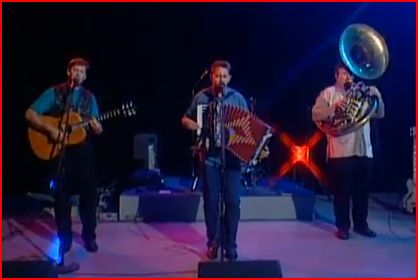
I decide to stick around and check out the next act, Sensacion Vallenata con Gustavo Nieto from the DC area. Now I'm a big fan of vallenato, a Columbian accordion based dance music that gave the world the "cumbia," and I have a couple of CD's that date from the classic 70's era when the music first started getting attention outside of it's home. I really dug the way the bass seemed to lazily lope through the tunes, working in conjunction with the percussion. Relaxed and behind the beat like old-school Reggae for instance. My pal Mike Maddux even has a vallento band here in Austin
Having never seen a real live Colombian playing the new complex style, I begged off returning to the hotel for a much needed rest and hung out on the side of the stage with the amiable monitor mix man. We watched the band set up and immediately there seemed to be a problem. No bass player. They were all set up ready to play and there was no sign of the bassist (or their lead singer as it turned out.) Now I don't speak much Spanish but I did wave the accordion player over and inquire. He tells me, I think, that the bass player drove up from DC and got caught in a storm and was running late. He was mighty upset about it.
 |
| Gustavo Nieto |
As I amble onstage I note It's a good sized band; with accordion and 4 percussionists and vocals all around. I can see in their eyes that they are spooked. It's a big festival gig, and 3 members of their band aren't there for the down beat on the big dance stage. Then some goofy looking Guerro in a cowboy hat crawls up on stage and sets up a bass amp. It must have been unnerving. They had a large plastic bottle of "Coke" which was actually the best Rum I ever had, and everybody was taking a hit to calm their nerves. They put me between 2 percussionist and only one spoke much English. The accordionist turns to me, gives me a key, plays a bit of the melody and then we're off.
OK, let's go back to what I noted before. I dig the "classicos" style of laid-back cumbia and I even know a few hits ("El Gota Fria," "Matilda Linda," etc..) so I can fake it. But only to a point. I suck it up, remembering that the whitey's like me in the audience will never know the difference, watch the boys for cues and concentrate on summoning the booty motivator. Whatever I'm playing seems to be working, and the dance floor is packed. The rum is mixing with the vodka from before and that mixed with jet lag and exhaustion I have mildly left my body. There's only one tune I bow out of; a meringue a style I know nothing about at all. The boys in the band are all smiles, and they are a rocking. Killer vocals, aggressive, funky accordion and a deep, deep percussion section. A total blast to play with.
After 90 minutes, and a sweaty dance floor, it's over. After I pack up, the boys all come over to thank me for hanging in. In my best attempt a Spanish I try and tell them that I hope I didn't embarrass them too awful bad. I collapse into a waiting shuttle and head to the arms of Morpheus.
Next morning I'm told that the bassist and the other members of the band were in fact in Lowell that night. They just couldn't find the festival. (Insert bass player joke here.)
Never did get a chance to hear them play, though the staff said the regular bassist was indeed a virtuoso, busy player. (I'm also told that the festival crew liked the band better when I was playing with them, but what do they know from Vallenato?)
One of the things I like most about big folk festivals is that you get to see and interact with some many great different styles of music. It's not often I get to sit in as well! Lets see what happens next week when I go up to the Festival for Cultural Exchange in Portland Maine.
4/29/04
Mark Vs. Jimmy Sturr
Several months back I got a call from what seemed to be a nice journalist fellow in Boston MA. Evidently he had been assigned to do a story on a well known East Coast Polka performer named Jimmy Sturr. While researching the story he did a Google search (and that seems to be just about all journalists do these days it seems for research) and found this cute thread on the newsgroup:

"Subject: Re: Question - Who is Jimmy Sturr ?-WHO CARES?
View: Complete Thread (17 articles)
Newsgroups: alt.music.polkas
Date: 1996/07/25
Dave Bedrich wrote:
For the sake of real polka music, Jimmy Sturr should be
banned from performing. This guy gives Czech, Polish and
German music a bad name. pure commercialized CRAP.
Amen Brother!
There's an old Yiddish saying that the Grandson wants to know most what the Grandfather has tried hard to forget.
It's probably easy to target Sturr, you can't begrudge his commercial success. But what he has to do with polka is beyond me. I've seen the Sturr show twice in as many years, and while I'm sure some would consider him an engaging showman, I found his performance glitzy and hollow, devoid of the very elements of soul that drew me to polka music in the first place. A few more generations subjected to Sturr, and the many others who follow lockstep in his "crossover" wake, and they'll be no tradition left in polka music.
I can't see that happening here in Texas, though. Folks 'round here still attach a great sense of community, a shared heritage and cultural pride in their polka, whether it makes them any money or not.
Just one fan's observations.
Mark Rubin"
Well, I'll tell you I learned two valuable lessons the day this guy calls me. 1) what you say on line stays around for all to see FOREVER, and 2) I still feel very much the same way 8 years later.
So Mr. Big City Paper Writer asks me to elaborate on my on line comments form so long ago. I commence to spend around 2 hours on the phone with this fellow all the while trying real hard to choose my words carefully. I've heard lots of negative squak about Sturr's bubble gum version of Polka culture from just about every musician I'd encountered here in Texas, Mr. Bedrich (see above) included. I was VERY important for me to make clear that I am not a Polka person, just a geeky fan, and that I spoke entirely from the perspective as an outsider. More importantly I felt it was important to give voice to those musicians that I had met and worked with who ARE polka people and would never get a call from a writer from Boston.
I hoped that I could reasonably speak on the nature of folk music created within a specific community, the multiple levels of context that informs that cultural expression through dance and music. And how that wasn't necessarily a purley vocational pursuit and that maybe that in fact wasn't such a bad thing after all.
I also brought up what I though was a provocative question as to why someone born and raised an Irishman, like Mr. Sturr, would want to change his surname for professional reasons and pass himself off as a "polka person," (the accepted codified language for Slavic-Americans.) Only to then bemoan the low pay scale of his career choice all too late in life. It seemed more than a little bit sad and pathetic, on many levels.

It's a situation that I, an Okie Jew, have been presented with on many, many occasions. I myself have performed on Festival stages literally across the world representing the cultural expression of groups that I AM IN NO WAY A MEMBER OF; Texas-Polish, Texas-Moravian, Texas-Mexican, Persian, Armenian and even Anglo Texan. At no time have I ever been confused that I was in fact an Okie Jew just lucky enough to be playing with these groups. And I tend to feel that reason I am afforded any respect from those communities is because everyone Iπm involved with musically is quite clear about my identity and my intents. I will never forget the first time I performed with Santiago Jimenez, Jr. outside of the US. Moments before we went onstage he stopped me, looked me straight in the eye and said "Tonight, you represent the people of San Antonio. Don't forget it." I took that to mean that I must hold myself to the highest professional standard onstage and off, all the while not forgetting I am not actually a hispanic person from San Antonio.
From interviews I've read in the press, I think Mr. Sturr has most likely forgotten that he's "not from San Antonio" if you get my drift...
OK, that's what I though I said. Here's what made it to print:
Mark Rubin also checked out the boys, but for a different reason.
Rubin played bass and tuba in the Bad Livers, an acclaimed
Texas-based roots band that released a half-dozen albums from
1992 to 2000. He's produced polka bands, and he knew about
Sturr's Grammys. He wanted to see the man behind them. He
wasn't pleased.
``It reminded me of a really smarmy Vegas act,'' says Rubin. ``It
was really quite depressing.''
As Rubin sees it, Sturr is so desperate to commercialize polka,
he's forgotten why people play it.
``It's just an indicator of how culturally void the American culture
has become,'' says Rubin. ``Polka is not supposed to be
commercial. For me, it was kind of sad.''
Other detractors have not been quite as tactful.
``For the sake of real polka music, Jimmy Sturr should be
banned from performing,'' one disgruntled fan writes on the
alt.music.polkas newsgroup.
``This guy gives Czech, Polish, and German music a bad name. Pure commercialized CRAP.''
The criticism does bother Sturr.
``They're not purists,'' he says. ``They're dumbbells.''
For context's sake,you can read the whole article here.
Well, I guess I can blame the editors. After all these years I should really know better than try and have an actual conversation with someone who in fact is only really listening when what you tell him someting that fits into his preconceived agenda.
Personally, I didn't think much of it until someone directed my attention to the, um, reaction to the article right there on the oldchat room again. Most involved me getting my ass kicked by a gentleman with the delightful e-mail address "polkabiker," (now there's two communities you don't see getting together enough.)
Most disturbingly, tucked in all the discussion was this missive from the PRESIDENT OF ROUNDER RECORDS (not coincidently Mr. Sturr's record label, who has made quite a good coin selling his music) who felt the need to address this pressing issue and evidently had the free time expend on the subject. As I had originally feared, he felt the need to "out" me as a Polka nobody. Oh yeah, that and my old band sucked too. Read on:
From: Ken Irwin (keni@rounder.com)
Subject: Re: Globe article on Sturr
Newsgroups: alt.music.polkas
Date: 2003-09-09 14:07:09 PST
In correspondence with the writer following the release of the
article, I pointed out that it was inappropriate for a writer to quote
an anonymous contributor to a list and further went on to say that
if I were to do so, I could find negative things to say about the
Pope,or anyone else on a given list serve. Geoff conceded that
that was a good point as he did about my point that Mark Rubin
was not necessarily the most appropriate person in the polka
field to check with. I went to on to point out that if you were to
speak to a traditional old-time musician, many would likely have
scandalous things to say about Mark's group the Bad Livers.
Wow.
Until then, I had always counted Mr. Irwin as one of the good guys in the business, and had shopped quite a few Polka releases to his company. Now I see why he passed on all of them without comment. Disappointed is not quite the word.
I will however tell you that since all that ruckus came up I have received so many positive e-mail and letters from hard working polka musicians from all over who appreciated my comments and wished they'd said the very same thing. As long as they all buy me a beer when they run into, it will have all been worth it.
Lessons learned from this experience:
1) Don't EVER post to newsgroups unless you care to talk about a decade later.
2) No matter what you say prepared to have it taken down wrong.
3) Evidently I'll never be a Rounder Records recording artist!
Caveat internet!

"Subject: Re: Question - Who is Jimmy Sturr ?-WHO CARES?
View: Complete Thread (17 articles)
Newsgroups: alt.music.polkas
Date: 1996/07/25
Dave Bedrich
banned from performing. This guy gives Czech, Polish and
German music a bad name. pure commercialized CRAP.
Amen Brother!
There's an old Yiddish saying that the Grandson wants to know most what the Grandfather has tried hard to forget.
It's probably easy to target Sturr, you can't begrudge his commercial success. But what he has to do with polka is beyond me. I've seen the Sturr show twice in as many years, and while I'm sure some would consider him an engaging showman, I found his performance glitzy and hollow, devoid of the very elements of soul that drew me to polka music in the first place. A few more generations subjected to Sturr, and the many others who follow lockstep in his "crossover" wake, and they'll be no tradition left in polka music.
I can't see that happening here in Texas, though. Folks 'round here still attach a great sense of community, a shared heritage and cultural pride in their polka, whether it makes them any money or not.
Just one fan's observations.
Mark Rubin"
Well, I'll tell you I learned two valuable lessons the day this guy calls me. 1) what you say on line stays around for all to see FOREVER, and 2) I still feel very much the same way 8 years later.
So Mr. Big City Paper Writer asks me to elaborate on my on line comments form so long ago. I commence to spend around 2 hours on the phone with this fellow all the while trying real hard to choose my words carefully. I've heard lots of negative squak about Sturr's bubble gum version of Polka culture from just about every musician I'd encountered here in Texas, Mr. Bedrich (see above) included. I was VERY important for me to make clear that I am not a Polka person, just a geeky fan, and that I spoke entirely from the perspective as an outsider. More importantly I felt it was important to give voice to those musicians that I had met and worked with who ARE polka people and would never get a call from a writer from Boston.
I hoped that I could reasonably speak on the nature of folk music created within a specific community, the multiple levels of context that informs that cultural expression through dance and music. And how that wasn't necessarily a purley vocational pursuit and that maybe that in fact wasn't such a bad thing after all.
I also brought up what I though was a provocative question as to why someone born and raised an Irishman, like Mr. Sturr, would want to change his surname for professional reasons and pass himself off as a "polka person," (the accepted codified language for Slavic-Americans.) Only to then bemoan the low pay scale of his career choice all too late in life. It seemed more than a little bit sad and pathetic, on many levels.

It's a situation that I, an Okie Jew, have been presented with on many, many occasions. I myself have performed on Festival stages literally across the world representing the cultural expression of groups that I AM IN NO WAY A MEMBER OF; Texas-Polish, Texas-Moravian, Texas-Mexican, Persian, Armenian and even Anglo Texan. At no time have I ever been confused that I was in fact an Okie Jew just lucky enough to be playing with these groups. And I tend to feel that reason I am afforded any respect from those communities is because everyone Iπm involved with musically is quite clear about my identity and my intents. I will never forget the first time I performed with Santiago Jimenez, Jr. outside of the US. Moments before we went onstage he stopped me, looked me straight in the eye and said "Tonight, you represent the people of San Antonio. Don't forget it." I took that to mean that I must hold myself to the highest professional standard onstage and off, all the while not forgetting I am not actually a hispanic person from San Antonio.
From interviews I've read in the press, I think Mr. Sturr has most likely forgotten that he's "not from San Antonio" if you get my drift...
OK, that's what I though I said. Here's what made it to print:
Mark Rubin also checked out the boys, but for a different reason.
Rubin played bass and tuba in the Bad Livers, an acclaimed
Texas-based roots band that released a half-dozen albums from
1992 to 2000. He's produced polka bands, and he knew about
Sturr's Grammys. He wanted to see the man behind them. He
wasn't pleased.
``It reminded me of a really smarmy Vegas act,'' says Rubin. ``It
was really quite depressing.''
As Rubin sees it, Sturr is so desperate to commercialize polka,
he's forgotten why people play it.
``It's just an indicator of how culturally void the American culture
has become,'' says Rubin. ``Polka is not supposed to be
banned from performing,'' one disgruntled fan writes on the
alt.music.polkas newsgroup.
``This guy gives Czech, Polish, and German music a bad name. Pure commercialized CRAP.''
The criticism does bother Sturr.
``They're not purists,'' he says. ``They're dumbbells.''
For context's sake,you can read the whole article here.
Well, I guess I can blame the editors. After all these years I should really know better than try and have an actual conversation with someone who in fact is only really listening when what you tell him someting that fits into his preconceived agenda.
Personally, I didn't think much of it until someone directed my attention to the, um, reaction to the article right there on the old
Most disturbingly, tucked in all the discussion was this missive from the PRESIDENT OF ROUNDER RECORDS (not coincidently Mr. Sturr's record label, who has made quite a good coin selling his music) who felt the need to address this pressing issue and evidently had the free time expend on the subject. As I had originally feared, he felt the need to "out" me as a Polka nobody. Oh yeah, that and my old band sucked too. Read on:
From: Ken Irwin (keni@rounder.com)
Subject: Re: Globe article on Sturr
Date: 2003-09-09 14:07:09 PST
In correspondence with the writer following the release of the
article, I pointed out that it was inappropriate for a writer to quote
an anonymous contributor to a list and further went on to say that
if I were to do so, I could find negative things to say about the
Pope,or anyone else on a given list serve. Geoff conceded that
that was a good point as he did about my point that Mark Rubin
was not necessarily the most appropriate person in the polka
field to check with. I went to on to point out that if you were to
speak to a traditional old-time musician, many would likely have
scandalous things to say about Mark's group the Bad Livers.
Wow.
Until then, I had always counted Mr. Irwin as one of the good guys in the business, and had shopped quite a few Polka releases to his company. Now I see why he passed on all of them without comment. Disappointed is not quite the word.
I will however tell you that since all that ruckus came up I have received so many positive e-mail and letters from hard working polka musicians from all over who appreciated my comments and wished they'd said the very same thing. As long as they all buy me a beer when they run into, it will have all been worth it.
Lessons learned from this experience:
1) Don't EVER post to newsgroups unless you care to talk about a decade later.
2) No matter what you say prepared to have it taken down wrong.
3) Evidently I'll never be a Rounder Records recording artist!
Caveat internet!
5/1/03
Middle European Tour Journal-Ridculous Headgear
This Tours Collection of Ridiculous Headgear
As is my tradition, I procured several examples of the local cover. Here's this years collection, this time all from Belgrade Serbia:


1) A Traditional Serbian Shropshepka, in Chetnik Black, purchased in the Belgrade open air market. As dear to Serbs as the beret is to the French. (Bit of a grave political statement associated with this cap however. Not something you wear on a trip to Croatia if you can dig.)
2) Also called a shropshekpa, but a more modern design and not too unlike a "Greek Fisherman's" cap. Purchased directly fromthe shop that makes them on Balkan Ave., walking distance from our hotel.
3) Given to me as a present by my generous local host and musician Djordje Stijepovic. It is a traditional Montenegrin hat that was actually his when he was a child. He explains: "the 5 gold bands represent the 500 years of Turkish occupation and the Serbian Orthodox cross (a cross with a C in each corner) stands for Serbians United will Never Fail." I'm deeply touched by his gesture.
As is my tradition, I procured several examples of the local cover. Here's this years collection, this time all from Belgrade Serbia:
1) A Traditional Serbian Shropshepka, in Chetnik Black, purchased in the Belgrade open air market. As dear to Serbs as the beret is to the French. (Bit of a grave political statement associated with this cap however. Not something you wear on a trip to Croatia if you can dig.)
2) Also called a shropshekpa, but a more modern design and not too unlike a "Greek Fisherman's" cap. Purchased directly fromthe shop that makes them on Balkan Ave., walking distance from our hotel.
3) Given to me as a present by my generous local host and musician Djordje Stijepovic. It is a traditional Montenegrin hat that was actually his when he was a child. He explains: "the 5 gold bands represent the 500 years of Turkish occupation and the Serbian Orthodox cross (a cross with a C in each corner) stands for Serbians United will Never Fail." I'm deeply touched by his gesture.
4/30/03
Middle European Tour Journal-Serbia to Vienna

From Vladichin Han, Serbia to Vienna
Over breakfast in the lovely courtyard of the Hotel Han, our driver (standing far right in this photo), who let us know straight off that he had 2 passports and there by could "go anywhere" (he has a Serbian AND Croatian passport) was grumbling. "Tziganes (gypsies) don't like me..mumble mumble.." Evidently Sascha felt he had been drinking too much, too much to drive us safely. Sasha calls his boss and chews him out royally. Hence, "gypsies don't like me." We are soon met by Boban's boys, driving a formerly Austrian Ford Transporter van, their normal of mode conveyance in Serbia, all 14 of 'em with gear.
We drive briskly to Belgrade and to catch a plane to Vienna. Along the way our still grumbling driver points outs various bridges and public buildings along the route. "Here..NATO..bomba..." I reckon I hear this 7 times, so when Merlin suggest we uncork the "Yellow Wasp" slivovitz he picked up in Belgrade airport, I heartily agree. It's 11 am and we've begun a trend. By 1 pm we're passing the "famed" Beograd Air Museum, featuring a wide array of rotting detritus courtesey former Warsaw pact aircraft dating to 1949, before entering the airport area proper. We bid a final farewell to our ever grumbling, most likely gypsy-hating driver.
When we originally arrived at the Beograd Aerodrom a few days prior and were promptly charged 55 Euros each to enter the country (up from 10 Euros just the week before,) we joked sardonically " I wonder how much will it cost to get out." 800 Dinar (12 Euros) is the answer. It's the "Airport tax" to get past the Serbian Customs officials. Now we need to get actual Visas to get back in for our appearance at the Ring Ring Festival here in Belgrade next week. The ever helpful Bojan says don't worry, he'll take care of it and we, completely out of our safe American element believe him. (As always and true to his word, he did indeed make all arrangements.)
 The Vienna experience was all and all a little too weird for words. It's a live concert broadcast for the opening of the Vienna Festival Week, evidently quite a big deal. Austrian State TV (ORT) is set up to broadcast the concert ALL over Europe.
 Normally the opening is your standard old fasioned, snooty classical performance. But in recent years they've tried to spice it up with high concept and a more adventureous talent booking policy. This year they've employed a movie production company to try and pull it off.
 This year's high concept theme is of Vienna as the central station of the "Station Europa." Very, very "Spockets" we come to understand but we are being paid to play along. Paid quite a bit actually. Our best guess is that we're here to speak for Jews and Boban the Rroma, in some small way somewhat absolving these racist bastards of thier barely contained contempt of our two cultures. (uh, sorry, but these Austrians want you to think that they did the world a favor, and come to think of it, they're the victims of WW2. But I digress...) The music we're playing is all from Bregorivich soundtracks, essentially stuff he lifted from Serbian bands like Boban, so it's nice to see him getting a paycheck too.
There are to be THREE DAYS OF REHERSAL, as in all Austrian functions nothing will be left to chance. But we come to find that majority of the music for the important grand finale is all sequenced on tape. Even so, they are micro managing everything to the littlest detail. It is after all, going to be broadcast all over Europe. The real work for us is getting with the locals we're supposed to play with in the concert proper, which turns out to be more work than we originally planned.
Highlights Include:
 The combined Brotherhood of Brass is to collaborate with a local acapella hip hop quartet called Bauchlang. Sounds awful on paper, but they actually rock. One fella makes a beat box sound with his nasal cavity, holding the mic up to his nose. Susan inquires if that's a normal thing or something he came up with. He figgers it's all his own, and I'm apt to agree. Rehearsals prove daunting what with 3 languages in play, but Frank, chaos being his element, pulls it off very well.
A local cat named Otto Lechner was hired on accordion to play a number with us; great player, even better rancountuer. We get the idea to break down to a smaller combo for his tune adding Sascha and Dragu from Boban's band to back him up, though I sit it out. Sounds very cool and looks even better.
A hip local string trio called Trilogy layed out a pretty cool version of Kraftwerk's "The Model." One of the violin players wears a shirt that from a distance looks like a "CK" Calvin Klein shirt, which in actual fact says "FuCK me." He even gets it past the censors unnoticed. We decide we like him.
There's a really lousy Kraut rock band on the bill as well, shipped in from Germany. Though they are nice kids and some of us hang a bit after the second day of rehearsals. Sweet kids. Dumb as potatoes.
 As our rehearsals are scheduled for evening time, to reflect the exact natural light that will be present show time, we have our mornings completely free. Frank, Curtis and I pay a visit to the famed Nacht Markt. We find many goodies to basically provide our own craft service for the rehersals as these lousy Austrians don't. Organic tomatoes, spicy sausage and goat cheese, fresh bread, olives and dried kiwi and other fruits are on our backstage menu. Not to mention sauerkraut.
In the Market, we meet Leo the famed local kraut and gherkin maker. That's a whole story on its own. We take many photos of his stall and decide to make him his own web site.

Since I am on a diet and all I decide to walk my ass off. In a city with so much culture I decide to start with the Modern Art Museum, filled with cutting edge and avant guard works , and end in the Ferdinand I exhibit at the National Museum across the street, filled with suits of armor and Rembrandts. Four and a half hours and I'm museum out (and they we're over 10 bucks each to enter so now I'm broke.)

Just prior to our big performance, Curtis takes Frank and me to the best schnitzel house in town. (Weiner-schnitzel, get it?) An amazing little joint called the Figmueller. As is evidently the custom there, the waiter basically tells us what we're having, we nod and he brings us what he thinks we should have. And it's great. A 15" round pork steak beaten to a thin pulp, lightly breaded and pan fried, served with a lemon slice, a fresh salad and red wine. Whoo-eee.
 Amazingly the show actually goes well. The whole square is packed to the gills (around 17,000 they reckoned) and evidently millions are tuning in at home as well, as it was broadcast live on all the German speaking chanels in Europe. Each individual act's segment is great though the big grand finale is just a soulless and corny as it was rehearsed.
Here's a preveiw from the local paper:
 In the morning Boban's Hungarian bodyguard- drivers meet us at the hotel to take us to Szeged Hungary.
Middle European Tour Journal-Szeged Hungary
Szeged
It's a mighty long drive from Vienna in a really tiny Hyundai mini van. I'm pretty certain we don't have an equivalent vehicle here in the States. For some unknown reason, the caravan of 3 vans taking both bands has avoided the toll roads, which are in every way comparable to a normal US highway. Being the largest member of the group, I'm given the front passenger seat, but I can tell that my fellow travelers have literally no leg room and look packed in like sardines in a can. We're given some respite with a nice meal at a road side stop midway in the day. But then we fold ourselves up and it's back to the back roads again.
The city center itself is quite beatiful, but rather than sight see we are delivered straight to the hotel. Tonight's accommodations are early post communist miserable: a 4th floor room with no fan or AC and a single window without a curtain. The bed is what I think we call a daybed over here, something quite a bit less than a single. Quite a job for me to lay my wide frame on it with any comfort. It's hot like hell and I'm going to be an unhappy camper I can tell. Sadly for him, drummer Aaron Alexander and I share a room.
 Good news is, the job site is amazing.
Both bands play totally acoustic and we are very well received by a packed house.

After a post show dinner they take me and Frank to the local TESCO, which is basically a huge WalMart open 24hrs. (Where's my camera!!!) We goof under the florescent lights on the huge selection on liquors,
including TESCO brand
Slivovitz, TESCO brand whisky, TESCO brand vodka, ect.. I imagine seeing a "Victory Gin." I buy a rotating fan, some bungee cords to salvage my fast falling apart tuba carrier and a package of the locally famous Peck brand Szegedi Paprika sausage.
Despite his claims to the contrary, Aaron doesn't snore too loud and now with a cool breeze (4999.99 Forints worth) I get a decent nights sleep.
As we check out, I come to find that there are in fact some very nice rooms in this hotel, some even with air conditioning. We were simply given rooms on the "economy" floor. Rooms in fact reserved for "gypsies" and other not first class guests. Very quickly, we are beginning to see bit of what it's like to be treated as a Rroma band in the hands of a Hungarian concert promoter and not our Serbian pal Bojan, who is looking better and better every day.
After a meager hotel meal, It's a short drive to Budapest.
It's a mighty long drive from Vienna in a really tiny Hyundai mini van.
I'm pretty certain we don't have an equivalent vehicle here in the States. For some unknown reason, the caravan of 3 vans taking both bands has avoided the toll roads, which are in every way comparable to a normal US highway. Being the largest member of the group, I'm given the front passenger seat, but I can tell that my fellow travelers have literally no leg room and look packed in like sardines in a can. We're given some respite with a nice meal at a road side stop midway in the day. But then we fold ourselves up and it's back to the back roads again.The city center
itself is quite beatiful, but rather than sight see we are delivered straight to the hotel. Tonight's accommodations are early post communist miserable: a 4th floor room with no fan or AC and a single window without a curtain. The bed is what I think we call a daybed over here, something quite a bit less than a single. Quite a job for me to lay my wide frame on it with any comfort. It's hot like hell and I'm going to be an unhappy camper I can tell. Sadly for him, drummer Aaron Alexander and I share a room. Good news is, the job site is amazing.Both bands play totally acoustic and we are very well received by a packed house.
After a post show dinner they take me and Frank to the local TESCO, which is basically a huge WalMart open 24hrs. (Where's my camera!!!) We goof under the florescent lights on the huge selection on liquors,
including TESCO brand
Slivovitz, TESCO brand whisky, TESCO brand vodka, ect.. I imagine seeing a "Victory Gin." I buy a rotating fan, some bungee cords to salvage my fast falling apart tuba carrier and a package of the locally famous Peck brand Szegedi Paprika sausage.
Despite his claims to the contrary, Aaron doesn't snore too loud and now with a cool breeze (4999.99 Forints worth) I get a decent nights sleep.
As we check out, I come to find that there are in fact some very nice rooms in this hotel, some even with air conditioning. We were simply given rooms on the "economy" floor. Rooms in fact reserved for "gypsies" and other not first class guests. Very quickly, we are beginning to see bit of what it's like to be treated as a Rroma band in the hands of a Hungarian concert promoter and not our Serbian pal Bojan, who is looking better and better every day.
After a meager hotel meal, It's a short drive to Budapest.
4/29/03
Middle European Tour Journal-Budapest
Budapest
Like the day before the drivers won't take the toll roads so the drive is needlessly long and dangerous, what with single lane passing and all. Better news is that Hotel is much nicer than last night, but as far from the venue or anything interesting as can be. My room has a working TV with BBC and CNN, curtians on the window and a fan, so no complaints. There's even internet connection in the lobby. (Susan tells me she got AC in her room, note to self 1st floor is the nicest rooms in East Europe)
We inquire the front desk about where we can good bowl of goulash. He can't think of anytyhing near there, but he does ask the chef of the resturant next door what he can do. He whips up a decent goulash special for us and there's plenty of Zwack Kosher Slivo at the bar and a nice fresh salad to boot, so all is well.
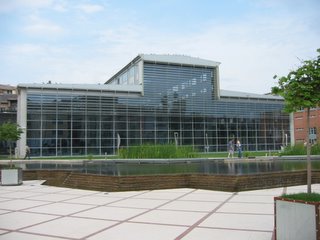 Not for long however as we're carted to the jobsite which is a mess. It's essentialy a barely renovated industrial space, acoustically a nightmare with no backstage to boot. There's a local fake gypsy opener (nice kids, but nothing either original or interesting which is strange seeing as killer Rroma bands play Budapest all the time.) so we head over to find grub before the show.
We run into Bob Cohen and his girlfriend Fume who lays a bottle Romanian moonshine, a handful of killer CDs and cassettes on us and then takes us to a nearby resturant. (Merlin gets Fume's famed homemade rice balls.) I get the Ziguenersteak topped with a crown of porkfat and am not disapointed. I am in Atkins-land.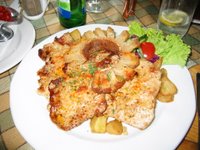
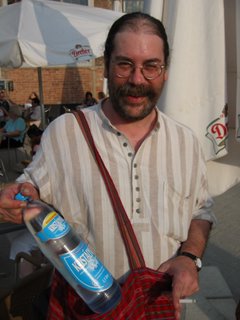
Bob tells us the barn we're playing in tonight is part of a European Union sponsored/funded boondoggle that has been eating up hard currency for years now. Evidently we were originally scheduled to play someplace cooler, but agin we see what iot's like to be promoted by someone other than our pal Bojan.
Opener sounds terrible, but can't determine if they suck or the room sucks. I reckon it's probably a 60/40 split. (Bob claims they're ok, but the singer is the best thing about them and we can't hear her at all over the general caterwall.) In a desperate attempt to rescue our show, we decide to create some kind of sense theater for our set. We make and acoustic entrance walking down a long walkway that spans over the audience. It totally works and we have a great set. Boban rocks as well. Despite all earlier indications it's a great show.
After the show we head over to a hip local hangout called Castro's with a very drunk Bob. He's trying to get me to expatriate and hunt down cool music with him. "Don't live vicariously!!," repeats loudly and often. He introduces us to a dark and evidently dangerous Romanian woman who's name translates to Kali (the Hindu godess of destruction and chaos.) Frank and I walk her and her friend home while she jumps up on truck beds and sings politically volitile gypsy songs, loudly, through the roughest neighborhood I've yet encountered in E. Europe. We arrive safely at the hotel and prepare for another cramped trip to Belgrade.
Following morning I get more great sausage from a local corner market and some killer Hungarian folk on CD. This time we take the toll road to Serbia.
Like the day before the drivers won't take the toll roads so the drive is needlessly long and dangerous, what with single lane passing and all. Better news is that Hotel is much nicer than last night, but as far from the venue or anything interesting as can be. My room has a working TV with BBC and CNN, curtians on the window and a fan, so no complaints. There's even internet connection in the lobby. (Susan tells me she got AC in her room, note to self 1st floor is the nicest rooms in East Europe)
We inquire the front desk about where we can good bowl of goulash. He can't think of anytyhing near there, but he does ask the chef of the resturant next door what he can do. He whips up a decent goulash special for us and there's plenty of Zwack Kosher Slivo at the bar and a nice fresh salad to boot, so all is well.
 Not for long however as we're carted to the jobsite which is a mess. It's essentialy a barely renovated industrial space, acoustically a nightmare with no backstage to boot. There's a local fake gypsy opener (nice kids, but nothing either original or interesting which is strange seeing as killer Rroma bands play Budapest all the time.) so we head over to find grub before the show.
We run into Bob Cohen and his girlfriend Fume who lays a bottle Romanian moonshine, a handful of killer CDs and cassettes on us and then takes us to a nearby resturant. (Merlin gets Fume's famed homemade rice balls.) I get the Ziguenersteak topped with a crown of porkfat and am not disapointed. I am in Atkins-land.


Bob tells us the barn we're playing in tonight is part of a European Union sponsored/funded boondoggle that has been eating up hard currency for years now. Evidently we were originally scheduled to play someplace cooler, but agin we see what iot's like to be promoted by someone other than our pal Bojan.
Opener sounds terrible, but can't determine if they suck or the room sucks. I reckon it's probably a 60/40 split. (Bob claims they're ok, but the singer is the best thing about them and we can't hear her at all over the general caterwall.) In a desperate attempt to rescue our show, we decide to create some kind of sense theater for our set. We make and acoustic entrance walking down a long walkway that spans over the audience. It totally works and we have a great set. Boban rocks as well. Despite all earlier indications it's a great show.
After the show we head over to a hip local hangout called Castro's with a very drunk Bob. He's trying to get me to expatriate and hunt down cool music with him. "Don't live vicariously!!," repeats loudly and often. He introduces us to a dark and evidently dangerous Romanian woman who's name translates to Kali (the Hindu godess of destruction and chaos.) Frank and I walk her and her friend home while she jumps up on truck beds and sings politically volitile gypsy songs, loudly, through the roughest neighborhood I've yet encountered in E. Europe. We arrive safely at the hotel and prepare for another cramped trip to Belgrade.
Following morning I get more great sausage from a local corner market and some killer Hungarian folk on CD. This time we take the toll road to Serbia.
11/11/99

5/30/99
On "No Depression" Bands

from Exclaim Magazine, Canada, 1999
"During the '80s, you'd have these bad new wave bands wearing country hats and bolo ties," recalls Bad Livers bass and tuba-player Mark Rubin with distaste. "I'd hate to think we had anything to do with that." Rubin still rankles at how Bad Livers were saddled with the country-punk tag, despite the diversity of their influences, ranging from Western swing and bluegrass to punk and klezmer.
"When we first started playing," Rubin explains, "we didn't have a lot of original material and had acoustic instruments, and the only way you could play was in clubs where you'd play from 9 to 2 a.m., so we needed a lot of covers. We played Mississippi Fred McDowell and [Thelonious] Monk, and we'd also play stuff from our collective memory, like Roky Erickson. Then people from the punk scene started seeing what was happening, and journalists, being a lazy bunch, they'd fasten on to the one Motörhead or Stooges song, not the Art Tatum or Charlie Poole or Son House. It's true that we were drawn to punk, but more because of our anarchic disposition and the punk DIY ethic, but to call us a country-punk group is just lazy."
"It's easier to sell to a scene than to sell quality," says a caustic Mark Rubin. "If a label has a band that doesn't belong to a scene, they have a conundrum. I mean, we've been taken to task because we weren't playing to a reviewer's scene. I think this alt-country stuff runs counter to punk rock. The spirit of punk rock was do your own thing, don't suck off on mine, and now, all alt-country is concerned with is appealing to an audience, not making music. The musicians are continually told they're this that that, and now they're expected to reference this thing they have nothing to do with. The Uncle Tupelo guys were embarrassed by being tagged with bluegrass and No Depression labels. If the guys in Wilco or Son Volt died in a car wreck, they'd be eulogised as alt-country; [Bad Livers would] be eulogised as punk-bluegrass. But they had nothing to do with that crap then, and they want nothing to do with it now, and neither should anyone who's just interested in good music."
5/29/99
On the Subject of "Bluegrass"
From the Austin Chronicle, 1999
Mark Rubin, bass and tuba player for Bad Livers, has this advice:
"Anyone who sets off on that path has to be aware of the fact that there is only a certain amount of economic recompense. The people I know who are the happiest at this stuff do it as part of a familial tradition, or a cultural tradition. That's where it's rewarding."
According to Rubin, unreasonable expectations are what lead many practitioners to fret at the state of bluegrass in today's popular music market.
"The bluegrass music industry is in a state of operative denial," states Rubin. "The operative denial that's in place is that bluegrass is a commercial music. The fact of the matter is it's not. It hasn't been since the mid-Sixties when Flatt & Scruggs stopped having hits with Bob Dylan covers. Like many musics that are based in traditional forms, at one time it was a commercial entity."
When contemporary artists discover these old forms of music and are so inspired by them that they attempt to copy or revive them, the resurgence of artistic interest, combined with the lack of a commercial interest, brings the music into the realm of the folkloric. For example, bluegrass is a folkloric art, while swing jazz is not. With respect to bluegrass, many of the form's originators and first wave of practitioners are still around, offering tips and wisdom to those looking to keep the music alive. But, with bluegrass, it doesn't come easy.
"Bluegrass music requires the study of a lifetime," says Rubin. "That's the problem. You end up trying to commercialize all this effort and you run into a brick wall. So, within the bluegrass music scene is the attempt to somehow improve bluegrass -- the catch phrases are 'Expand its horizons' or 'Push the tradition.' A friend of mine calls that rearranging the deck chairs on the Titanic.
"I think that's exceptionally misguided, because you have to be awake with the modern age and understand that once you're in the study of bluegrass music it's akin to the Civil War recreation or the Society for Creative Anachronism. It's only going to be a hobby. Tom Ludwick and [Leon Valley Bluegrass] epitomize what bluegrass music is today. They are people who are music fans who got turned on to this particular art form and then devoted themselves to it as an all-consuming hobby, which then becomes a lifestyle."
Rubin's own band, Bad Livers, is often referred to as a bluegrass band, a title Rubin and bandmate Danny Barnes -- a banjo player and guitarist of extraordinary skill -- flat-out deny. "I have far too much love and respect and admiration for bluegrass to have ever chipped away at its reputation by assigning our dumb asses to it," says Rubin.
Rather, both Rubin and Barnes were well-versed in bluegrass and went on to develop their own style of music, which was based as much in the ethos of punk rock as it was in the style or instrumentation of bluegrass. While it's tempting to relate banjo music to bluegrass as a means of discussing the music of Bad Livers, the weight and focus carried by the bluegrass tradition makes its title something to be taken more seriously than a word like, say, "rock."
"It's like the word 'folk,'" continues Rubin. "Folk now includes these pathetic singer-songwriters telling you all about their girlfriend. The whole detestable singer-songwriter phenomenon now goes under the moniker 'folk.' I think Big Bill Broonzy is a folk artist, not this stuff. Just because the whole situation today is jive doesn't mean the terminology has to follow it too."
Mark Rubin, bass and tuba player for Bad Livers, has this advice:
"Anyone who sets off on that path has to be aware of the fact that there is only a certain amount of economic recompense. The people I know who are the happiest at this stuff do it as part of a familial tradition, or a cultural tradition. That's where it's rewarding."
According to Rubin, unreasonable expectations are what lead many practitioners to fret at the state of bluegrass in today's popular music market.
"The bluegrass music industry is in a state of operative denial," states Rubin. "The operative denial that's in place is that bluegrass is a commercial music. The fact of the matter is it's not. It hasn't been since the mid-Sixties when Flatt & Scruggs stopped having hits with Bob Dylan covers. Like many musics that are based in traditional forms, at one time it was a commercial entity."
When contemporary artists discover these old forms of music and are so inspired by them that they attempt to copy or revive them, the resurgence of artistic interest, combined with the lack of a commercial interest, brings the music into the realm of the folkloric. For example, bluegrass is a folkloric art, while swing jazz is not. With respect to bluegrass, many of the form's originators and first wave of practitioners are still around, offering tips and wisdom to those looking to keep the music alive. But, with bluegrass, it doesn't come easy.
"Bluegrass music requires the study of a lifetime," says Rubin. "That's the problem. You end up trying to commercialize all this effort and you run into a brick wall. So, within the bluegrass music scene is the attempt to somehow improve bluegrass -- the catch phrases are 'Expand its horizons' or 'Push the tradition.' A friend of mine calls that rearranging the deck chairs on the Titanic.
"I think that's exceptionally misguided, because you have to be awake with the modern age and understand that once you're in the study of bluegrass music it's akin to the Civil War recreation or the Society for Creative Anachronism. It's only going to be a hobby. Tom Ludwick and [Leon Valley Bluegrass] epitomize what bluegrass music is today. They are people who are music fans who got turned on to this particular art form and then devoted themselves to it as an all-consuming hobby, which then becomes a lifestyle."
 |
| Leon Valley Bluegrass |
Rather, both Rubin and Barnes were well-versed in bluegrass and went on to develop their own style of music, which was based as much in the ethos of punk rock as it was in the style or instrumentation of bluegrass. While it's tempting to relate banjo music to bluegrass as a means of discussing the music of Bad Livers, the weight and focus carried by the bluegrass tradition makes its title something to be taken more seriously than a word like, say, "rock."
"It's like the word 'folk,'" continues Rubin. "Folk now includes these pathetic singer-songwriters telling you all about their girlfriend. The whole detestable singer-songwriter phenomenon now goes under the moniker 'folk.' I think Big Bill Broonzy is a folk artist, not this stuff. Just because the whole situation today is jive doesn't mean the terminology has to follow it too."
Subscribe to:
Posts (Atom)